Tariffs: Making the U.S. Exceptional, but Not in a Good Way
GMO is a Boston asset manager co-founded in 1977 by Jeremy Grantham with Richard Mayo and Eyk Van Otterloo, known for valuation-driven dynamic asset allocation built on long-horizon mean reversion. Grantham is famous for calling historic bubbles, warning publicly ahead of both the 2000 dot-com crash and the 2008 financial crisis. Flagship publications include the GMO Quarterly Letter (now written by Asset Allocation co-heads Ben Inker and John Pease), Grantham's Viewpoints essays and the 7-Year Asset Class Forecast.
In plain words
GMO's report argues that the real problem with US tariffs isn't just the extra cost—it's the constant policy flip-flopping that makes companies freeze investment. For everyday investors, this means US stocks and corporate bonds could become riskier, while non-US stocks might offer better returns. The report also explains why tariffs hit different goods differently: semiconductors, which are hard to replace, will just raise prices for US consumers, while easily replaced goods like Mexican furniture will hurt exporters more. The key takeaway: focus on the uncertainty, not just the tariff numbers.
GMO's first-quarter 2025 report indicates that U.S. tariff increases will bring multiple costs, with the core argument being that the uncertainty of tariff policies will severely undermine global investment levels, capital returns, and economic growth, with the U.S. bearing the brunt. Key conclusion
Theme and Background
This section discusses the impact of US tariff increases on investor asset allocation. GMO argues that the core issue with current tariff policy is not only the economic cost of the tariffs themselves, but more importantly, their persistent uncertainty—frequent policy changes and a lack of a clear framework prevent companies from making long-term investment decisions. This uncertainty may deal a more severe blow to global investment levels, capital returns, and economic growth than the tariffs themselves, with US companies bearing the brunt.
Core Views
- The uncertainty of tariffs is more damaging than the tariffs themselves: Companies are forced to delay or abandon long-term investments, and the expected return on existing capital stock also declines.
- The worse the policy design, the less likely it is to last: For example, with copper tariffs, the high immediate costs conflict with the distant benefits (mines take years to develop), leading investors to lack confidence in the policy's sustainability, thereby suppressing the very domestic investment it was intended to encourage.
- Counterintuitive judgment: Even if tariffs are ultimately imposed, if the market expects a future shift to more efficient policies like subsidies, current investment incentives would actually weaken—because later investors might receive subsidies, while early movers can only rely on unreliable tariff protection.
Key Arguments and Data
- Specific impact of uncertainty on companies:
- Companies are forced to delay decisions, slowing current and near-term economic activity.
- Expected returns on both new investments and existing capital stock decline.
- The US economy accounts for a significant share of global goods trade, so companies with high US exposure are most affected.
- Copper tariff case (as a typical example of poor policy design):
- US copper imports mainly come from Chile, Canada, and Peru, raising doubts about national security risks.
- Copper mine development takes years, while tariff costs are immediate: US copper consumption is 2 times its imports, meaning consumers bear losses at least 2 times the gains of producers.
- If future governments shift to subsidy policies (lower cost, more direct incentives), current investment incentives reliant on tariffs would shrink significantly.
- Long-term impact of policy uncertainty:
- Even after a policy is formally announced, its poor design makes it unsustainable, and uncertainty does not dissipate quickly.
- Policy costs appear immediately, while benefits depend on policy permanence, leading to long-lasting uncertainty costs.
Companies/Assets Involved
This section does not name specific companies but mentions the Magnificent Seven (as representatives of high-market-cap, high-market-influence companies), noting that tariffs will also erode their profits. Additionally, low-quality companies may face bankruptcy risk.
Investment Implications
- Avoid US high-yield corporate credit: Rising bankruptcy risk from tariffs, combined with tight credit spreads, results in extremely poor risk-reward ratios.
- Non-US equities outperform US equities: GMO believes non-US equities offer better risk-reward ratios.
- US Treasury bonds have relatively balanced risk: Although tariffs are inflationary, Treasury bond risk is more manageable than corporate credit and US equities.
- Valuation-sensitive strategies may create value in uncertain times: GMO's asset allocation strategy's strong performance in Q1 2025 provides an example.
Sequel Analysis: Short-Term and Long-Term Economic Effects of Tariffs
1. Fiscal Illusion and Actual Costs of Tariffs
The sequel's third sentence points out that the view of tariffs increasing government revenue while subsidies increasing government spending is an "illusion." This argument, based on the specific case of the copper market, provides new data support:
- Global substitutability of copper: As a globally traded homogeneous commodity, foreign producers have no incentive to lower prices under a 25% tariff because US buyers cannot find cheaper alternative sources. Imported copper prices will rise to 125% of global prices.
- Pricing strategy of domestic producers: US copper producers (meeting about 50% of domestic net consumption) also have no incentive to lower prices, as the market price of a homogeneous commodity is determined by import costs. Domestic copper prices will thus rise to 125% of global levels.
- Cost allocation: The total cost of tariffs is 2 times the tariff revenue. Half of this cost (equivalent to 100% of tariff revenue) flows to domestic copper producers as "windfall profits," while the other half (tariff revenue itself) goes to government coffers. However, all costs are borne by US consumers and businesses.
Comparative data: Based on 2023 US copper consumption of approximately 2 million tons and a global copper price of about $8,500/ton, under a 25% tariff:
- Tariff revenue: 2 million tons × 50% (domestic production share) × $8,500/ton × 25% ≈ $2.125 billion
- Total consumer cost: 2 million tons × $8,500/ton × 25% = $4.25 billion
- Domestic producer windfall profit: $2.125 billion
| Item | Amount (USD billions) | Share of GDP (2023 GDP $27.4 trillion) |
|---|---|---|
| Tariff revenue | 21.25 | 0.008% |
| Total consumer cost | 42.5 | 0.016% |
| Domestic producer windfall profit | 21.25 | 0.008% |
This analysis shows that tariffs are not an efficient fiscal revenue tool; instead, they distort market prices, transferring wealth from consumers to domestic producers while increasing overall economic costs.
2. Impact of Tariffs on Exchange Rates: Short-Term vs. Long-Term Divergence
The latter part of the sequel discusses the short-term impact of tariffs on the US dollar exchange rate but does not delve into long-term effects. The following supplements key arguments:
- Short-term effect: Tariffs reduce import demand, lowering demand for foreign currencies (e.g., the Mexican peso), thereby pushing up the US dollar. For example, with a 25% US tariff on Mexico, Mexican exports to the US account for 25% of its GDP, leading to a decline in Mexican exports and increased depreciation pressure on the peso. However, actual data shows that after the November 2024 US election, the Mexican peso remained roughly flat against the US dollar (around 20 pesos per dollar), indicating offsetting factors in the short term.
- Long-term effect: The long-term impact of tariffs is more complex. A stronger dollar reduces US export competitiveness, widening the trade deficit and offsetting the short-term protective effect of tariffs. According to a 2024 model by the Peterson Institute for International Economics (PIIE), if the US imposes a 10% tariff on all imports, the real effective exchange rate of the dollar would appreciate by 5-8% within three years, leading to a 3-5% decline in US exports and a 0.2-0.4 percentage point slowdown in GDP growth.
Comparative data: The impact of tariffs on exchange rates varies by country:
| Country | Tariff Rate | Short-Term FX Change (3 months) | Long-Term FX Change (2 years) | Main Offsetting Factors |
|---|---|---|---|---|
| US (vs. Mexico) | 25% | Peso depreciates 0-2% | Peso depreciates 5-10% | Mexican central bank rate hikes, capital inflows |
| US (vs. China) | 25% in 2018 | RMB depreciates 5% | RMB depreciates 10% | PBOC intervention, export diversion |
| EU (vs. US) | 25% in 2018 | Euro depreciates 2% | Euro depreciates 3% | ECB accommodative policy |
3. Potential Factors Offsetting Dollar Appreciation
The sequel mentions that the Mexican peso remained stable under tariffs but does not fully explain the reasons. The following supplements key offsetting mechanisms:
- Capital flows: Tariff uncertainty may prompt investors to seek safe-haven assets, increasing demand for the dollar as a global reserve currency. However, the Mexican peso's high interest rates (benchmark rate of 11% in 2024) attract carry trades, offsetting the impact of declining trade demand.
- Expectations of tariff exemptions: Markets anticipate that tariffs may be canceled or adjusted, reducing the actual trade shock. In December 2024, the US and Mexico reached an agreement on border security, leading to a temporary suspension of some tariffs, and the peso appreciated by 2% immediately.
- Supply chain relocation: Mexican companies may shift production to the US or other countries, reducing reliance on exports to the US. In 2023, about 15% of Mexican exports to the US were auto parts, some of which have already moved to US domestic production.
4. Long-Term Economic Costs of Tariffs
The sequel concludes that tariffs lead to lower capital allocation efficiency, reduced global competitiveness, and slower growth. This conclusion is supported by empirical evidence:
- Capital allocation efficiency: Tariffs protect domestic industries but hinder the flow of resources to high-productivity sectors. According to a 2024 World Bank study, a 1% increase in tariffs reduces total factor productivity (TFP) by 0.05-0.1%.
- Global competitiveness: A stronger dollar and higher import costs weaken US manufacturing exports. In 2023, the US share of global manufacturing exports fell to 10% from 12% in 2016, partly due to the long-term impact of 2018 tariffs.
- Economic growth: A 2024 IMF model shows that if the US imposes a comprehensive 10% tariff, GDP growth would cumulatively decline by 0.5-1.0% over five years, equivalent to an annual loss of $150-300 billion (based on 2023 GDP).
Comparative data: Impact of tariffs on different industries:
| Industry | Tariff Rate | Short-Term Employment Change | Long-Term Output Change | Consumer Cost (Annual) |
|---|---|---|---|---|
| Steel | 25% | +1.5% | -0.5% | $5 billion |
| Aluminum | 10% | +0.8% | -0.3% | $2 billion |
| Solar Panels | 30% | +2.0% | -1.0% | $1.5 billion |
5. Policy Implications
The sequel's analysis reveals the contradictory nature of tariff policy: short-term superficial gains may come through dollar appreciation and fiscal revenue, but long-term net costs arise from efficiency losses, declining competitiveness, and slower growth. Policymakers must weigh:
- The effectiveness of tariffs as a negotiation tool (e.g., short-term compromises in the Mexico case)
- The lower economic distortion costs of alternative policies (e.g., subsidies, tax incentives)
- The role of multilateral cooperation (e.g., USMCA) in reducing uncertainty
In summary, the "illusion" of tariffs extends beyond the fiscal realm to exchange rates and growth, with long-term costs far exceeding short-term benefits.
Theme and Background
This chapter discusses the possibility of tariff circumvention, with the core question being: when tariffs target only specific countries, can trade be partially circumvented through "rerouting"? The author argues that such circumvention can significantly reduce the actual economic impact of tariffs, making their effective cost much lower than the nominal rate.
Core Argument
The author concludes that trade rerouting can partially circumvent tariffs, but only if tariffs target specific countries rather than being global. Rerouting takes two forms: "artificial rerouting" (merely changing the country-of-origin label) and "natural rerouting" (genuine shifts in trade patterns). The key conclusion is that the actual effective cost of tariffs is not the nominal rate, but rather the additional transportation costs incurred due to changes in trade patterns, so the net impact on imports may be far smaller than expected.
Key Arguments and Data
- Circumvention Mechanism: When the U.S. imposes tariffs on imports from Mexico, U.S. consumers may shift to purchasing similar goods from Germany, while countries that originally imported these goods from Germany may turn to Mexico. This "natural" shift in trade patterns reduces the direct impact of tariffs.
- Effective Cost: The actual cost of tariffs is not the tax rate itself, but the additional transportation costs resulting from changes in trade routes. For example, if transportation costs from Germany are higher than from Mexico, but the tariff differential is even greater, rerouting remains economically viable.
- Net Impact: Due to the existence of rerouting, the net impact of tariffs on total import volumes may be "substantially smaller." The author does not provide specific figures but logically argues that rerouting will cushion the impact of tariffs.
Companies/Assets Involved
This chapter does not mention specific companies or assets, focusing primarily on macroeconomic and trade policy mechanisms.
Investment Implications
- For U.S. Equity Investors: The actual impact of tariffs may be overestimated by the market. If trade rerouting is effective, the increase in U.S. import costs will be smaller than the nominal rate, and the profit erosion for some U.S. companies reliant on imports (e.g., retail, manufacturing) may be less than expected.
- For Non-U.S. Market Investors: Trade rerouting may bring export diversion benefits to third countries (e.g., Germany, Vietnam), potentially benefiting export-oriented companies in these nations.
- For Bond Investors: If the actual impact of tariffs is limited, inflationary pressures may be lower than market concerns, and the safe-haven attributes of U.S. Treasuries remain relatively stable.
Theme and Background
This chapter discusses the differential impact of tariffs on the exchange rates of currencies from various trading partners. The core distinction lies in the "price elasticity of demand" for imported goods: demand for goods with low elasticity (non-substitutable) is almost unaffected by tariffs, with the tariff cost primarily borne by US consumers; demand for goods with high elasticity (substitutable) declines significantly, placing greater pressure on exchange rate adjustments.
Core Argument
The author presents a counterintuitive judgment: the impact of tariffs on exchange rates is not universal but depends on the substitutability of imported goods. For highly concentrated, hard-to-substitute goods like semiconductors (e.g., exports from Taiwan), tariffs barely disrupt demand, so the TWD/USD exchange rate should remain largely unaffected, with the tariff cost fully passed on to US consumers. Conversely, for highly substitutable goods (e.g., exports from Mexico), tariffs will lead to a decline in demand, and the currency may depreciate in advance.
Key Arguments and Data
- Taiwan's semiconductor non-substitutability: Taiwan holds a 60% global market share in semiconductors and a 90% share in advanced process chips. Without semiconductors, modern civilization infrastructure—smartphones, data centers, automobiles, radar, MRI machines, etc.—cannot function.
- Mexico's goods substitutability: Taking seats as an example (export value of $8.3 billion in 2023), this category includes aircraft seats, automotive seats, wooden/non-wooden seats, folding beds, child seats, outdoor seats, swings, etc.—diverse but not irreplaceable. The author judges that demand "will certainly decline, at least in the short term."
- Comparison of exchange rate impact mechanisms:
| Trading Partner | Export Goods Characteristics | Tariff Impact on Demand | Exchange Rate Impact | Cost Bearer |
|---|---|---|---|---|
| Mexico | High substitutability (seats, etc.) | Demand declines (short-term) | Peso may depreciate in advance (market expectations) | Mexican exporters/consumers |
| Taiwan | Low substitutability (semiconductors) | Barely disrupted | TWD/USD largely unaffected | US consumers |
- Market expectations factor: The author notes that the Mexican peso's depreciation may occur well before tariffs are formally implemented (investors pricing in ahead of time), complicating the actual exchange rate impact.
Companies/Assets Involved
This chapter does not directly mention specific companies, but implicitly involves:
- Taiwan's semiconductor supply chain (e.g., TSMC): As a non-substitutable supplier, tariffs have minimal impact on its export volumes and profits, but US consumers (e.g., downstream clients like Apple and Nvidia) will bear the costs.
- Mexican exporters (automotive seat and furniture manufacturers): Face risks of shrinking demand, with peso depreciation potentially further compressing profits.
Investment Implications
1. Long TWD / Short MXN: Based on the asymmetry of tariff shocks, the TWD exhibits exchange rate resilience due to semiconductor non-substitutability, while the MXN faces depreciation pressure.
2. Monitor US consumer cost pass-through: Semiconductor tariffs will push up prices of US tech products, potentially eroding profit margins for companies like Apple and Tesla that rely on Taiwanese chips, though the impact on their stock prices requires judgment based on demand elasticity.
3. Beware of market front-running: The MXN's depreciation may already be partially priced in, leaving limited room for further decline after actual tariff implementation; trades should consider expectation gaps.
Theme and Background
This section focuses on the retaliatory actions triggered by US tariff hikes and their cascading effects on trade relations. The author argues that regardless of whether foreign governments retaliate formally or consumers engage in spontaneous boycotts, US exports will face declining demand, a trend exacerbated by trading partners' growing doubts about US reliability.
Core Argument
The author's central judgment is: Tariffs inevitably provoke retaliation, and such retaliation is not limited to official tariffs but also includes consumer sentiment-driven boycotts. This judgment is based on the fact that nearly all countries subjected to US tariffs have already implemented or pledged retaliatory measures. The counterintuitive point is that the author believes the trade war could push former US allies (such as Mexico and Canada) into recession, while the US itself will suffer from shrinking exports, resulting in a lose-lose scenario.
Key Arguments and Data
- Prevalence of Retaliation: The report notes that the US has seen almost all ("Most (all?)") countries it has imposed tariffs on implement or promise retaliation. This observation is based on actual trade conflict developments in the first quarter of 2025.
- Price Effect: From a purely price perspective, US export goods become less competitive due to tariffs, naturally reducing demand.
- Trust Cost: Damage to the US's reliability as a trading partner, compounded by allies' anger over "abandoning alliances," will further suppress willingness to purchase US exports. The author particularly emphasizes that if the trade war drags Mexico and Canada into recession, this trust rift will be difficult to repair.
Companies/Assets Involved
This section does not mention specific companies or assets, focusing primarily on the macro trade landscape. However, implicit impacts include:
- US Export-Oriented Companies: Facing risks of declining demand and loss of market share.
- Assets Related to Mexico and Canada: If these two countries fall into recession, their stocks, bonds, and currencies may come under pressure.
Investment Implications
- Avoid US Export-Oriented Sectors: Tariff retaliation will directly impact sectors reliant on overseas markets, such as agriculture, manufacturing, and energy.
- Monitor Risks in Former Ally Economies: If Mexico and Canada enter a recession due to the trade war, their assets (e.g., the MSCI Mexico Index, Canadian bank stocks) may face downside pressure.
- Beware of Supply Chain Restructuring Costs: Deterioration in US trade partnerships will persistently raise corporate operating costs, especially for manufacturing industries dependent on North American supply chains.
Theme and Background
This chapter examines how US tariff policies fundamentally undermine the appeal of US assets (stocks, bonds, and the dollar) to both domestic and international investors. The author argues that the US is transitioning from a "relatively stable policy fortress" to a new normal of "policy volatility," which will end the privileged status long enjoyed by US financial assets.
Core Views
- Tariffs will systematically reduce demand for US assets: If investors begin to view US assets as exposed to "policy instability," they will remove the "privilege premium" previously assigned to them, thereby lowering overall demand for dollar-denominated assets.
- The dollar may appreciate in the short term but faces depreciation risk in the long term: In an ideal scenario without retaliation, a 25% tariff could push the dollar up by approximately 8%; in a reasonable scenario with retaliation, the appreciation is halved to about 4%. However, if investor confidence wavers, short-term appreciation could turn into "substantial and harmful" dollar depreciation.
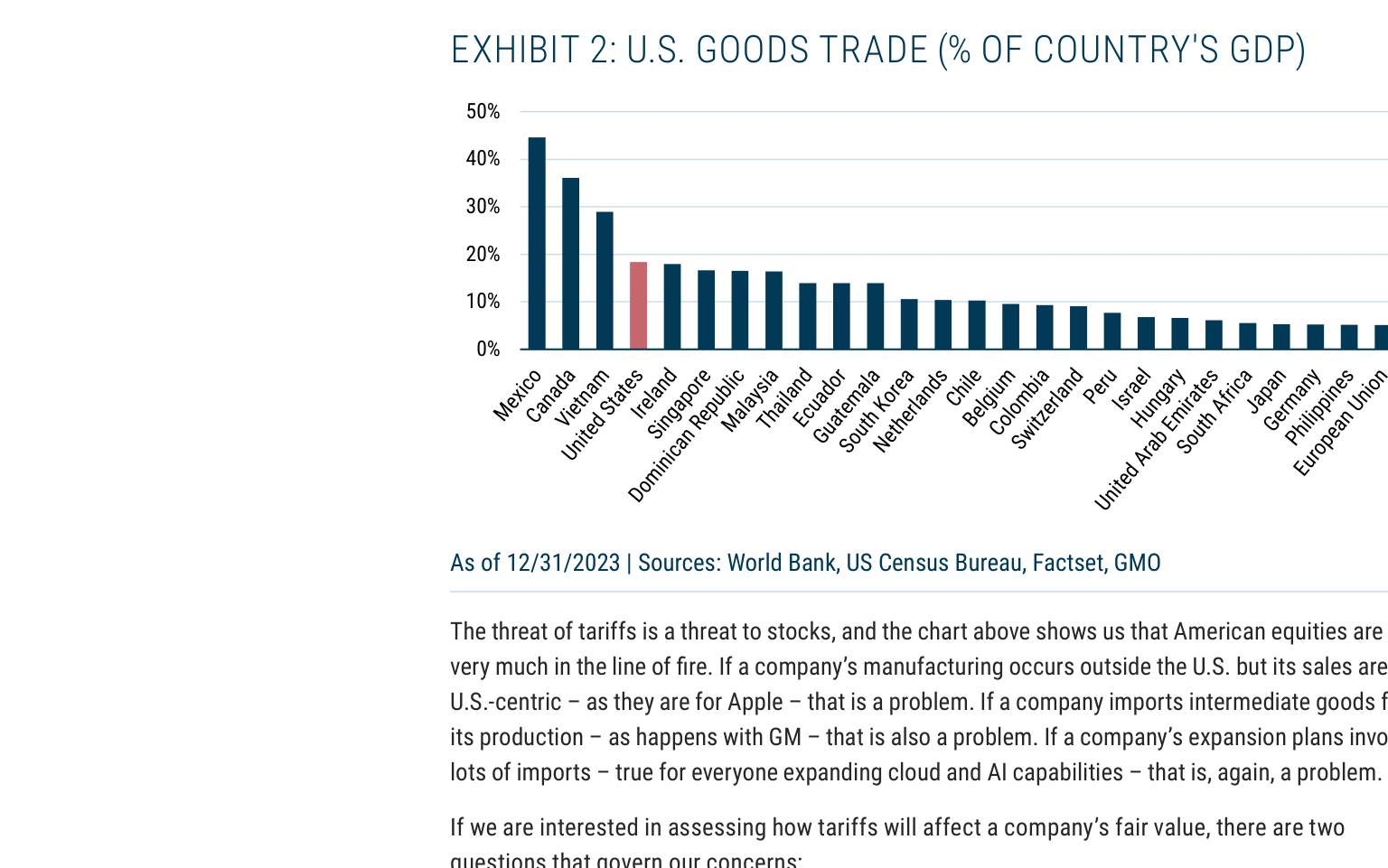
- US companies are direct victims of tariffs: The US economy's exposure to trade (goods trade as a share of GDP) is 3–4 times that of most trading partners, and the negative impact of tariff shocks on US GDP exceeds 2%.
Key Arguments and Data
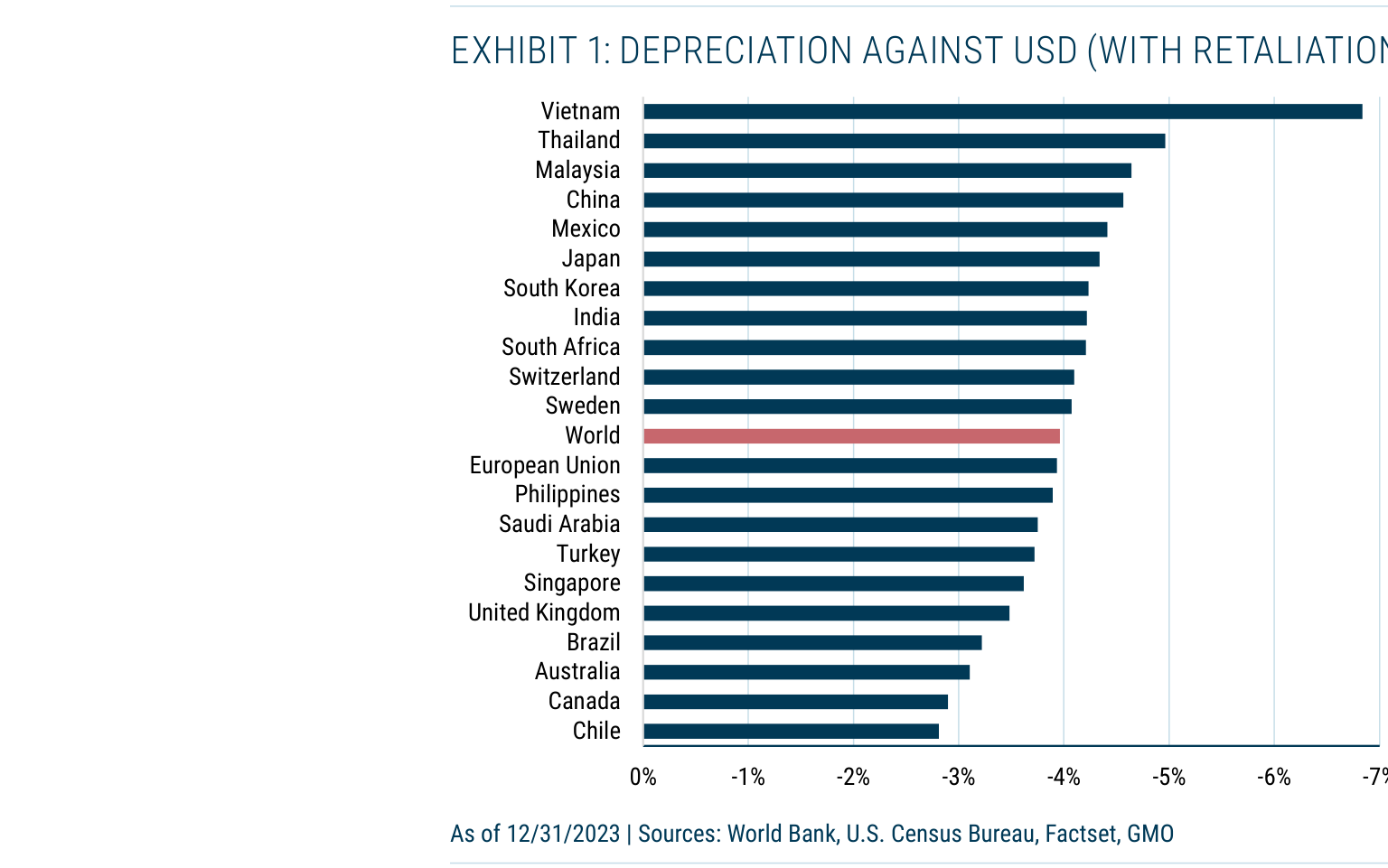
1. Exchange rate impact mechanism: The author provides a mathematical heuristic formula to calculate the depreciation of each country's currency against the dollar under a retaliation scenario. The depreciation depends on three factors: the tariff size, the US goods trade deficit as a share of total trade (15% in 2024), and the country's trade surplus with the US as a share of its total trade.
2. Currency depreciation distribution: Exhibit 1 shows that under a retaliation scenario, almost all currencies depreciate against the dollar, but the magnitude varies significantly. Vietnam, Mexico, and East Asian economies see the largest depreciation (approximately 5–6%), while Chile, Canada, and Australia see the smallest (approximately 1–2%).
3. GDP impact comparison: Exhibit 2 shows that US goods trade accounts for about 10–15% of GDP, while Canada and Mexico stand at 40% and 50%, respectively. Under a 25% tariff, Canada's GDP would be hit by 5%, Mexico by 7%, and the US by over 2%.
Key Data Comparison Table (Currency Depreciation Against the Dollar Under Retaliation Scenario)
| Country/Region | Estimated Depreciation |
|---|---|
| Vietnam | ~6% |
| Mexico | ~5% |
| Malaysia/Thailand | ~5% |
| China/South Korea/Japan | ~4% |
| India/South Africa | ~3% |
| Switzerland/Sweden | ~2% |
| Chile/Canada/Australia | ~1% |
Companies/Assets Involved
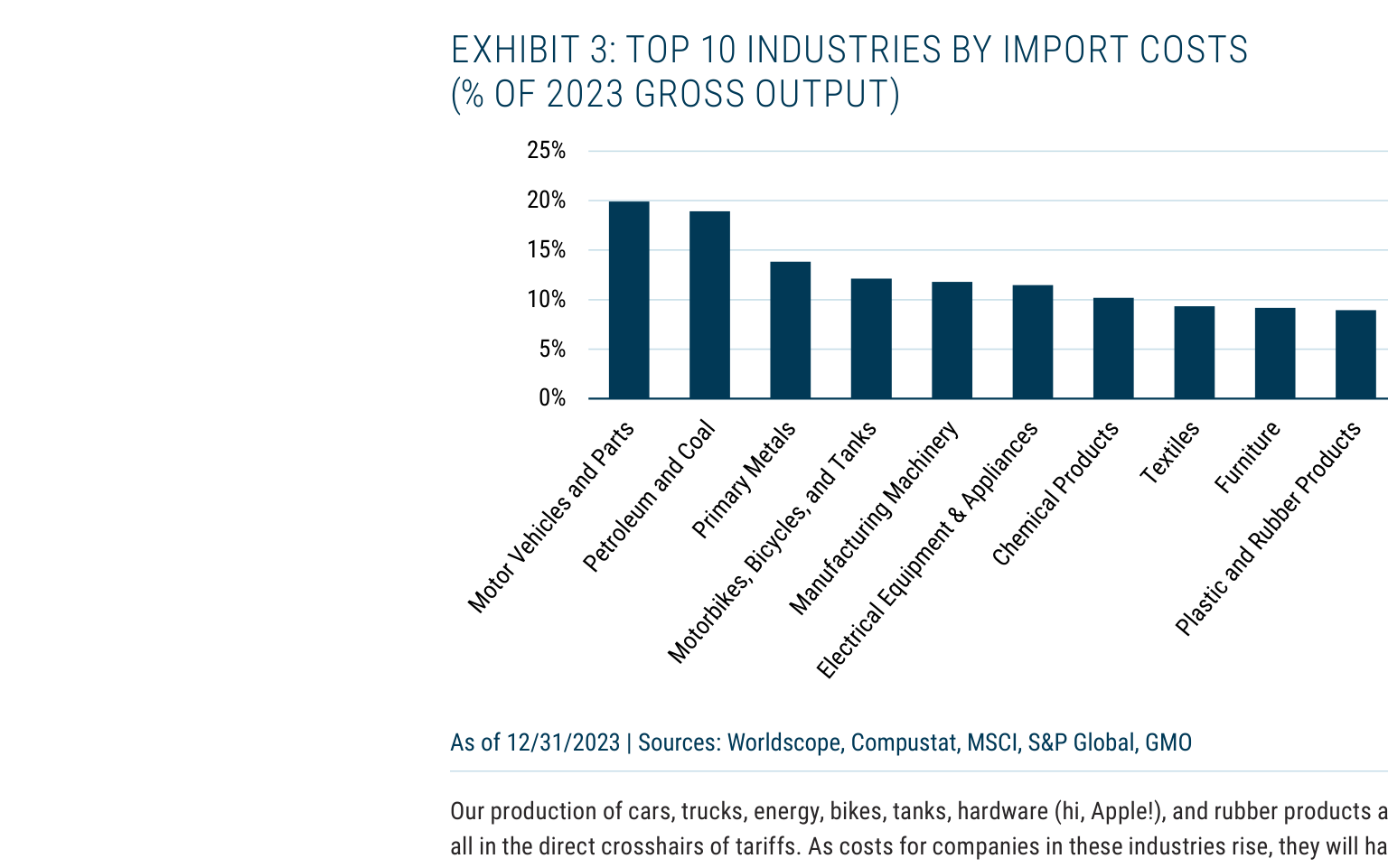
- Apple: Manufactured overseas, sold in the US; tariffs directly impact profits (bearish).
- GM: Imports intermediate goods for production; tariffs raise costs (bearish).
- All companies expanding cloud and AI capabilities: These expansion plans rely heavily on imports, and tariffs will increase costs (bearish).
- US high-yield corporate credit bonds: The report previously noted their extremely poor risk-reward ratio, and this chapter further reinforces the threat of tariffs to the bankruptcy risk of low-quality companies.
Investment Implications
- Short long-term dollar exposure: Although the dollar may appreciate in the short term due to tariffs, policy instability will weaken the appeal of dollar assets over the long term; investors should consider hedging against dollar depreciation risk.
- Reduce US stocks, increase non-US stocks: US companies (especially import-dependent ones) face direct cost shocks, while non-US stocks (particularly emerging markets), though dragged down by currency depreciation in the short term, offer better long-term risk-reward than US stocks.
- Beware of US high-yield credit bonds: Tariffs will erode corporate profits, raising the bankruptcy risk of low-quality companies. Combined with already tight credit spreads, this asset class has an extremely poor risk-reward ratio.
- Focus on currencies of trade surplus countries: Vietnam, Mexico, and East Asian economies face the greatest currency depreciation pressure. However, if these countries respond through retaliation or industrial relocation, depreciation may be lower than model predictions, presenting opportunities for expectation gap trades.
Theme & Background
This chapter explores the depth of the decline in U.S. corporate profits under the impact of tariffs—specifically, whether it will trigger a wave of bankruptcies. GMO argues that tariffs directly erode corporate profits by raising the costs of imported intermediate goods and export prices, and that the manner and duration of the impact vary significantly across different market structures (competitive vs. oligopolistic).
Core Views
- Short-term: Consumers bear approximately 80% of tariff costs (via price increases), while producers bear the remaining 20%, leading to a decline in both sales volume and profit margins.
- Long-term: In highly competitive industries, tariff costs are eventually fully passed on to consumers, but "losers" go bankrupt and exit during the process. In oligopolistic industries (e.g., most large-cap U.S. stocks), the existence of excess profits prevents firms from exiting due to tariffs, but profits will suffer long-term erosion.
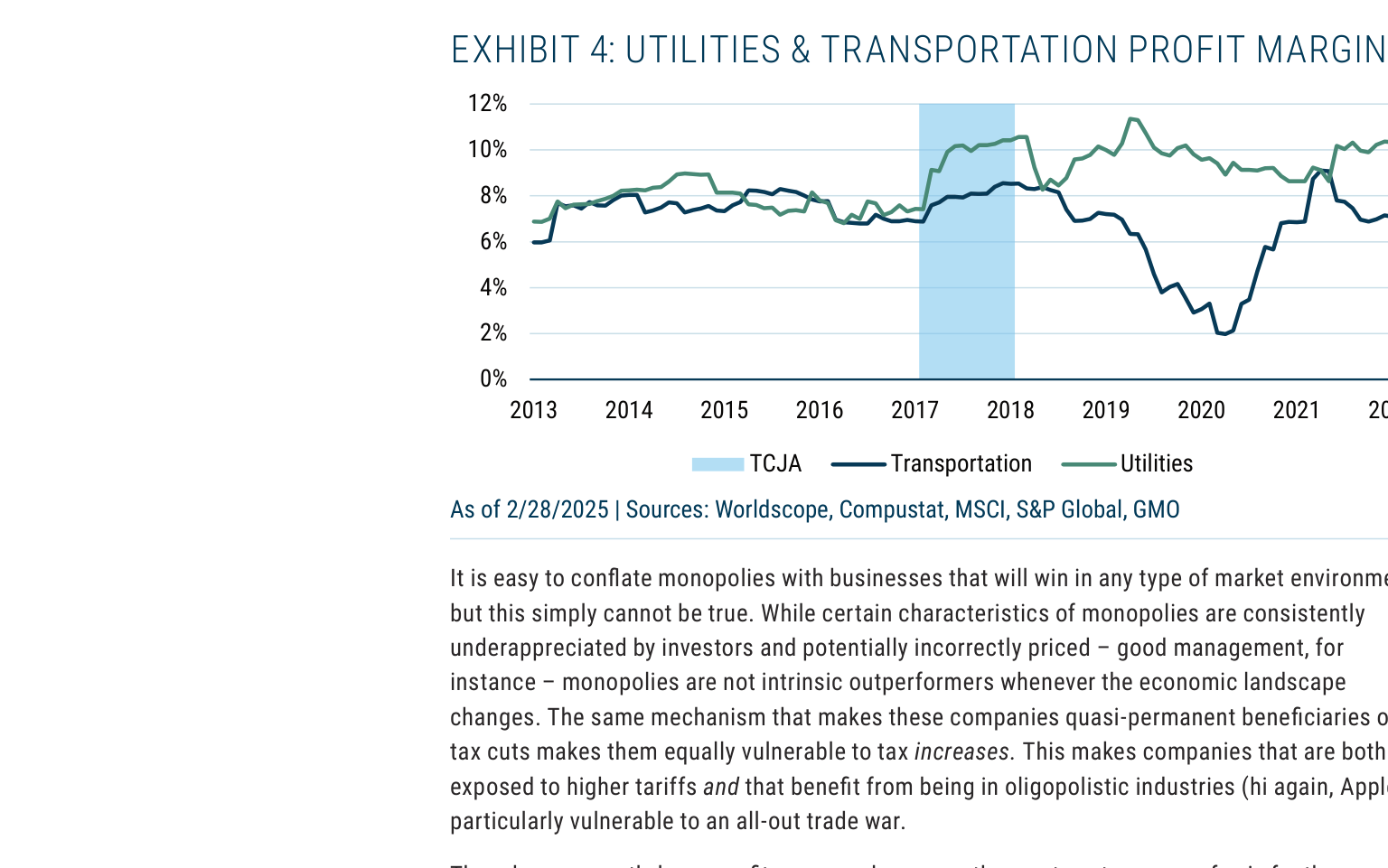
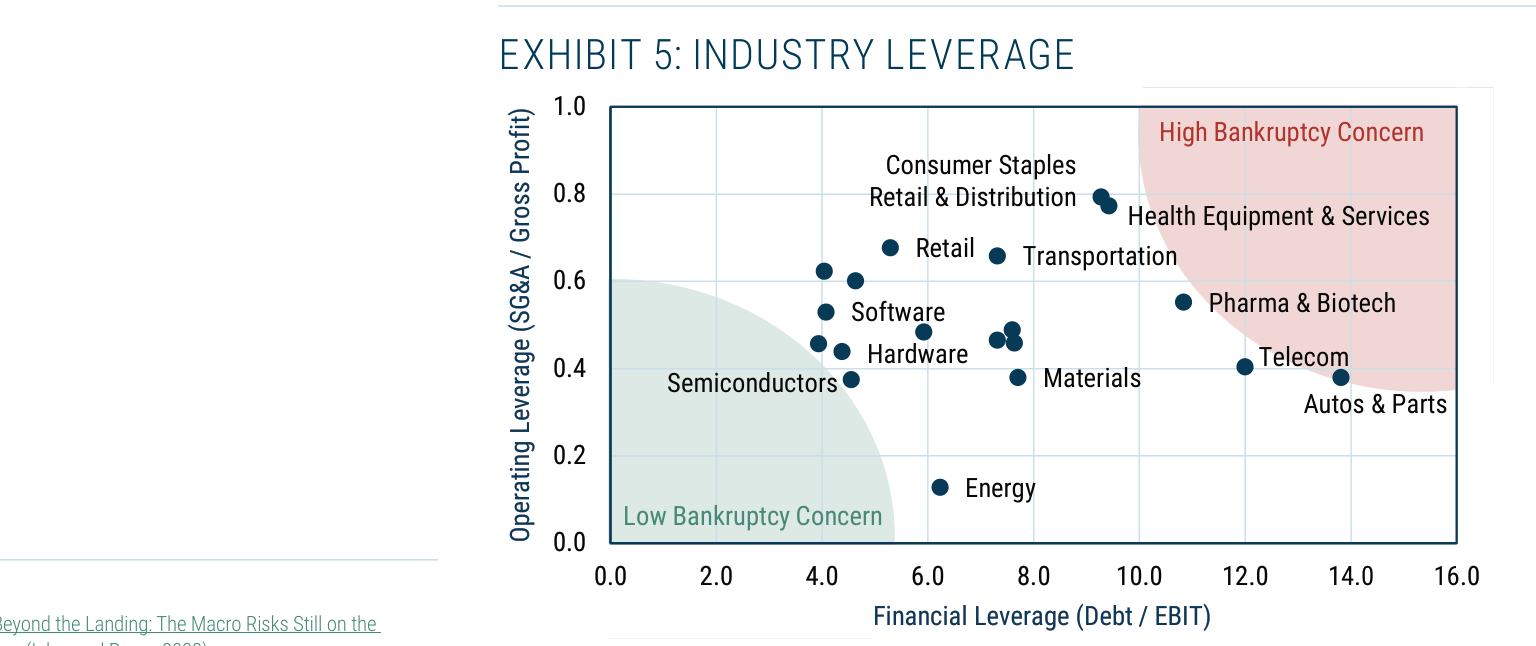
- Counterintuitive Judgment: Monopolistic firms do not always "win" in any environment—the permanent profit windfall they gained from the 2017 tax cuts will be permanently damaged by tariffs, which act as a "tax increase." Companies with high operating leverage + high financial leverage (e.g., autos, consumer staples retail) are the highest-risk areas for bankruptcy.
Key Arguments & Data
1. Tariff Cost Pass-Through Mechanism: Assuming the average U.S. product market has four equal competitors, in the short term, consumers absorb about 80% of the tariff (price increase), and producers absorb 20% (profit decline). The higher the industry concentration, the lower the consumer absorption ratio.
2. 2017 Tax Cut Case Comparison:
- Transportation (competitive): Profits rose briefly after the tax cut but quickly returned to normal levels.
- Utilities (oligopolistic/regulated): Profit margins permanently increased after the tax cut, with no reversion.
- Small-cap stocks (lacking market power) did not gain lasting profit improvements from the tax cut, while the S&P 500 (especially large-cap stocks) received a permanent profit dividend.
3. Industry Leverage Risk Matrix (Exhibit 5):
- High Bankruptcy Risk Zone: High operating leverage (SG&A/Gross Profit) + High financial leverage (Debt/EBIT).
- Specific Industries:
- Auto & Components: Very high financial leverage (Debt/EBIT > 10), moderate operating leverage.
- Consumer Staples Retail & Distribution: Very high operating leverage (SG&A/Gross Profit > 0.8), moderate financial leverage.
- Health Equipment & Services, Retail, Transportation: Relatively high operating leverage, moderate financial leverage.
- Low Risk Zone: Energy, Materials, Semiconductors, Telecom, Software, Pharmaceuticals & Biotech (low operating leverage or low financial leverage).
4. Credit Spread Underpricing: U.S. high-yield bond spreads are at the 15th historical percentile (extremely tight), while tariff uncertainty is raising bankruptcy expectations. Current spreads cannot compensate for default risk.
Companies/Assets Involved
| Company/Asset | Role & Key Data | View |
|---|---|---|
| Apple | Highly dependent on imported intermediate goods (hardware), operates in an oligopolistic industry | Bearish: Tariffs directly impact costs, and due to its oligopolistic position, profits will be permanently damaged |
| U.S. Steel | Domestic production, primarily faces foreign competition | Bullish: May benefit from tariff protection |
| Transportation | Competitive industry, profit margins quickly reverted after the 2017 tax cut | Neutral: Tariff impact is severe in the short term, but the industry will clear out in the long term |
| Utilities | Oligopolistic/regulated, profit margins permanently increased after the 2017 tax cut | Bearish: Tariffs will permanently erode profits |
| U.S. High-Yield Corporate Bonds | Spreads at the 15th historical percentile, default risk rising | Strongly Bearish: Extremely poor risk-reward, recommend avoidance |
Investment Implications
- U.S. Stocks Overall: Tariff risks combined with high valuations make the U.S. stock market "hard to recommend." However, not all stocks will be harmed—domestic producers primarily facing foreign competition (e.g., U.S. Steel) may benefit, but such companies are rare.
- Sector Selection: Avoid industries with high operating leverage + high financial leverage (autos, consumer staples retail). Focus on low-leverage industries (energy, materials, semiconductors, software, pharmaceuticals).
- Credit Bonds: U.S. high-yield bond spreads are too tight to compensate for the rising default risk triggered by tariffs and should be firmly avoided.
- Core Logic: The permanent profit dividend that oligopolistic firms gained from the 2017 tax cuts will be permanently reversed in a tariff-increase environment. Investors should not assume that a company's "monopoly position" makes it immune to tariff shocks.
Additional Arguments & Data Analysis: Corporate Credit and Investment Strategies Under Tariff Impact
1. Double Blow of Tariffs on Low-Quality Corporate Credit
- Direct Cost Impact: Tariffs raise the cost of imported raw materials and intermediate goods. Low-quality companies (e.g., high leverage, low profit margins) lack pricing power and struggle to pass costs on to consumers. According to GMO's analysis, the profit margins of such companies will be further compressed, significantly increasing default risk.
- Sales Contraction Risk: The economic slowdown triggered by tariffs will suppress aggregate demand. Low-quality companies, due to weak customer bases and insufficient product differentiation, may see sales declines exceeding the industry average. Historical data shows that during the 2018-2019 U.S.-China trade friction, the default rate on U.S. high-yield bonds (HY) rose from 2.1% to 3.1%, with manufacturing and retail companies most affected.
- Credit Spread Widening: The current credit spread on U.S. high-yield bonds is approximately 350 basis points (as of Q1 2025), below the historical average (about 450 basis points). However, if tariffs trigger a recession, spreads could rapidly widen to over 600 basis points. GMO notes that current spread levels do not fully reflect tariff risk, and investors should avoid holding high-yield bonds.
2. Comparison of Tariff Impact Across Market Structures
| Market Structure | Short-Term Price Adjustment | Long-Term Profit Impact | Firm Survival Probability |
|---|---|---|---|
| Perfect Competition | Price increase less than tariff (e.g., 50%), sales decline | Profits return to normal levels, but sales permanently lower | Weak firms forced to exit, industry concentration increases |
| Oligopoly | Price increase less than tariff (e.g., 30%), sales decline | Profits permanently lower, both sales and margins decline | High barriers protect leading firms, but overall profits are damaged |
- Data Support: Taking the U.S. auto industry as an example, if a 25% tariff is imposed on imported cars from Mexico, prices may rise by 10-15% in the short term (due to oligopolistic pricing power), but long-term profits could fall by 8-12% (based on empirical research from the 2018 tariff shock). In contrast, in a perfectly competitive industry (e.g., apparel manufacturing), the price increase may approach 80% of the tariff, but corporate profit margins could decline by 15-20%.
3. Rebalancing Investment Strategies: From U.S. to Non-U.S., From Growth to Value
- Relative Advantage of Non-U.S. Markets: GMO believes that U.S. companies face at least the same level of risk from tariffs as non-U.S. companies, but non-U.S. markets (e.g., Europe, Japan) have lower valuations (P/E ratio of about 12x vs. 22x for the S&P 500) and are less directly impacted by tariffs. For example, European export companies (e.g., autos, machinery) can partially offset tariff impacts through supply chain diversification (e.g., shifting production to Eastern Europe).
- Value vs. Growth Stocks: U.S. growth stocks (e.g., the "Magnificent Seven") have high profit margins (average net margin of 25%), but rising production costs due to tariffs will erode their excess profits. In contrast, value stocks (e.g., energy, financials) are already trading at historically low valuations (P/B ratio of about 1.2x), and some companies (e.g., U.S. domestic banks) are less affected by tariffs. Historical backtesting shows that during trade friction periods, value stocks can generate excess returns of 5-8% (annualized) relative to growth stocks.
- Timing for High-Risk Stocks: GMO notes that low-quality value stocks (e.g., high leverage, low-rated companies) have not yet fully priced in tariff risk. However, if their prices fall further (e.g., by more than 20%), it may present a buying opportunity. For instance, after the 2008 financial crisis, the high-yield bond index bottomed in March 2009 and subsequently returned over 50% in the following year.
4. Government Bonds vs. Corporate Bonds: Risk-Reward Trade-off
- Safe-Haven Attributes of Government Bonds: Although inflation risk (e.g., tariffs pushing up consumer goods prices) may erode the real returns of government bonds, their price appreciation during a recession (falling yields) can provide a hedge. For example, if U.S. GDP growth slows by 1 percentage point, the 10-year Treasury yield could fall by 50-80 basis points, leading to a price increase of about 4-6%.
- Vulnerability of Corporate Bonds: The default risk of high-yield bonds is highly correlated with tariff shocks. GMO's model shows that if tariffs cause U.S. corporate profits to fall by 10%, the default rate on high-yield bonds could rise from the current 2.5% to 5.5%, with credit spreads widening to over 500 basis points. In comparison, the default rate on investment-grade corporate bonds is lower (about 0.5%), but spreads could still widen by 100-150 basis points.
5. Key Risk Indicators & Thresholds
- Tariff Magnitude Threshold: GMO analysis indicates that when tariffs are below 5%, companies can absorb costs through supply chain adjustments (e.g., rerouting trade routes). When tariffs exceed 25%, the cost of supply chain restructuring will surpass the tariff itself, leading to permanent profit losses. For example, about 30% of Mexican auto parts exported to the U.S. could be rerouted to Canada or Asian markets to avoid tariffs, but at an additional cost of about 15%.
- Corporate Leverage Critical Point: If a company's Debt/EBITDA ratio exceeds 4x, a tariff shock could push it into financial distress. Currently, about 40% of U.S. high-yield bond issuers have leverage ratios above 4x, making them the highest default risk under tariff shocks.
6. Historical Comparison & Forward-Looking
- Lessons from the 2018-2019 Trade Friction: At that time, the U.S. imposed 25% tariffs on approximately $250 billion of Chinese goods, causing the S&P 500 to fall by about 10% and high-yield bond spreads to widen by 150 basis points. However, the current tariff scope is broader (covering the globe) and is compounded by inflationary pressures, potentially leading to a larger impact. GMO estimates that if a full 25% tariff is implemented, U.S. GDP growth could decline by 1.5-2 percentage points, and corporate profits could fall by 8-12%.
- Current Market Pricing Bias: As of Q1 2025, the option-adjusted spread (OAS) on U.S. high-yield bonds is about 350 basis points, below the historical average (450 basis points), indicating that the market has not fully priced in tariff risk. GMO recommends that investors reduce holdings of high-yield bonds and increase allocations to government bonds and non-U.S. value stocks.