Platinum Bombed (May 2025)
The Capital Cycle is the official podcast that Marathon Asset Management (the London firm founded in 1986) launched in 2024, hosted by financial historian Edward Chancellor, who interviews Marathon's investors about each Global Investment Review letter — applying the firm's long-term, contrarian "capital cycle" supply-side approach.
In plain words
This report looks at platinum group metals (PGMs, used in car exhaust systems) mining companies. Prices and stocks have crashed, and the industry is losing money. But the author argues that because everyone has stopped investing, mines are aging and supply will shrink, which could lead to a price rebound. For regular investors, this might be a good time to buy a basket of these stocks cheaply, but you need patience. It's worth reading because it shows a contrarian idea: the worst moment can be the start of an opportunity.
This report is centered on the capital cycle philosophy, advocating for identifying opportunities amid uncertainty and focusing on supply-side dynamics rather than demand-side factors. The report argues that the market’s pursuit of certainty often leads to concentrated positions and increased fragil
Theme and Background
This chapter focuses on the underlying logic of the capital cycle investment philosophy and uses it to introduce a specific contrarian investment case — the platinum group metals (PGM) mining industry. The report argues that the market's excessive pursuit of certainty leads to crowded positions and rising portfolio fragility; meanwhile, truly attractive capital cycle reversal opportunities often emerge from the shadow of extreme uncertainty. At present, the PGM industry has experienced years of price collapse and capital outflows, making it a real-world testing ground for this philosophy.
Core Thesis
The author's core investment argument is: PGM mining is at the bottom of the capital cycle, supply-side constraints are tightening, the industry has reversal potential, and now is the time to strategically increase exposure.
A counterintuitive judgment is that despite immense uncertainty on the demand side (especially the replacement of internal combustion engine vehicles by electric vehicles), the author believes supply-side contraction (insufficient capital expenditure, aging mines, negative cash flows) is a more certain and more bettable factor. The widespread market pessimism toward the PGM industry may overlook the structural changes that have already occurred on the supply side.
Key Arguments and Data
The report supports the logic of supply-side contraction with extensive data:
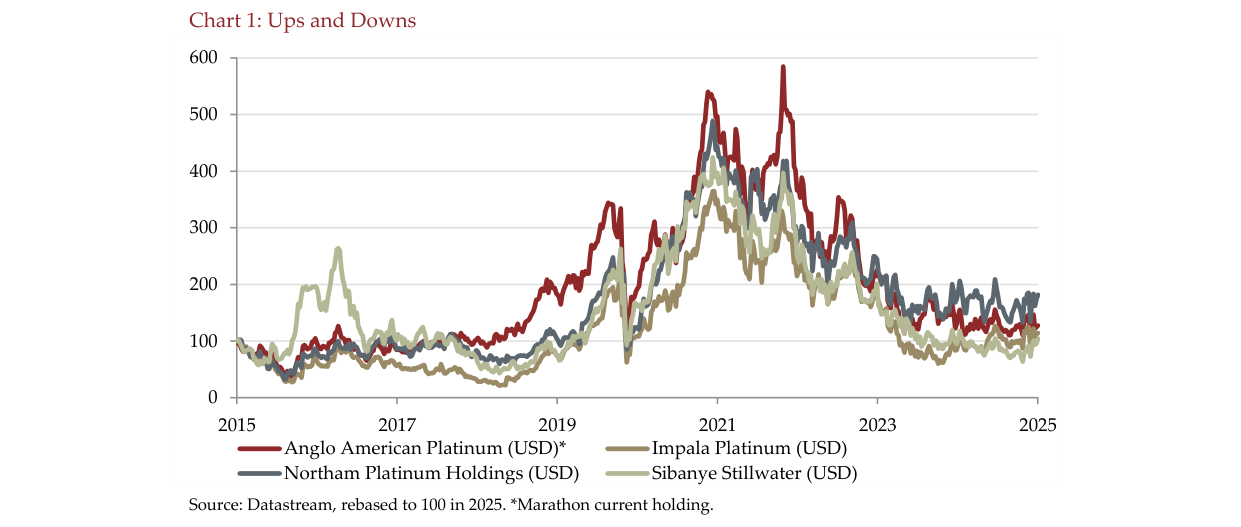
The share price trends of four PGM mining companies show that, indexed to 100 in 2015, prices peaked around 500–600 in 2021 before falling sharply to the range of approximately 100–200 by 2025.
1. Market Cap and Price Collapse: Over the past four years, the total market capitalization of the PGM mining sector has evaporated by approximately 70%. The PGM basket price (60% platinum, 30% palladium, 8% rhodium, 2% gold) has fallen sharply, causing about 30% of industry supply to turn cash flow negative.
2. Cost Curve and Deep Price Penetration: The PGM basket price has deeply penetrated the cost curve. Specific data are shown in the table below (based on the original chart description):
| Cost Curve Percentile | Relationship between Current Price and Cost Support |
|---|---|
| 90th Percentile | Price far below this cost line |
| 70th Percentile | Price below this cost line |
| 50th Percentile | Price below this cost line |
(Note: The report states that the PGM basket price is significantly below the cost support lines at the 50th–90th percentiles, indicating severe losses for most high-cost miners.)
3. Capital Expenditure Consistently Below Sustenance Level: In eight of the past ten years, industry capital expenditure has been below the "sustenance capital" level required to maintain current production. By 2030, the ratio of capital expenditure to depreciation is expected to remain extremely low (the chart shows below 0.5x).
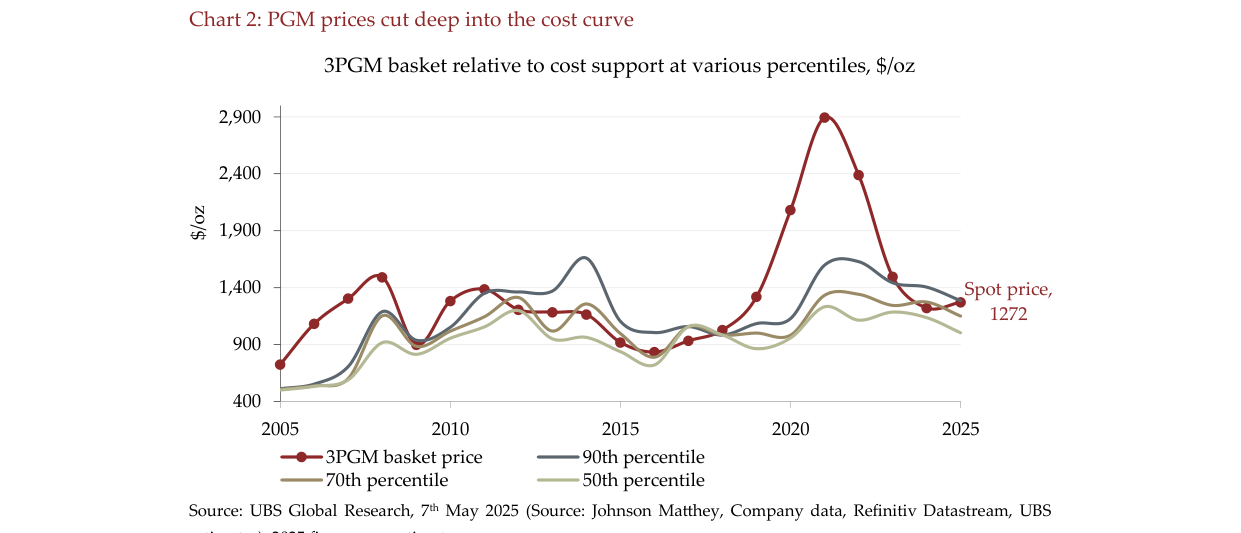
The 3PGM basket price relative to the cost support line shows that the current spot price of USD 1,272/oz is below the 90th and 70th percentile cost lines, indicating that approximately 30% of industry supply is cash flow negative.
4. Structural Decline in Production: South African platinum production has fallen from approximately 5.2 million ounces in 2006 to 3.9 million ounces in 2024, and producers expect a further 10% decline by the end of this decade. The majority of existing production comes from mines built more than 20 years ago, with reserves nearing depletion.
5. High Replacement Costs: Industry executives note that the replacement cost per ounce of production is nearly three times the current market value, and it takes more than ten years from environmental assessment to first production. This means a large-scale restart of supply is extremely difficult.
Companies/Assets Involved
The report analyzes the industry as a whole and mentions four major producers (used as examples of price performance in the charts), but it does not give explicit long or short judgments on individual stocks. Instead, it recommends a "cluster strategy." These companies are:
| Company Name | Role and Description |
|---|---|
| Anglo American Platinum (AMS) | One of the world's largest platinum producers; its stock price trend is used as an industry performance benchmark. The author does not explicitly take a bullish or bearish stance on the individual company, but it is clearly a core player in any industry reversal. |
| Impala Platinum (Implats) | Another top producer, also used to illustrate the long-term downtrend in industry share prices. |
| Northam Platinum Holdings | A major South African producer. |
| Sibanye Stillwater | A diversified precious metals miner with PGM assets in both South Africa and the United States. |
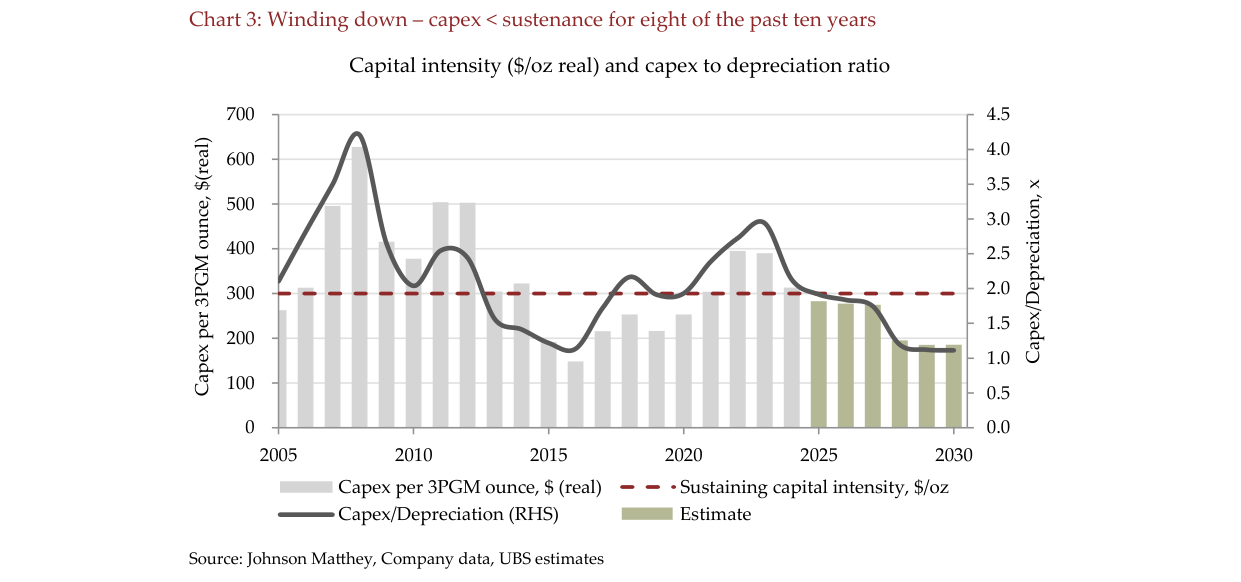
Capital expenditure intensity shows that capex per ounce of 3PGM has fallen from a peak of approximately USD 650/oz in 2008 to about USD 200/oz in 2024, and in eight of the past ten years, capex has been below the sustenance capital intensity (USD 300/oz).
Overall Judgment: The author holds a strategically bullish view on the entire PGM mining sector, arguing that even "the dirtiest shirts" are worth holding because the entire industry is deteriorating and a reversal is imminent.
Investment Implications
For investors, the specific directions provided in this chapter are:
1. Adopt a "Cluster Strategy" for Allocation: Given that the entire industry is undergoing de-capitalization, it is very difficult to pick "the best company." The author advises against stock selection and instead recommends broad allocation across the entire PGM mining sector (i.e., buying a basket of PGM miner stocks) to capture the reversal gains of the entire industry.
2. Be Patient for the Supply-Side Logic to Play Out: Current uncertainties (demand, timing) represent a high "carry cost" for holding PGM stocks. However, the report believes that the persistent lack of capital expenditure will force supply to exit, which is more reliable than predicting when demand will bottom. Investors need to endure short-term volatility and wait for this structural logic to move from "possibility" to "reality."
3. Focus on Hybrid and Industrial Demand: There is no need to over-interpret the "fatal threat" to PGM demand from electric vehicles. Hybrids ("stop/start" technology) and trucks have higher platinum demand, and the penetration rate growth of pure battery electric vehicles has slowed (US <10%, Europe 15%, China 33%). The "obituary" for PGM catalysts may be premature.