Buyback Heaven (July 2026)
The Capital Cycle is the official podcast that Marathon Asset Management (the London firm founded in 1986) launched in 2024, hosted by financial historian Edward Chancellor, who interviews Marathon's investors about each Global Investment Review letter — applying the firm's long-term, contrarian "capital cycle" supply-side approach.
In plain words
Japanese companies are now buying back their own shares on a large scale—using cash to repurchase and cancel stock, so each remaining share earns more. Japan’s exchange now requires companies trading below book value to explain why, and buybacks have reached roughly the same size as in the S&P 500. For ordinary investors, this can add to returns from Japanese stocks or funds, beyond share-price gains. The report is worth reading because it uses cases like NTT to show how buybacks lift earnings per share even when profits barely grow, and flags companies that may act next.
At a Glance
The author believes: Japan's corporate buyback wave has substantively begun, and discounted buybacks will systematically unlock shareholder value — the outlook for Japanese equity holdings is [optimistic].
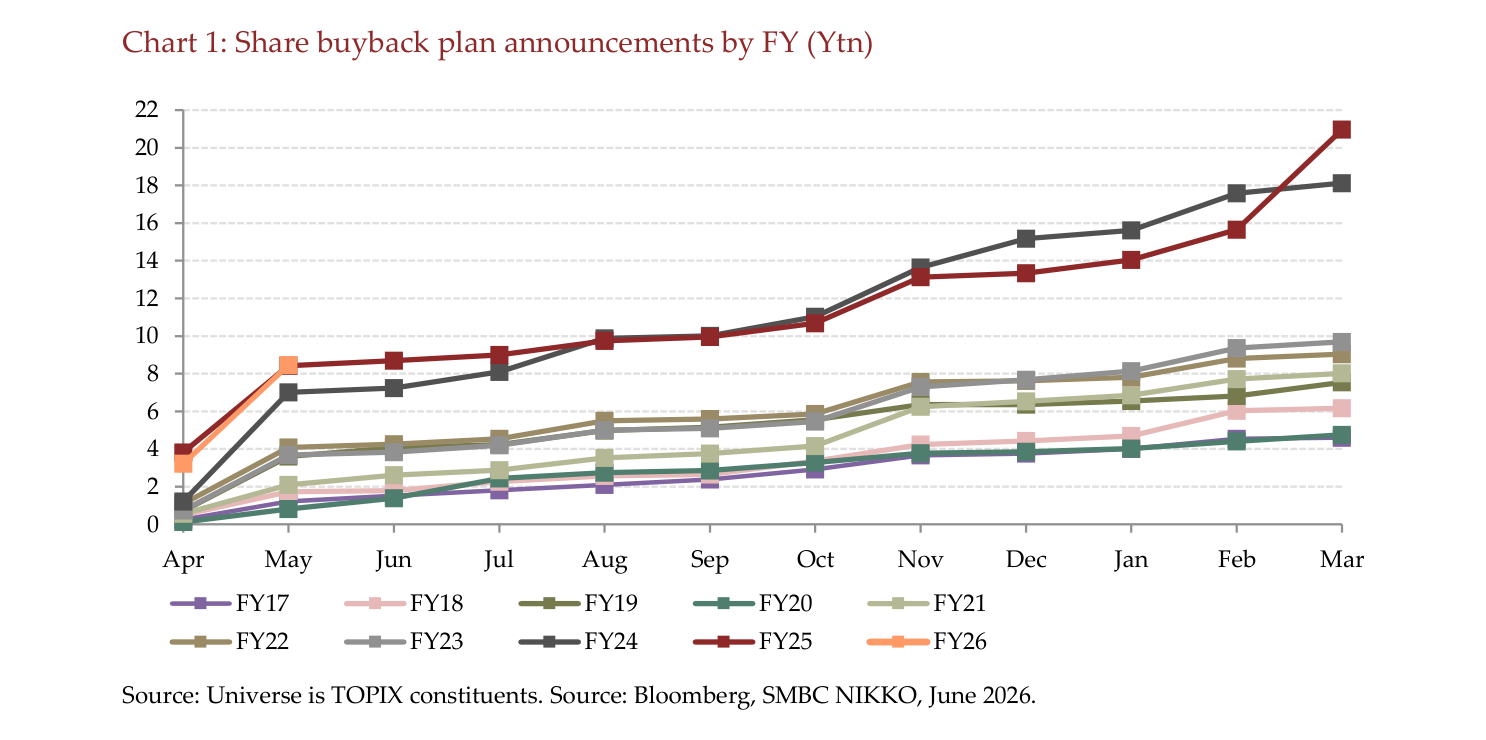
- The Tokyo Stock Exchange formally required companies trading below book value to explain the reasons and propose countermeasures. Combined with the inflection point in inflation and interest rate expectations, Japanese buyback announcements almost immediately surged in volume. Total buyback scale has reached about 1.4% of TOPIX market capitalization, on par with the S&P 500.
- Over two decades, NTT's operating profit grew only 2.1% compounded annually, but through sustained buybacks and cancellation of nearly half its share capital, EPS compound growth reached 6.6% (TOPIX: 4.4%), with a total return of 367% outperforming TOPIX's 277%.
- One-off buybacks from major shareholders are the most impactful: Kinden spent Y220bn to repurchase 17% of floating shares from Kansai Electric Power, boosting EPS by 19%; Seria repurchased 17% of the founder's shares at a 23% discount, boosting EPS by 19%; Japan Post Holdings spent roughly Y600bn over two years on discounted buybacks, boosting EPS by 13%.
- Secom holds about Y330bn in idle cash (over a fifth of equity). If it moderately increases leverage to net debt/equity of 33%, it could deploy Y800bn+ for buybacks, with potential EPS upside of 32%.
TSE Pressure, Combined with a Macro Inflection Point, Immediately Triggers a Buyback Wave
The article's core timeline: In 2023, eight years after the Tokyo Stock Exchange (TSE) issued its Corporate Governance Code, the TSE formally required companies trading below book value to explain why and propose countermeasures. Combined with an inflection point in inflation and interest-rate expectations, Japanese corporate buyback announcements almost immediately surged in volume. The article opens by quoting Warren Buffett's famous line from Berkshire's 1984 annual report: for a company with an excellent business and a comfortable financial position, if its share price is far below intrinsic value, a buyback is the most certain way to benefit shareholders. When relaying the TSE's requirement, the author writes: "If your shares are trading at below book value please explain why, and what you are going to do about it." In other words: "If your shares are below book value, explain why and what you intend to do about it."
The author believes the TSE chose the right moment—inflation and interest-rate expectations were at an inflection point, and the market had already begun to pay more attention to Japanese companies' capital management. Previously, Japanese shareholders had ranked last among corporate stakeholders, but the ownership structure had shifted from friendly corporate cross-shareholdings to financial investors, and with the deflationary era seemingly over, "the TSE was pushing on a half-open door." Chart 1, showing cumulative buyback announcements by fiscal year, indicates that the change in buyback activity was almost immediate.
Discounted Buybacks Are a Low-Risk Opportunity to Outperform the Cost of Capital
The author argues that, for companies trading below intrinsic value, a buyback is an opportunity to outperform the cost of capital with extremely high certainty, especially when large yen balances on the books can earn only a negative real return. The author asks rhetorically: apart from the business a company knows best, where else can it find an investment so certain to outperform its cost of capital? If ROE is depressed because the return on a large amount of cash on the books is significantly negative, the case for a buyback is even stronger. The article provides a key comparison:
| Comparison item | Value |
|---|---|
| Japan's one-year deposit rate | Approx. 0.4% |
| Japan's recent core inflation | 2.8% |
| Total Japanese buybacks / TOPIX total market cap | Approx. 1.4% |
| S&P 500 buyback scale for comparison | Comparable (the original text gives no specific figure) |
Based on this, the author concludes that Japanese companies have begun to seize this opportunity, with total buybacks reaching around 1.4% of TOPIX total market capitalization, comparable to the S&P 500.
The Author Divides His Holdings into Three Tiers: Long-Term, New Converts, and Not Yet Acting
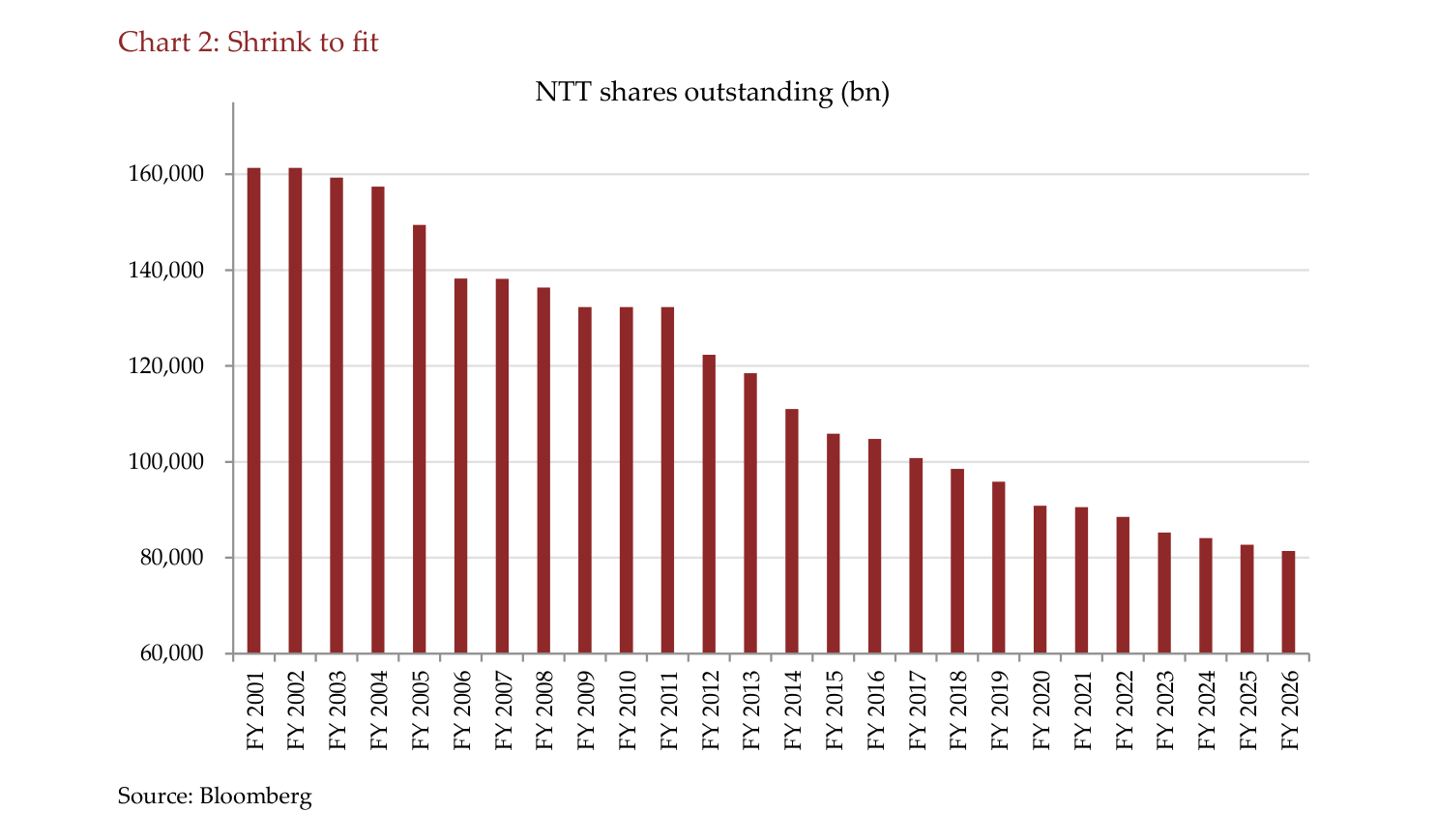
The author judges thatMarathon's holdings in Japan all trade below its assessed intrinsic value; many also have balance sheets carrying excess capital, so buybacks are highly desirable for most of these holdings; he divides these companies into three tiers. The first tier consists of "companies that have been buying back for years," the second of "new converts," and the third of "companies that should be conducting large-scale buybacks but have not yet acted." As a benchmark for the first tier, NTT (formerly Nippon Telegraph and Telephone Corporation) has bought back shares with metronomic regularity over the past 20 years; on a split-adjusted basis, its outstanding share count is equivalent to 160 trillion shares.
Investment Implications
The article views Japanese buybacks as a core mechanism for unlocking shareholder value: the combination of regulatory pressure, the end of deflation, and changes in the shareholder structure is leading companies with "discount + excess cash" to begin returning cash to shareholders. For Marathon's holdings, buybacks are a relatively high-certainty source of returns; the three-tier classification also suggests that future stock selection can focus on companies that "should act but have not yet done so." It is worth noting that the author is a position holder; the entire article uses the positive logic of buybacks to argue for the soundness of its Japanese equity holdings, without elaborating on risks such as execution rates, buyback timing, or the opportunity cost of cash.
NTT's Buybacks Nearly Halve Share Count; EPS Compounds at 6.6%
The author uses NTT as the core case study of long-term buybacks creating shareholder value: operating profit was almost flat over two decades, yet earnings per share compounded at 6.6%, clearly outperforming TOPIX. The chapter title refers precisely to NTT—"since then it has bought back and cancelled nearly half of its shares, leaving 81 trillion shares outstanding." Chart 2 shows NTT's shares outstanding shrinking from approximately 160 trillion shares all the way to approximately 81 trillion shares. The author describes the business as having "exhibited stable, utility-like economic characteristics for most of the period": operating profit rose from Y1.2tn in the fiscal year ended March 2006 to Y1.8tn in the fiscal year ending March 2026, a compound growth rate of just 2.1%. But persistently deploying strong cash flow to buy back shares allowed EPS to compound at 6.6%, clearly exceeding TOPIX's 4.4%. Over the two decades, NTT delivered a 367% total return, versus a 277% market return for TOPIX.
| Metric (20 years) | NTT | TOPIX |
|---|---|---|
| Operating profit CAGR | 2.1% | — |
| EPS CAGR | 6.6% | 4.4% |
| Total return | 367% | 277% |
Even Modest Buyback Announcements Can Trigger Significant Re-ratings
The author believes that even the announcement of a modest buyback program can bring a meaningful share-price re-rating, citing Buffett's 1984 shareholder letter as the theoretical basis and Hitachi as the practical example. The author quotes Buffett's 1984 shareholder letter directly: "Investors should pay more for a business that is lodged in the hands of a manager with demonstrated pro-shareholder leanings," meaning "investors should pay a higher price for a business that is in the hands of managers with demonstrated pro-shareholder leanings." The mechanism: a discounted buyback signals to the market that management treats shareholders well; investors therefore raise their expectations of future returns, and the share price moves toward intrinsic value.
Hitachi recorded the largest loss in Japanese corporate history—Y787bn—in 2009 before launching aggressive business reforms, and by the early 2020s its profitability had improved markedly: from a Y787bn loss in 2009 to net income of Y649bn in 2023. But the author notes that the share price truly "took off" only after management combined operational improvement with capital optimization—a Y200bn buyback announced in 2023. Shares outstanding have since fallen 7%, and leverage has actually declined over the same period, so the author sees considerable potential for further buybacks.
The Most Impactful: One-off Buybacks from Major Shareholders
The author judges that the most impactful moves come from companies persuading major shareholders to sell large stakes in a one-off transaction, with Kinden, Seria, and Japan Post Holdings as examples.
Kinden (an electrical engineering company, previously discussed in the December 2025 GIR article "Tough, Dirty and Dangerous") announced a Y220bn buyback of 17% of its outstanding shares from its former parent, Kansai Electric Power. With Y200bn of idle cash and Y130bn of listed equity holdings on its books, the company did not even need to borrow. The transaction added 20% to earnings and EPS before interest costs.
| Kinden (fiscal year ending March 2026) | Before buyback | After buyback | Change |
|---|---|---|---|
| Shares outstanding (millions) | 198 | 165 | -17% |
| EPS | 351 | 417 | +19% |
| BVPS | 3,343 | 2,676 | -20% |
| P/E | 19.3 | 16.3 | — |
| PBR | 2.0 | 2.5 | — |
Note: assumes a 0.5% interest rate on the cash balance. The author points to the one blemish for long-term shareholders: Kinden completed the transaction only after the share price had risen above book value—in early 2023 the shares traded at a 45% discount to book, when a buyback would have significantly accreted both BVPS and EPS. But the author remains positive: the intrinsic value estimate is far above book value and above the current share price, and he is "happy to see cash used for buybacks rather than dividends."
Seria (a discount retailer) executed a similar block transaction in June 2025, buying back 17% of its shares from a founder no longer involved in operations. It negotiated a 23% discount, pricing the deal at 1.4x book value—below the prior year's historical-low PBR of 1.55x. Again, no borrowing was needed; only one-third of cash on hand was used. Because the buy-in valuation was low, EPS rose 19% while BVPS fell only modestly, by 8%. A year later, the move "looks especially wise": the share price is Y3,500, versus a buyback price of just Y2,000.
Japan Post Holdings is on a larger scale: over the two years through March 2026, it bought back roughly Y600bn of shares at an average price of Y1,510 per share, against book value per share of Y3,203 in March 2024—a purchase at a significant discount. This added 13% to EPS and 10% to BVPS. The author believes that, assuming book value is at least a reasonable approximation of economic value (and the author judges JPH's actual value to be above book), the company is in an "enviable" position. At Y2,318, the current share price still trades at a 30% discount to book. The author's observation: the more it buys back, the cheaper the stock becomes—because each discounted buyback further accretes book value per share.
Secom's Active Buybacks Could Lift EPS 32%
The author notes that 85% of Marathon's existing Japanese holdings have announced buybacks over the past three years, but some companies still act with old-Japanese-style conservatism, and Secom is a typical example. Secom is Japan's security leader: it holds more than 40% of the electronic security market and nearly 60% of the remote monitoring and dispatch market. The company is an extremely strong cash generator, converting Y513bn of net income into Y516bn of free cash flow over the past five years. It only began small buybacks in 2022, and including dividends has returned just Y374bn in total to shareholders, so the cash pile has barely been drawn down—currently around Y330bn (excluding customer custody cash), more than one-fifth of shareholders' equity. Given that Secom has never posted a loss since listing and has recorded negative free cash flow in only two years, the author describes the need for a cash buffer as "debatable" (to put it kindly). The author runs a hypothetical calculation: if Secom raised net debt to an unaggressive level of just 33% of equity (2x EBITDA), it would have Y800bn+ available to deploy; buying back shares at a 20% premium to the current price would reduce the share count by 26% and lift EPS by 32%. The author's original words are: "We don't expect radical change, but a modest acceleration in the right direction could work wonders for the share price"—meaning "we do not expect radical change, but a modest acceleration in the right direction could do wonders for the share price."
Investment Implications
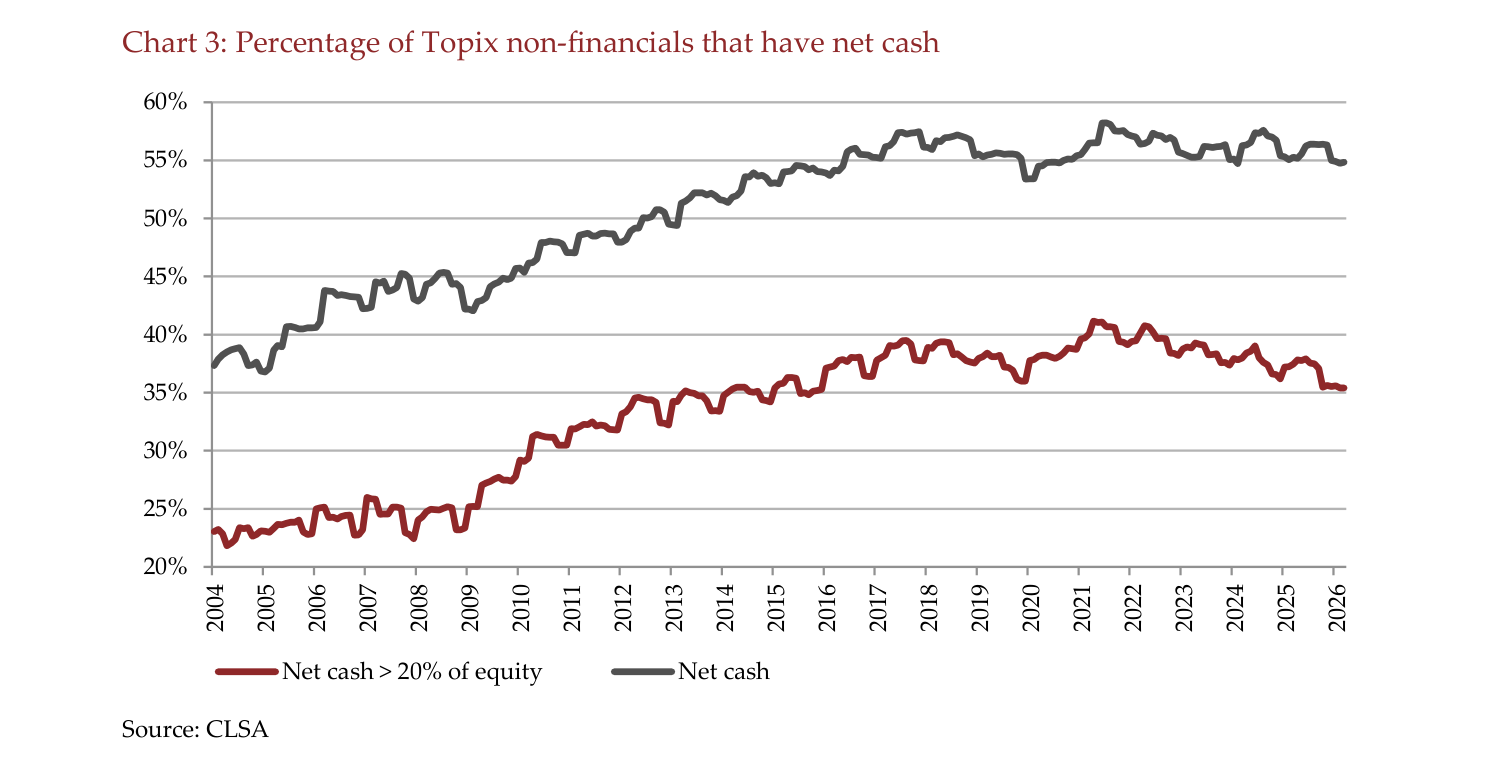
The article concludes that, although Japanese corporate buybacks have increased markedly over the past three years, the proportion of TOPIX non-financial companies holding net cash (and with net cash exceeding 20% of equity) remains high (Chart 3), leaving enormous scope for balance-sheet optimization. Marathon says it will continue to "gently encourage" management to think about improving capital structure—for many companies, most of the upside comes from improved profitability, but optimizing the balance sheet "can be the icing on the cake." Institutional-perspective caveat: Marathon is a holder of these Japanese stocks, and its advocacy of buybacks is aligned with its own shareholders' interests; readers should note that this is a position-holder's perspective, not a neutral analysis.
Position Moves
| Target | Direction | Author's One-Line View | Key Data |
|---|---|---|---|
| NTT | Hold/Watch | A benchmark of consistent long-term buybacks, with EPS growth significantly outpacing the market | Shares outstanding reduced from ~160 trillion to ~81 trillion; operating profit CAGR 2.1%, EPS CAGR 6.6% (TOPIX 4.4%); 20-year total return 367% (TOPIX 277%) |
| Secom | Hold/Watch | Excess cash and conservative buybacks; modest acceleration could yield significant returns | Five-year FCF ¥516bn; idle cash ~¥330bn, over 20% of equity; assuming leverage to net debt/equity of 33%, could deploy ¥800bn+, reducing shares 26% and lifting EPS 32% |
| Kinden | Hold/Watch | One-off buyback from a major shareholder boosts EPS; missed the discount window but still undervalued | Spent ¥220bn to buy back 17% of shares outstanding from Kansai Electric; EPS rose from 351 to 417 (+19%), BVPS down 20% to 2,676, P/E down to 16.3 |
| Seria | Hold/Watch | Bought back founder shares at a low price; a year later it "looks especially prudent" | Repurchased 17% of shares at a 23% discount, priced at 1.4× book; EPS up 19%, BVPS down only 8%; buyback price ¥2,000, current price ¥3,500 |
| Japan Post Holdings | Hold/Watch | Buybacks at a significant discount continue to lift per-share book value; stock still below book | Over two years, bought back ~¥600bn at an average price of ¥1,510 (book value ¥3,203); EPS up 13%, BVPS up 10%; current price ¥2,318, still a 30% discount |
| Hitachi | Not stated | After operational improvement plus buybacks, the stock took off; still has substantial buyback potential | Lost ¥787bn in 2009, net income ¥649bn in 2023; announced ¥200bn buyback in 2023, shares outstanding reduced 7% |
| Kansai Electric Power | Not stated | Acted as the counterparty selling 17% of shares outstanding to Kinden | Transaction value ¥220bn; Kinden needed no borrowing, funding the acquisition with cash on hand and listed equity holdings |