Masters of the Air (March 2026)
The Capital Cycle is the official podcast that Marathon Asset Management (the London firm founded in 1986) launched in 2024, hosted by financial historian Edward Chancellor, who interviews Marathon's investors about each Global Investment Review letter — applying the firm's long-term, contrarian "capital cycle" supply-side approach.
In plain words
This report argues that in European aerospace, the real winners aren't plane makers like Airbus or Boeing, but engine makers like Rolls-Royce and Safran. With aircraft orders backlogged into the 2030s and delivery wait times doubling to 5 years, old planes fly longer and need more maintenance. Engine makers use a 'razor-blade' model—sell the engine once, then profit from ongoing repairs and services. As supply stays tight, their earnings get a bigger boost. For regular investors, this suggests focusing on engine OEMs (original equipment manufacturers) rather than planemakers.
This report examines the history and investment outlook of the European aerospace industry. The core argument is that engine OEMs (such as Rolls-Royce, Safran, and MTU) will experience sustained growth due to long-term supply constraints (industry oligopoly and post-capital-cycle consolidation). Key
Theme and Background
This section reviews the history of the European aerospace industry from the early 20th century to the present, focusing on its current investment prospects. The report argues that Europe has global competitiveness in the aviation industry, and its oligopolistic market structure (duopoly in aircraft manufacturing, oligopoly in engine manufacturing) is the core logic underpinning the strong performance of related stocks.
Core Thesis
The author’s central argument is that due to extremely tight supply (Boeing/Airbus order backlogs extending into the 2030s, delivery wait times for wide-body aircraft doubling to five years), and consolidation following the industry’s capital cycle, engine OEMs (Original Equipment Manufacturers) are the most beneficiaries. This view runs counter to market consensus: investors typically focus on demand for aircraft manufacturers (e.g., Airbus), but the author believes that the "razor-blade" business model of engine OEMs offers greater earnings resilience during supply shortage cycles.
Key Arguments and Data
Aircraft delivery wait times have increased from approximately 2 years in 2000 to around 5-6 years in 2025, with the longest waits for wide-body jets
1. Structural Demand Growth: Global air travel demand has grown at an average of +5% per year since 1990, and has rebounded after every major shock. Emerging markets offer immense potential:
| Country/Region | Flights per capita per year |
|---|---|
| United States | 2.2 |
| Europe | 1.9 |
| China | 0.6 |
| Brazil | 0.5 |
| India | 0.1 |
2. Extremely Tight Supply:
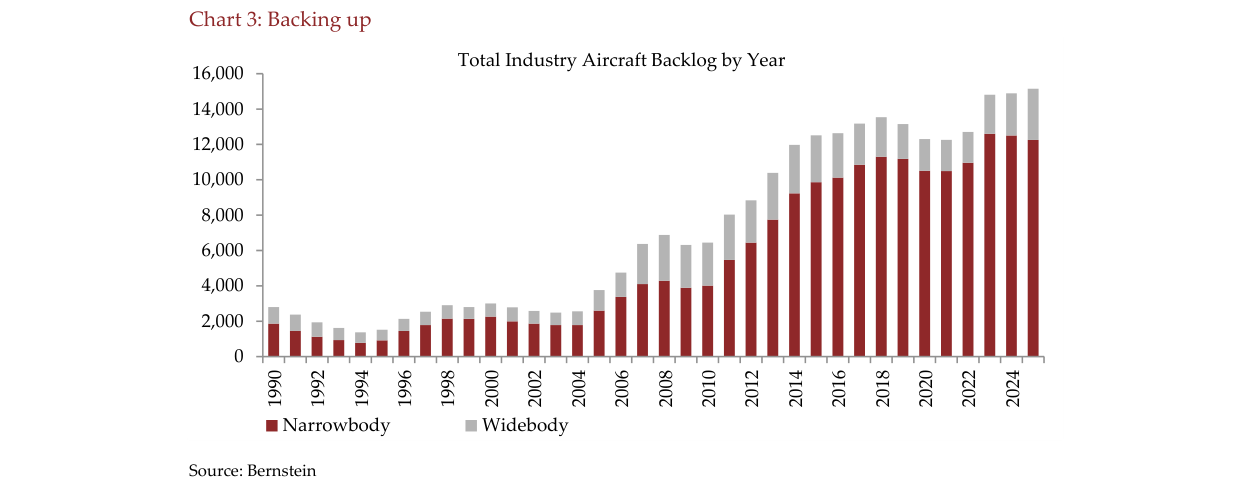
- Boeing and Airbus order backlogs are at record levels (data source: Bernstein chart shows backlog exceeding 14,000 aircraft).
- Delivery wait times for wide-body aircraft have doubled from ~2 years to 5 years.
- Airbus plans to reach a monthly production target of 75 aircraft by 2027, but market consensus, based on its past performance, doubts whether it can achieve this.
3. Engine OEM Business Model Benefits:
- The existing fleet is flying longer, driving a surge in aftermarket services (MRO) demand, boosting aftermarket revenue for engine OEMs (chart shows average growth rates between 15%-28%).
- Balance sheets have improved, enabling companies to return more capital to shareholders via dividends and buybacks than expected.
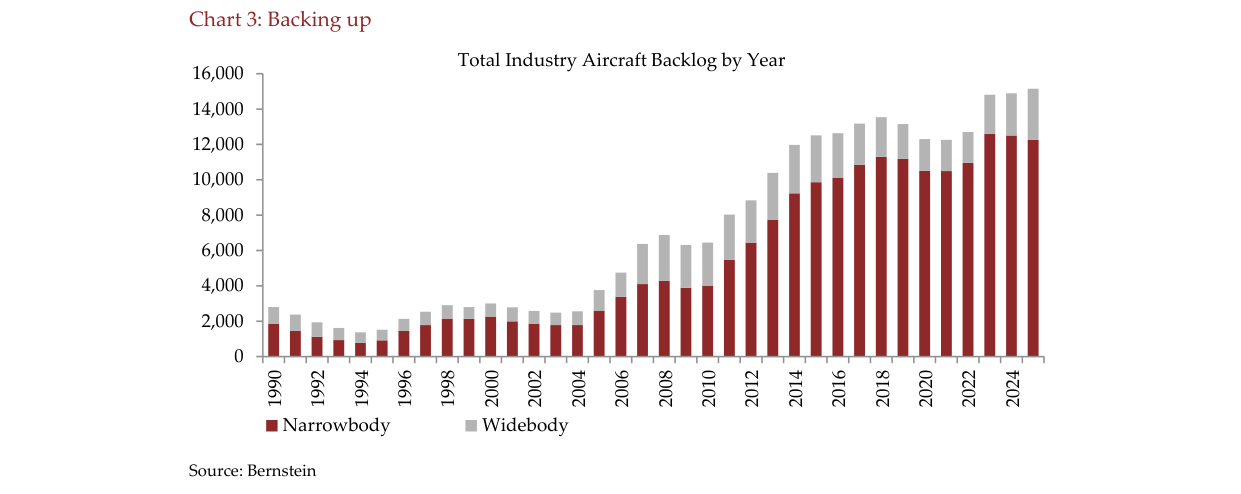
Global aircraft order backlogs have grown steadily from ~2,500 units in 1990 to ~15,000 units in 2024, with narrow-body aircraft accounting for about 80%
Companies/Assets Covered
- Rolls-Royce: Bullish. A top holding of the Marathon European team. Has outperformed the MSCI Europe benchmark by +995% over the past five years (total return +1153%). Currently valued at 41x 2026e P/E. The CEO is regarded as having executed one of the most successful turnarounds in European corporate history.
- Safran: Bullish. Valuation appears relatively reasonable at 30x 2026e P/E. Benefits from aftermarket demand for engines such as the CFM56.
- MTU Aero Engines: Bullish. Valuation is the most reasonable among the three at 24x 2026e P/E.
- GE Aerospace (US): A comparable company, also valued at 41x 2026e P/E.
- Airbus / Boeing: The "bottleneck" on the supply side, whose capacity constraints create favorable conditions for engine OEMs.
- Alten: Bearish / Underperform. A small position in the Marathon portfolio, as European automotive clients have underperformed due to Chinese competition and inflation shocks.
Investment Implications
1. Overweight Engine OEMs: The core strategy is to capitalize on the certain opportunity presented by supply shortages. Although valuations appear high (Rolls-Royce and Safran), the report argues that EPS growth (mid-to-high teens) over the next several years can justify current valuations.
2. Focus on Aftermarket Services: The core of the investment thesis is that "older planes need more maintenance," providing engine manufacturers with stable, predictable long-term cash flows (time & material contracts, long-term service agreements).
3. Beware of Supply Chain Risks: The report indirectly suggests that investing in upstream or downstream "general suppliers" (e.g., Alten) may be exposed to headwinds from other industries such as automotive. Focusing on the oligopolistic position of engine OEMs is a more selective choice.