Greek Banking Odyssey (June 2025)
The Capital Cycle is the official podcast that Marathon Asset Management (the London firm founded in 1986) launched in 2024, hosted by financial historian Edward Chancellor, who interviews Marathon's investors about each Global Investment Review letter — applying the firm's long-term, contrarian "capital cycle" supply-side approach.
In plain words
This report is about Greek banks, especially National Bank of Greece (NBG). After the debt crisis, Greek banks got bailed out with €50 billion, shrank from 40+ banks to just four, and now control 95% of assets. Bad loans dropped from 27% to 2%. NBG has super cheap funding (0.17% cost) and strong capital (17-19% CET1 ratio, a key safety measure). Yet the market still prices it like a crisis bank, at book value. The author argues NBG can deliver over 10% annual returns even with modest growth, mostly from dividends and buybacks. For regular investors, it's a reminder: don't let past fears blind you to real change.
Greece's banking sector has undergone a profound capital cycle repair. After the sovereign debt crisis, the banks received three rounds of capital injections totaling €50 billion to survive. Subsequently, the industry consolidated from over forty institutions into four major banks—NBG, Alpha, Euroba
Theme and Background
This chapter starts from the concept of "essentialism" in behavioral finance, pointing out that investors tend to view things with a static mindset, ignoring the direction and speed of change. The report applies this framework to the Greek banking sector, arguing that the country's banking industry has undergone a profound capital cycle repair, moving from a post-crisis survival state to fundamental improvement, yet the market continues to price it based on past impressions, creating a significant opportunity.
Core Argument
The report's core investment thesis is clear: National Bank of Greece (NBG) is the primary beneficiary of the capital cycle repair, with strong fundamentals, a concentrated industry structure, and valuations that are attractive on both an absolute and global basis. The market prices the four major Greek banks collectively at only book value, a classic contrarian consensus—the author believes the market overlooks that these banks have transformed from "uninvestable" to institutions generating steady returns.
Key Arguments and Data
- Path of Capital Cycle Repair: The 2012 Greek sovereign debt restructuring rendered banks insolvent, requiring a total of €50 billion in capital injections across three rounds for survival. The industry has since consolidated from over forty players to four (NBG, Alpha, Eurobank, Piraeus), controlling 95% of system assets (compared to less than 70% before the crisis).
- Underinvestment in Economy and Credit:
- Greece's gross fixed capital formation as a share of GDP averages only 14% (one of the lowest globally), roughly half that of emerging markets and the global average.
- Private sector domestic bank credit to GDP stands at about 50%, far below the euro area's 85% and emerging markets' 65%.
- The industry's loan-to-deposit ratio is 69%, and NBG's is 64% (2024), both indicating room for healthy credit growth.
- NBG's Competitive Advantages:
- Holds €57 billion in deposits, nearly 80% of which are low-cost current and savings accounts; core deposits account for 77% of net funding, with a funding cost of only 0.17% (industry-leading).
- Common Equity Tier 1 (CET1) ratio averages 17%, with the latest at 19%, well above the regulatory minimum of 9.6% and higher than the average for global large banks.
- Capital Quality and Outlook:
- The report cites Marathon's view that the nominal capital ratio is overstated due to government-guaranteed deferred tax credits (DTCs). Even if NBG's "commitment" is discounted by 50%, its CET1 would still be 13%, on par with the global average.
- DTCs are expected to halve by 2027 and disappear by 2032. Internal capital generation is sufficient to cover credit expansion and shareholder returns, maintaining a capital adequacy ratio above 18%.
- Valuation and Return Potential:
- NBG's three-year average RoE is 16%. The report assumes a sustainable RoE of 14%, corresponding to a normalized earnings yield of 13%; even under a pessimistic assumption of 11% RoE, the earnings yield would still be double-digit, while emerging markets and global equity average earnings yields are less than 5-7%.
- At current valuation, a growth rate of only 4.4% is needed to achieve an annualized return of 10%, which is less than half of management's forecast. At a 60% payout ratio, the cash yield is approximately 8% (=13% earnings yield × 60%).
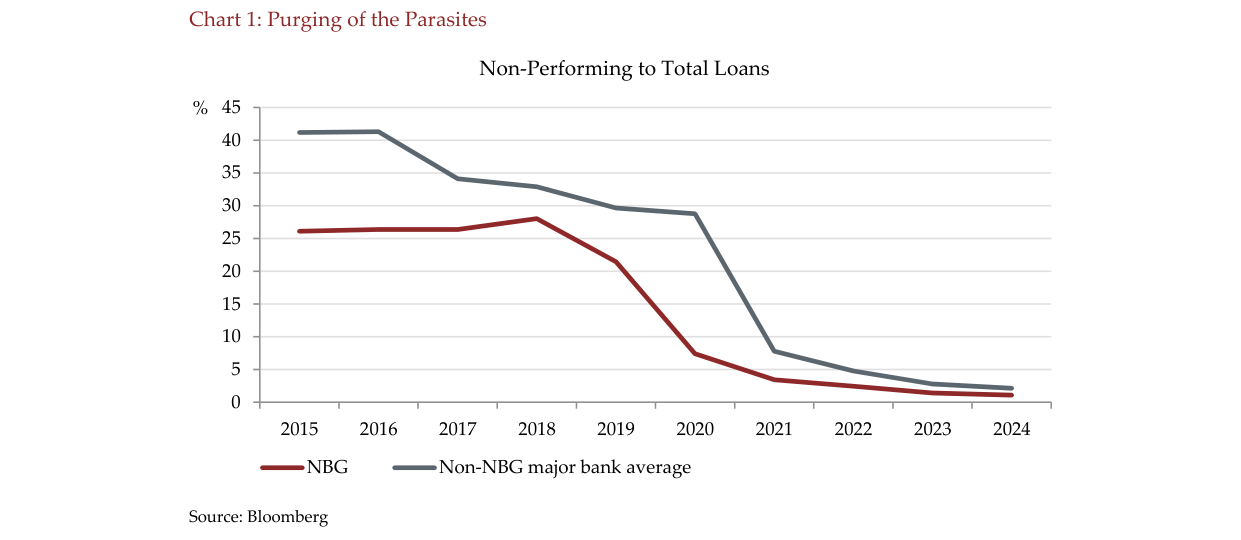
NBG's NPL ratio has steadily declined from about 27% in 2015 to about 2% in 2024; the average for non-NBG major banks fell from about 41% to about 3%
| Metric | NBG/Greek Banking Sector | Comparison |
|---|---|---|
| Private Sector Credit/GDP | ~50% | Euro area ~85%, Emerging markets ~65% |
| Loan-to-Deposit Ratio (Industry/NBG) | 69%/64% | Developed markets typically >100% |
| CET1 (NBG) | 17%-19% | Global large bank average is lower |
| Funding Cost (NBG) | 0.17% | Industry-leading |
| Normalized Earnings Yield | 13% (assuming 14% RoE) | Emerging markets/global equities <5-7% |
Companies/Assets Involved
- National Bank of Greece (NBG): The core focus of the report. The author is bullish, citing the lowest cost, simplest business, and most conservative Greek bank; sustainable RoE in the low double digits (11-14%); initiating share buybacks at below book value and returning cash; no major overseas acquisitions, clear strategy; capital adequacy and NPL coverage are both the highest in Greece.
- Alpha, Eurobank, Piraeus: The other three major Greek banks, which together with NBG control 95% of system assets. The report does not analyze them individually but mentions them in the context of industry structure.
- Marathon Asset Management: A research source holding NBG. The author quotes its analysis, believing that capital quality ratios are overstated by DTCs but the trend is improving.
Investment Implications
- High Returns Under Low Growth Expectations: Through earnings yield and growth rate scenario analysis, the report indicates that NBG's current valuation embeds a "margin of safety." Even if economic growth falls short of management's forecast, core cash returns (dividends + buybacks) already cover most of the expected return.
- Structural Advantages Over Interest Rate Cycles: The ECB has cut rates to 2%, compressing asset yields in the near term, but the report emphasizes that NBG's low-cost deposit base and conservative management allow it to better absorb shocks and maintain attractive risk-adjusted returns.
- Ignoring Capital Quality Improvement Is a Risk: If the market undervalues NBG based solely on the large DTC share, it overlooks the rapid decline in DTCs and the certainty of internal capital generation. This "undervaluation" itself is a window for investors to position.
- Investment Direction: Favor buying or adding to NBG, as its valuation still reflects a "crisis bank" pricing (book value) rather than a post-repair bank generating steady returns. The author believes the market will eventually recognize this transformation.