Whitbread (March 2025)
The Capital Cycle is the official podcast that Marathon Asset Management (the London firm founded in 1986) launched in 2024, hosted by financial historian Edward Chancellor, who interviews Marathon's investors about each Global Investment Review letter — applying the firm's long-term, contrarian "capital cycle" supply-side approach.
In plain words
This report looks at how the UK hotel industry changed after COVID. Many small hotels closed for good, and high interest rates make it hard to build new ones. Meanwhile, demand is almost back to pre-pandemic levels. That means the hotels that survived can raise prices and earn more. Premier Inn (owned by Whitbread) is in a strong position because it has little debt and can afford to expand, while rivals like Travelodge are stuck with heavy debt. Whitbread's stock price is still where it was before COVID, with a price-to-earnings ratio of just 14. The market doesn't seem to fully appreciate its advantage. In short: supply is tight, demand is recovering, and the leader is cheap.
The UK hotel industry has faced supply contraction after the pandemic: from 2019 to 2021, the number of rooms fell from 715,000 to 685,000, the lowest since 2013, with approximately 70% of the lost supply permanently exiting due to conversion into residential properties. Travelodge (the second large
Theme and Background
This chapter analyzes the structural supply contraction experienced by the UK hotel industry after the pandemic, and the investment opportunities this capital cycle change presents for leading companies. The market context: the pandemic in 2020-2021 caused a sharp drop in hotel occupancy rates and high industry debt, leading a large number of small independent hotels to exit, while demand is gradually recovering to pre-pandemic levels. High interest rates and a construction cycle of 5-6 years further restrict new supply from entering the market.
Core Thesis
The report's core investment argument is: In a capital cycle of supply contraction and demand recovery, industry leaders with strong balance sheets and the ability to continuously expand (such as Whitbread's Premier Inn) are poised to gain market share and enhance pricing power, making them the best investment targets in the current UK hotel industry.
Counter-intuitive point: Whitbread's share price remains at pre-pandemic levels (absolute share price has not increased), yet the valuation is only 14 times P/E; the market has not fully priced in its structural advantages.
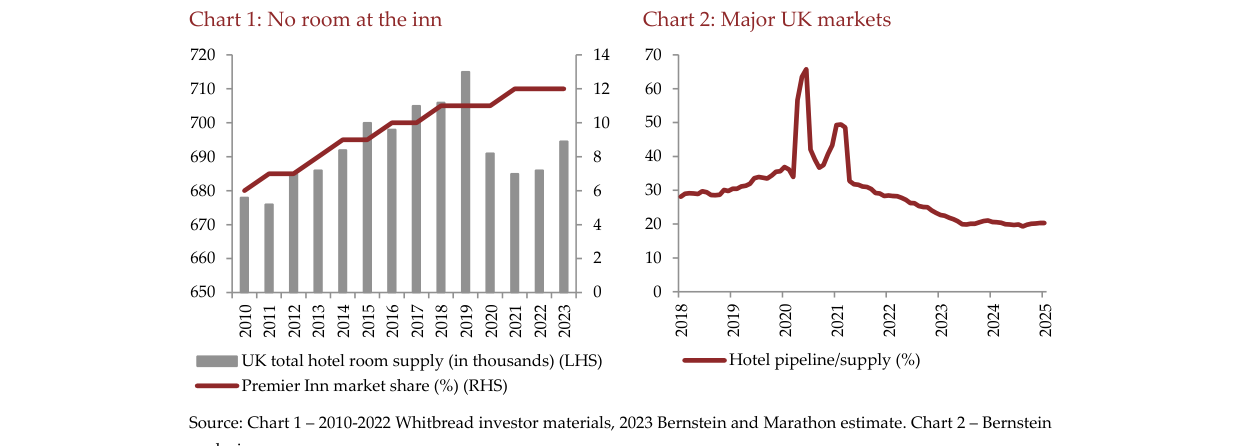
Total UK hotel room supply fluctuated between 680,000 and 715,000 rooms from 2010 to 2023, peaking in 2019 and then falling back to 695,000 rooms; Premier Inn's market share steadily rose from approximately 6% to approximately 12%
Key Arguments and Data
1. Supply-side Contraction Magnitude: From 2019 to 2021, the number of UK hotel rooms fell from 715,000 to 685,000 (a decrease of 4%), the lowest since 2013. Approximately 70% of the lost supply was permanently removed from the market due to conversion to residential use.
2. Competitors' Difficulties:
- Travelodge (second largest UK hotel group): Net debt at the start of 2020 was approximately £350 million (excluding leases), 3 times 2019 EBITDA; forced to raise approximately £200 million to improve liquidity, and its original plan to increase rooms by 10% was delayed.
- Whitbread (Premier Inn operator): Raised £1 billion through a rights issue (equivalent to 1.8 times FY20 EBITDA), moving from historically moderate leverage (approximately 1x EBITDA) to a net cash position, allowing it to maintain investment during the pandemic.
3. Expansion Comparison:
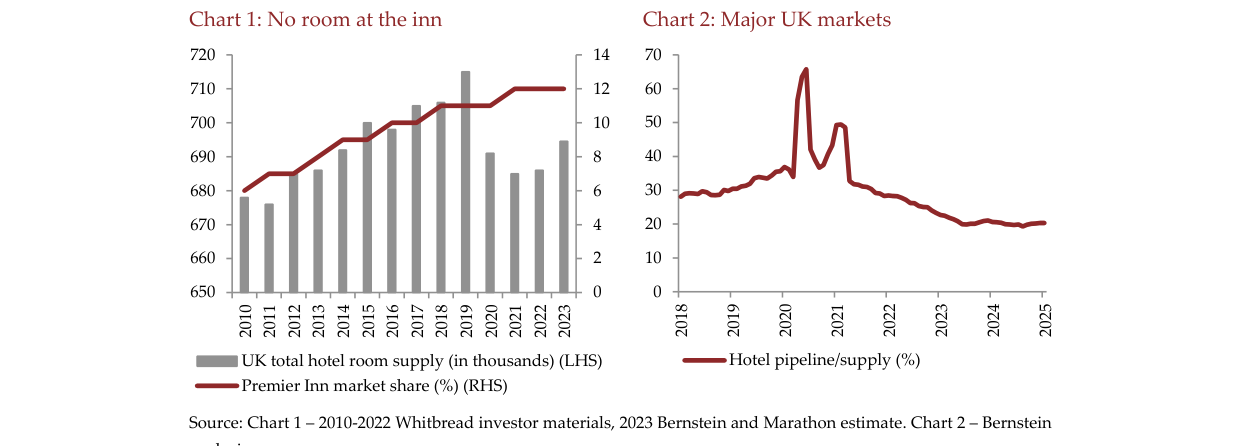
Ratio of hotel pipeline/supply in major UK markets surged from approximately 30% in 2018 to a peak of approximately 65% in 2020, then fell back to an estimated 20% by 2025
| Indicator | Premier Inn (2019-2023) | Travelodge (2019-2023) |
|---|---|---|
| Room Growth | 10% | 3% |
| Planned New Rooms (by 2030) | 11,500 rooms (+13%) | Not specified |
4. Profitability Comparison (ROCE):
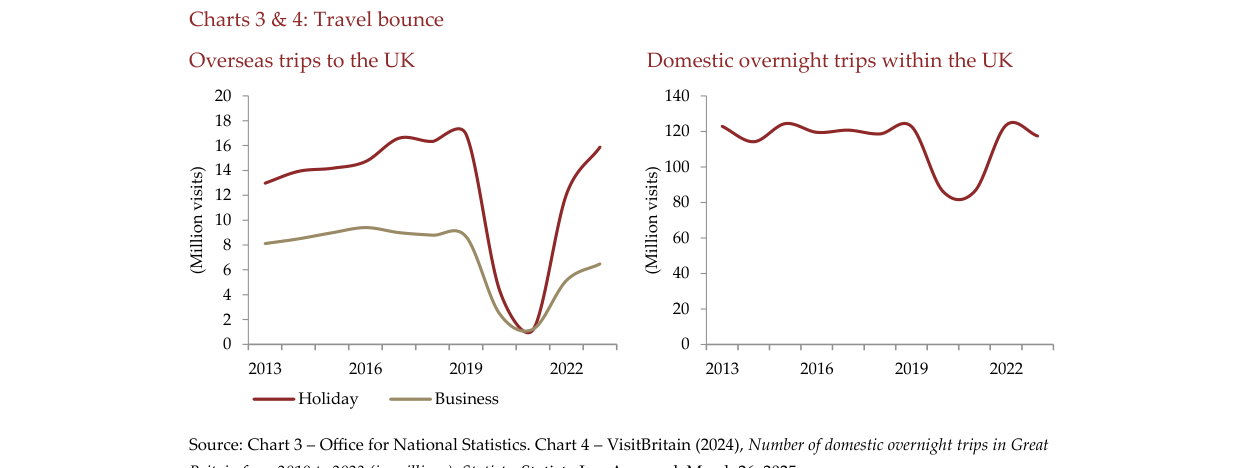
UK domestic overnight trips fluctuated from approximately 120 million in 2013 to approximately 125 million in 2022, plummeting to approximately 80 million in 2020 due to the pandemic before rebounding quickly
| Hotel Brand/Type | Average ROCE |
|---|---|
| Premier Inn | 10%+ |
| Independent Operators | 3% |
| Majority of Chain Brands (e.g., Marriott, Hilton, etc.) | Mid-to-high single digits (e.g., 5-9%) |
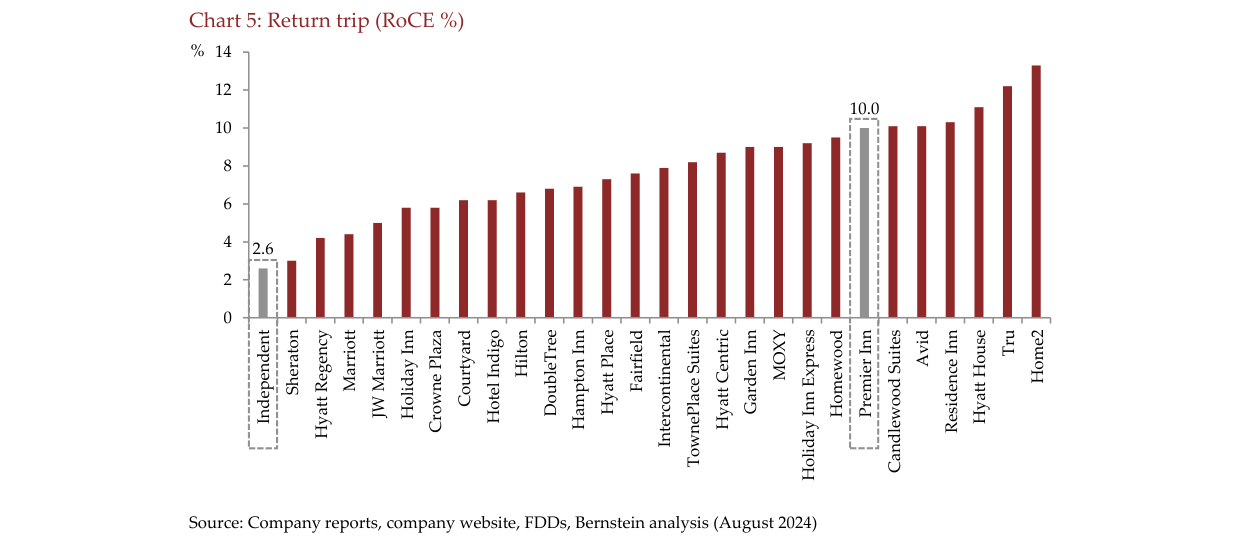
Comparison of return on capital employed (RoCE) across hotel brands shows Independent at only 2.6%, Premier Inn at 10.0%, and Home2 at the highest approximately 13%, significantly above the industry average
5. Cost Advantages: Direct booking reduces reliance on OTAs, avoiding 10-15% commissions; standardized room design lowers cleaning costs; cross-trained employees improve efficiency.
6. Demand Side: Overseas visitor arrivals to the UK and UK domestic overnight trips are both close to pre-pandemic levels; business travel is structurally reduced due to video conferencing, but this is offset by leisure demand.
7. Valuation: Whitbread's current P/E is 14 times, with the share price still at pre-pandemic levels (as of the writing of the report).
Companies/Assets Involved
- Whitbread plc (Premier Inn): Protagonist, bullish. The largest UK hotel brand, with excellent operational efficiency, ROCE above 10%, and the ability to expand through conservative financial management; plans to add 11,500 rooms (+13%) by 2030. It is also expanding in Germany (where independent hotels have a higher share), potentially replicating its UK success.
- Travelodge: Bearish. Hampered by high debt, expansion has stalled and market share is being lost.
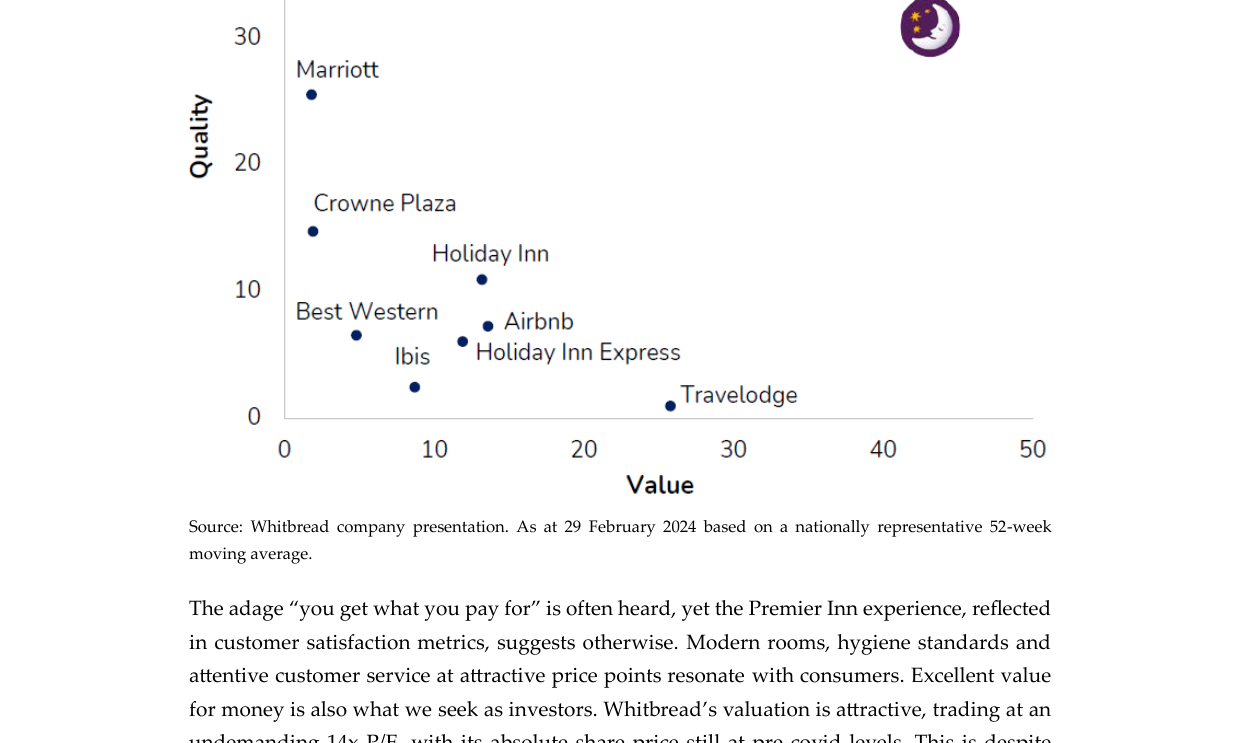
In the hotel quality-value matrix, Premier Inn leads with a high value score of approximately 45 and a quality score of approximately 32, outperforming competitors such as Hilton (approx. 35 quality/5 value) and Marriott (approx. 27 quality/3 value)
Investment Implications
- Direction: Buy Whitbread. (The report explicitly states "Whitbread is our preferred way to get exposure to the UK hotel capital cycle.")
- Logic: Supply contraction + demand recovery = enhanced pricing power; Whitbread, leveraging its balance sheet strength, can expand counter-cyclically and capture market share; valuation of 14x P/E (share price not rising) provides a margin of safety.
- Risk Points: Structural weakness in business travel demand; uncertainty over whether the Germany expansion can replicate the UK model.