Rolling in the Deep: The Capital Cycle in PGMs
Hosking Partners is a London boutique founded in 2013 by Jeremy Hosking, a portfolio manager at Marathon Asset Management for over 25 years. It runs a single global equity strategy built on the capital-cycle, supply-side approach — contrarian, long-term, and unusually diversified (350+ holdings) under a multi-counsellor model, managing around $5.5bn.
In plain words
This report says the platinum group metals (PGM) industry has under-invested for a decade, and electric vehicle (EV) adoption is slower than expected, creating a supply shortage and deeply undervalued stocks. Hosking Partners is bullish, betting the market is too pessimistic. They own five companies: Impala Platinum (its smelter would cost $8-10 billion to rebuild, but the whole company is worth only $4.5 billion), Anglo American Platinum (on sale because its parent must sell it), and Northam Platinum (quadrupled output without issuing new shares). The bet: supply deficits will lift prices, giving multi-bagger returns.
At a Glance
One-sentence summary of the author's market view this period: The platinum group metals (PGM) industry, due to a decade of underinvestment and the suppression of the electric vehicle narrative, presents a contrarian investment opportunity where supply shortages and deep value coexist, with stock prices having multiple times upside potential. [Bullish]
- Through on-site research at South African PGM miners, the author confirms the industry has been underinvested for a decade, with primary supply shortages persisting into the 2030s.
- Current PGM stock prices already reflect unsustainably low prices and short asset lives, representing deep value. For example, Impala Platinum's smelting asset replacement cost ($8-10 billion) is nearly double its enterprise value ($4.5 billion).
- The electric vehicle narrative is being corrected by reality: In September 2024, global (ex-China) pure EV penetration was flat year-on-year, European EV sales fell 44% year-on-year, while hybrid vehicles' PGM loading is 15% higher than traditional ICE vehicles.
- The author adopts a diversified basket approach, investing in five PGM producers (Impala Platinum, Anglo American Platinum, Northam Platinum, Sibanye Stillwater, Sylvania Platinum) to diversify individual risks and capture multiple returns from supply shortages.
- The industry's endgame is further consolidation, with South African-listed PGM miners expected to shrink from five to two or three. The author will lobby management to drive this process.
Return on Capital Drives Long-Term Returns, Not Future Narratives
The article opens by laying out its core framework: the capital cycle theory holds that what determines investors' long-term returns is a company's return on capital, not the story around future earnings. The author quotes Adele's lyrics "There’s a fire starting in my heart / Reaching a fever pitch and it’s bringing me out the dark" as a metaphor for rising market sentiment, but the Hosking Partners team remains wary of the "new paradigm" narrative. The author states: "The capital cycle complements this contrarianism and is built upon the observation that, over the long run, a company’s return on capital, not a story around future profitability, determines investor returns." The author emphasizes that focusing on measurable industry capacity or supply, rather than forecasts of demand (which are inherently stories about the future), is key to understanding capital flows.
Field Research Confirms a Decade of Underinvestment in the PGM Industry, with Supply Shortages Extending into the 2030s
Through on-site research at South African platinum group metals (PGM) miners, the author confirms that the industry has been underinvested for a decade, and structural primary supply deficits will persist into the 2030s. The team traveled to South Africa's Rustenberg platinum belt, meeting with management from the four major producers—Northam Platinum, Impala Platinum, Sibanye Stillwater, and Anglo American Platinum—and descended over 1 kilometer into Sibanye Stillwater's K4 Marikana mine. The author states: "From an investment perspective, we came away with a clear picture: the industry has under-invested for a decade. Primary supply deficits are structural and run into the 2030s." The underground experience also shattered the author's stereotypes about deep-level non-mechanized mining—approximately 40% of K4 mine employees are women, the working environment is well-ventilated and brightly lit, and it showcased stakeholder capitalism practices in South Africa's mining industry in the post-Marikana tragedy era.
Stock Prices Already Discount Unsustainably Low Prices and Short Asset Lives, Falling into Deep Value
Although PGM prices are under pressure due to the electric vehicle narrative, the author judges that current stock prices already discount persistently low prices and unrealistically short asset lives, placing them firmly in the deep value category. The article notes that 65% of PGMs are used in internal combustion engine vehicle catalysts, and the market has depressed prices due to the EV narrative. However, the author believes that the replacement cost of above-ground smelting and refining assets provides a significant margin of safety, and if PGM prices return to historical norms (relative to precious metals), there is multi-bagger upside. The author writes: "Equity prices, however, discount continued low prices, unfeasibly short asset lives of PGM mines and are firmly in the ‘deep value’ category." The author cautions that this is a position-holder's perspective, and readers should be aware of the potential divergence between narrative and fundamentals.
Investment Implications
The implied operational implication of the article is that current PGM miner stock prices have already over-discounted pessimistic expectations, and if supply shortages drive prices back to historical norms, there is significant upside. However, it should be noted that this is the view of Hosking Partners as a position-holder, whose capital cycle framework naturally favors supply-constrained industries, and the long-term substitution risk from electric vehicles has not been entirely dismissed.
Demand Narrative Suppresses Prices, but EV Penetration Shows Signs of Fatigue
The current low PGM prices are primarily driven by the narrative of rapid EV substitution for ICE vehicles, but actual data already reveals cracks in this narrative. According to the World Platinum Investment Council (WPIC), approximately 65% of PGMs are used in catalysts for ICE vehicles. The author notes that the market broadly expects EVs to follow an S-curve and rapidly replace ICEs, thereby compressing the PGM demand window to just about a decade. However, the article cites CLSA analyst data stating: "as of September 2024, YoY global battery electric vehicle penetration is flat ex-China." The author argues that all demand forecasts are inherently unreliable, and the negative PGM demand narrative—compounded by OEM supply chain issues, excess recycled materials, and concerns over Russian "inventories"—has driven the PGM price basket to generational lows, creating an opportunity for contrarian investors.
Platinum at Historic Lows Relative to Gold, with a Decade of Underinvestment in Capex
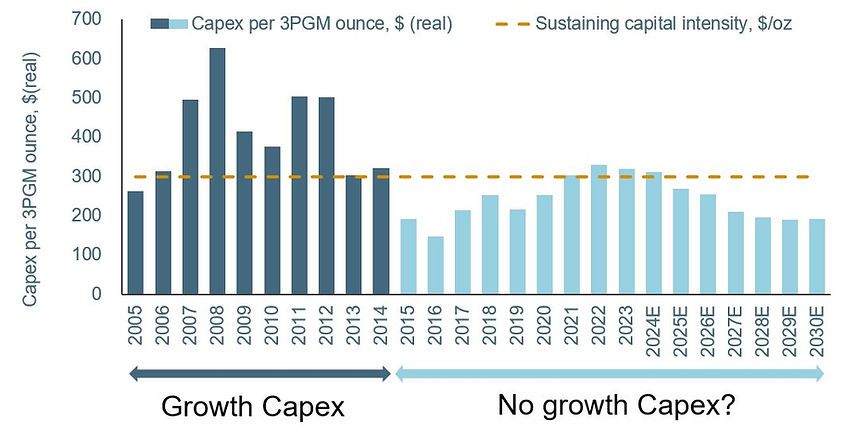
Platinum prices have fallen to an extreme low of a 1:1 historical ratio with gold, while long-term underinvestment in industry capex sets the stage for supply shortages. The author points out that annual platinum production is roughly 1/15th that of gold, yet platinum currently trades at $1,003/oz versus gold at $2,720/oz, offering a significant margin of safety. Since 2014, growth capex in the PGM industry has steadily declined, averaging about $240/oz over the past decade—roughly $175/oz lower than the prior decade. The author calculates that the industry has cumulatively underspent on sustaining capex by approximately $18 billion, while the total market capitalization of South African-listed PGM companies stands at just $21 billion. The author emphasizes: "the $18bn cumulative capex underspend is a Mount Everest of an obstacle to overcome." This reflects a core lesson of capital cycle analysis: at the trough of the cycle, low valuations themselves constrain industry expansion.
Supply Deficit Already Apparent, Current Prices Unsustainable
The PGM market is already facing a supply-demand deficit of up to 15%, but low prices are forcing high-cost capacity to exit. The article notes that primary PGM supply has been declining since peaking in 2007, while demand only peaked in 2019. In 2024, primary platinum supply (5.5 million oz) plus recycling (1.5 million oz) still leaves a shortfall of about 1 million oz; for palladium, after Sibanye Stillwater closed the Stillwater West mine (reducing output by 200,000 oz, roughly 3% of annual production), the deficit approaches 1.5 million oz. The author asserts: "the PGM market is in deficit of up to 15% of primary and recycled material in the short and medium term." At current prices, roughly one-third of PGM miners are operating at a loss, and despite high exit barriers, supply contraction is already underway. Geopolitical and infrastructure obstacles in South Africa, Zimbabwe, and Russia make new capacity additions extremely difficult. The author estimates that PGM prices would need to rise by 50% to incentivize meaningful new production capacity.
Deep Value: Asset Replacement Cost Far Exceeds Market Cap
PGM miners are valued below the replacement cost of their core assets, offering a substantial margin of safety. The author uses Impala Platinum as an example: management states that merely replicating its smelting and refining assets would require $8-10 billion, while the company's current enterprise value is only $4.5 billion. The author notes that investors are effectively buying one of the industry's two major smelting assets (with significant strategic value) at 50 cents on the dollar, and receiving for free 55 million oz of proven PGM reserves (roughly 20 years of production) plus an operating business that generated $1.1 billion in free cash flow annually over the past five years. The article also mentions Northam Platinum, Sibanye Stillwater, and Anglo American Platinum, but does not provide similar specific valuation analyses for them. The author believes that the industry, due to its capital intensity, exposure to ICEs, and location in South Africa, is easily overlooked by global investors, but valuations have compressed to levels far below replacement cost, representing deep value.
Investment Implications
Through the capital cycle framework, the author argues that the PGM industry, due to prolonged underinvestment and a suppressed demand narrative, now sits in a deep-value zone characterized by supply shortages and low valuations. The core thesis is that current stock prices already discount unsustainably low prices and short asset lives; if PGM prices revert to historical norms, there is potential for multiple-fold upside. However, it should be noted that this is a long-position perspective, and the author's optimistic interpretation of slowing EV penetration may underestimate the long-term trend of technological substitution. Additionally, South African operational risks (electricity, politics, labor) remain persistent discount factors.
The EV Narrative Is Being Corrected by Reality, PGM Demand May Prove More Resilient Than the Market Expects
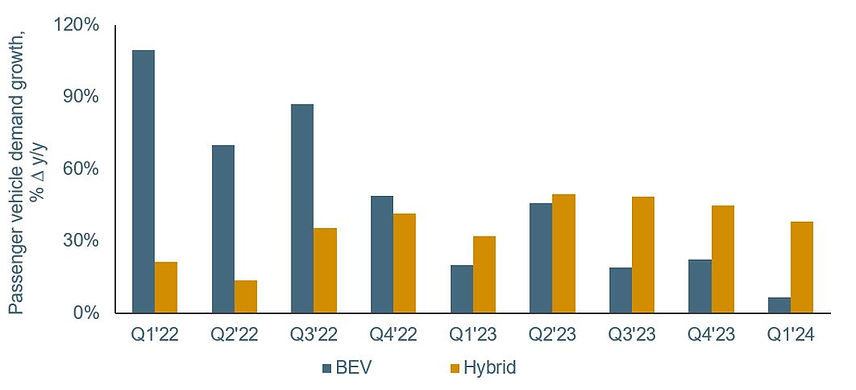
The report argues that the pace of electric vehicle (EV) adoption is far slower than market consensus, and the demise of the internal combustion engine (ICE) has been greatly exaggerated, providing support for PGM demand. The author cites Rob West of Thunder Said Energy, who analyzed data on the 50 best-selling ICE and EV models in the U.S. in 2024, noting that "EVs are 50% more expensive than comparable ICEs with an average sticker price of $47k, or equal to approximately one year, post tax average household income." Additionally, when factoring in full-cycle operating costs including depreciation and battery life, EVs are roughly 40% more expensive than ICEs. Consequently, the highest EV adoption rate is among U.S. households earning over $250,000 annually, and EVs are often purchased as a second vehicle; the lower the income, the steeper the decline in EV acceptance. The author believes that for EVs to achieve full fleet penetration, they must be widely adopted by lower-income groups.
The author further points out that the sharp slowdown in EV sales in the Western world—European EV sales fell 44% year-over-year in August 2024—is a major warning sign, suggesting that the EV adoption curve is unlikely to replicate the 10-year, 0-to-100% penetration path of refrigerators or televisions in the U.S. in the 1960s. Those technologies offered "day and night improvements," whereas range anxiety and expensive charging (especially for those without home charging access) limit the advantages of EVs. The author poses a hypothesis: "Perhaps we should entertain the idea of a world in which EVs end up penetrating the higher income segments of two thirds of the developed world population?" If so, this would be a positive for PGM demand.
Moreover, hybrid vehicles carry 15% more PGM loading than traditional ICEs and are becoming the choice for unsubsidized consumers. Even in China, where EV pricing and infrastructure are most favorable, all EV growth over the past two years has come from plug-in hybrids (PHEVs), which still feature an ICE engine. The author questions: "If EV demand is plateauing in China, could it have peaked in the rest of the world?" If so, PGM demand could rise in the near term.
Capturing Multi-Bagger Returns from Supply Shortages via a Diversified Basket of PGM Producers
Leveraging the advantage of its diversified portfolio, Hosking Partners has constructed a basket of five PGM producers to diversify the idiosyncratic risks of individual mines while retaining exposure to the industry's supply outlook. The author notes that small and mid-cap mining stocks are difficult to hold in more concentrated portfolios due to the high and specific geological, political, or labor risks of individual mines; diversification serves as a risk mitigation tool, allowing investment in "less popular but no less compelling areas." Their approach is "approximately right," achieved through a basket of five PGM producers.
Among these five companies, four are South African junior producers with reserves sufficient to sustain at least 20 years of production—but only if the PGM basket price rises significantly from its current level of around $1,000. At current prices, the basket's return on invested capital is in the mid-single digits (below the cost of capital in rand terms), with a one-year forward EV/EBITDA multiple of roughly 4x. The author points out that if platinum were to revert to its historical 1:1 price ratio with gold, the potential earnings multiples of these companies would fall below 1x.
Each company in the basket has distinct characteristics, collectively forming a risk-diversified portfolio with substantial upside potential:
| Company | Key Features as Described by the Author |
|---|---|
| Impala Platinum | Largest holding, representing a roughly 50% discount to replacement cost opportunity |
| Anglo American Platinum | Owns the highest-quality "trophy asset" mines, and is being sold at a discount as parent company Anglo American is forced to divest its 75% stake |
| Northam Platinum | One of the strongest balance sheets in the industry, growing production from 250,000 oz to 1 million oz over the past 10 years without issuing new shares |
| Sibanye Stillwater | Heavily indebted (due to some questionable battery metals acquisitions), but offers the highest leverage to a basket price recovery |
| Sylvania Platinum | London-listed, a chrome tailings processor recovering PGMs at low cost, with a market cap of just $165 million, net cash of $100 million, and normalized profitability of $25-30 million |
The author concludes: "All in, we feel the substantial individual risks associated with each company are dispersed within the basket and believe that these stocks offer multi-bagger potential in a recovering basket price scenario."
Investment Implications
The report presents a clear contrarian investment thesis: the market has undervalued PGM demand prospects due to the EV narrative, but real-world data (high EV costs, slowing adoption, the rise of hybrids) is challenging this consensus. Hosking Partners is betting on PGM supply shortages and price normalization through a diversified basket, with its core margin of safety coming from the replacement cost of above-ground smelting assets. Institutional bias note: The author is a position holder, and the argument deliberately downplays the long-term disruptive risk of EVs while emphasizing the superiority of its own diversification strategy. Readers should be aware that if EV technology breakthroughs or policy acceleration occur, this logic could break down.
At a Glance
The industry's endpoint is further consolidation, with 30% of mining companies operating at a loss, forcing capacity to be shuttered.
After a week-long field survey in South Africa, the author concludes that the platinum group metals (PGM) industry, regardless of price trends, will ultimately move toward a more concentrated structure. Currently, 30% of mining companies are losing money on a single-mine basis, and the short-term priority is survival through further capacity closures and the cancellation of growth projects. Over the long term, the extensive overlap of mining areas and the significant synergies in smelting and processing cannot be ignored. In 2016, there were eight listed PGM mining companies in South Africa; now there are only five. The author believes this is not the end and expects the number to shrink to two or three in the coming years, with plans to lobby management to make this happen. The decision by industry leader Anglo American Platinum to separate from its London-listed parent company will be key. Citing Sibanye Stillwater's 2018 acquisition of Lonmin as an example, the author notes that mergers not only benefit shareholders but also bring business stability, improved wages, and a more solid tax base. The author's original statement: "We expect to see that number move toward two to three in the coming years and will be lobbying management to make this happen."
Underground Field Experience Reinforces the Sense of Crisis, Supply Shortages Create a Window for Consolidation
After personally going underground to speak with miners, the author deeply realized that the industry cannot afford to waste this crisis. Even under a scenario of rapid price increases, primary supply shortages will persist until 2030. Over the next year or so, management has an opportunity to create lasting economic value beyond a rise in the PGM basket price. The author concludes: "We have come for the supply deficits, but we will stay around if the industry consolidates. We are, for now, in deep!" This implies that the author has already taken a heavy position and is anticipating additional returns from consolidation.
Investment Implications
The author is clearly bullish on the consolidation prospects of South African PGM mining companies, believing that the current industry distress (30% losses, supply shortages) provides a window for management to create value. Institutional bias: As a position holder, the author's statement of being "in deep" suggests a heavy allocation, and readers should be aware that the optimistic outlook may contain a self-reinforcing bias. Whether the consolidation expectations materialize depends on Anglo American Platinum's post-split decisions and the support of the South African government and unions.
Position Moves
| Ticker | Direction | Author's One-Sentence View | Key Data |
|---|---|---|---|
| Impala Platinum | Hold for Observation | Largest position, representing roughly a 50% discount to replacement cost | Smelting asset replacement cost $8-10 billion, enterprise value only $4.5 billion; holds 55 million ounces of proven reserves (approximately 20 years of production) |
| Anglo American Platinum | Hold for Observation | Owns the "prime location" with the best ore quality, and is being "sold at a discount" due to the parent company's forced divestiture of 75% stake | No specific valuation data provided |
| Northam Platinum | Hold for Observation | One of the strongest balance sheets in the industry; production increased from 250,000 ounces to 1 million ounces over the past 10 years without issuing additional shares | No specific valuation data provided |
| Sibanye Stillwater | Hold for Observation | Heavily indebted (due to battery metals acquisitions), but has the strongest leverage to a basket price recovery | Closed the Stillwater West mine, reducing production by 200,000 ounces (approximately 3% of annual output) |
| Sylvania Platinum | Hold for Observation | Listed in London, low-cost recovery of PGMs from chrome tailings, with ample net cash | Market cap only $165 million, net cash $100 million, normalized profitability $25-30 million |