Knock on Wood (September 2026)
The Capital Cycle is the official podcast that Marathon Asset Management (the London firm founded in 1986) launched in 2024, hosted by financial historian Edward Chancellor, who interviews Marathon's investors about each Global Investment Review letter — applying the firm's long-term, contrarian "capital cycle" supply-side approach.
In plain words
This report says lumber supply has dropped to a 10-year low while the US faces a severe housing shortage, so demand could outstrip supply when it recovers. The author is bullish on lumber long-term, arguing timberland is undervalued. Key holdings: Rayonier and Weyerhaeuser, whose timberland is valued at only about $2,000 per acre, which the author sees as too cheap.
At a Glance
One-sentence summary: The author is long-term bullish on timber, arguing that supply has fallen to a decade low and that once demand recovers, shortages will emerge, while current timberland asset values are undervalued. [Bullish]
- North American timber supply has declined for four consecutive years, hitting a decade low, while the U.S. housing shortage stands at 3.7 million units, creating a massive supply-demand gap.
- Canada's share of timber supply has dropped from 45% to 32%, and the cost of building a new sawmill has risen to approximately $200 million, structurally constraining supply.
- Timber accounts for only 3% of home construction costs and 2% of sale prices, creating an asymmetric dynamic where a critical input represents a minimal share of customer budgets.
- Timberland assets are valued at roughly $2,000 per acre, while the historical gold-to-timberland ratio shows capital flowing toward gold, leaving timberland undervalued.
- The NCREIF Timberland Property Index posted an annualized return of 10.2% from 1989 to 2023, outperforming the MSCI World Index's 8.8%, with lower volatility.
At a Glance
Lumber supply has fallen to a ten-year low, marking the fourth consecutive year of decline. Data from West Fraser, North America's largest lumber producer, shows net lumber supply has decreased by 1.6% annually over the past two decades. On the demand side, the U.S. housing market remains weak, with existing home sales this year at just 4 million units—near a thirty-year low—and new housing starts at 1.2 million units. Freddie Mac estimates that since the financial crisis, the U.S. has underbuilt 3.7 million homes. Industry analysts expect no significant recovery in construction activity in the near term. The report argues that if new housing starts recover to the 1.5–1.6 million units needed to meet demand, it would require more lumber than is currently available, and the industry has spent four years cutting supply capacity. Lumber accounts for only 3% of the average home construction cost and 2% of the sale price, creating an asymmetric dynamic where a critical input represents a minimal share of the customer's budget.
Three Structural Factors on the Supply Side Suppressing Output
Canada's supply share has dropped from 45% to 32%, and the cost of building a new sawmill has risen to approximately $200 million. First, British Columbia has seen a sharp decline in harvest volumes due to the mountain pine beetle infestation, mill closures, and tariffs. Second, the construction cost for a sawmill with an annual capacity of 250 million board feet is about $200 million—75% higher than pre-pandemic levels—and requires a supply of 1 million tons of sawlogs (2–4 million trees) per year, with a three-year build time and only two major equipment suppliers remaining. Third, revenue from byproducts such as wood chips and sawdust (accounting for 10–20% of mill revenue) has been in long-term decline due to the disappearance of paper demand, disproportionately impacting profit margins. The author concludes: "Marathon is long-term bullish on lumber."
Timberland Asset Values Are Undervalued, at Approximately $2,000 per Acre
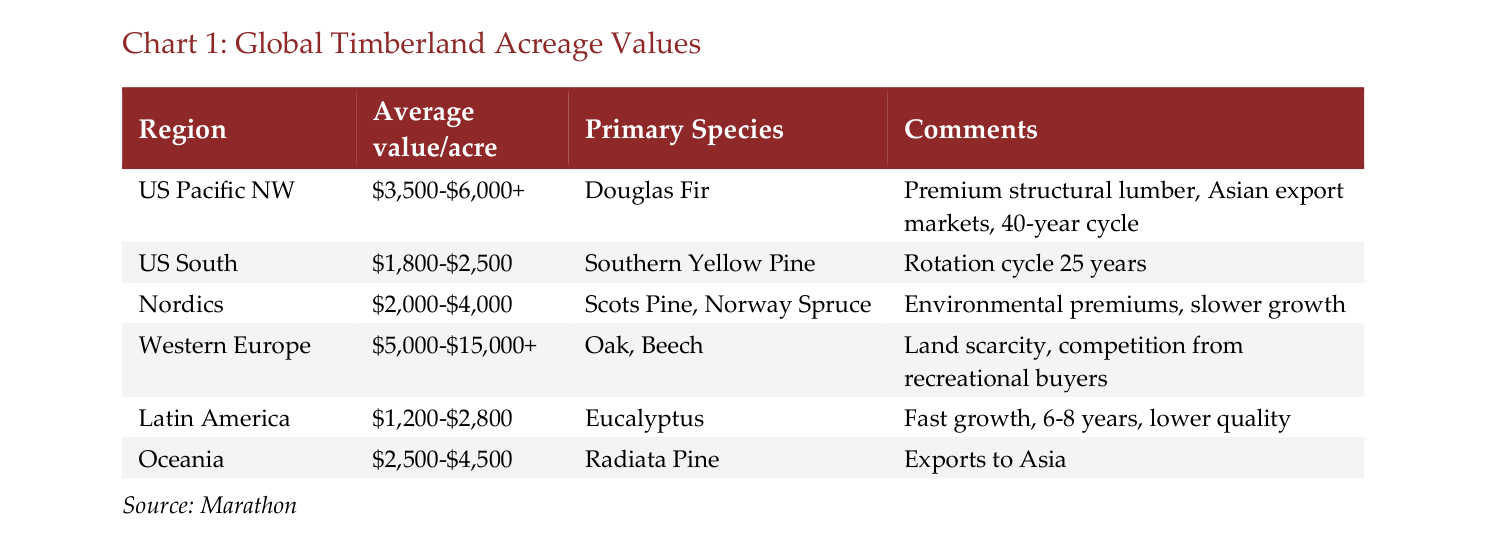
Rayonier and Weyerhaeuser together have an enterprise value of $28 billion, with per-acre valuations only slightly above $2,000. Southern U.S. pine timberland costs about $2,000 per acre (with a rotation cycle of over 25 years), while Douglas fir timberland in the Pacific Northwest can cost twice as much (with a 40-year rotation cycle). Southern log prices have remained in the $20-per-ton range for over a decade due to oversupply from overplanting in the 1990s. The author believes that even bare "cutover" land, without trees, could be worth $1,500 per acre. Returns from timberland come from harvest income, improvements in forestry productivity, higher-value land uses (real estate, solar leases, carbon capture—which can increase land values by 5–15 times), and land appreciation. The NCREIF Timberland Property Index posted an annualized return of 10.2% from 1989 to 2023, outperforming the MSCI World Index's 8.8%, with lower volatility (9.6% vs. 17.4%). Currently, one ounce of gold can buy 2.5 acres of Southern timberland, compared to a historical average of 0.7 acres, indicating capital is flowing toward gold rather than timberland.
Position Moves
| Position | Action | Key Data and Rationale |
|---|---|---|
| Rayonier | Hold and observe | Enterprise value of approximately $28 billion (combined with Weyerhaeuser), per-acre valuation around $2,000, timberland asset values are undervalued |
| Weyerhaeuser | Hold and observe | Same as above, timberland asset values are undervalued, lumber and wood products business not priced in |
| West Fraser | Not specified | North America's largest lumber producer, data shows net supply declining 1.6% annually |
Position Moves
| Ticker | Direction | Author's One-Sentence View | Key Data |
|---|---|---|---|
| Rayonier | Hold for observation | Timberland asset value is undervalued, with per-acre valuation at only about $2,000 | Combined enterprise value with Weyerhaeuser at $28 billion |
| Weyerhaeuser | Hold for observation | Same as above; lumber and wood products business remains unpriced | Same as above |
| West Fraser | Not explicitly stated | North America's largest lumber manufacturer; data shows net supply declining 1.6% annually | Net lumber supply has declined 1.6% annually over the past two decades |