← 返回列表
Hosking Partners26 May 2025

Metamorphosis

作者: Omar Malik
Metamorphosis

AI 中文摘要

本期播客的核心论点是:市场对欧洲化学品行业极度悲观,导致其估值已跌至重置成本以下,这为具备长期资本配置纪律的优质公司创造了重大投资机会。当前行业正经历一场由能源危机、去库存和地缘政治引发的“完美风暴”,导致盈利处于近15年低位。然而,供给侧正在发生深刻变化:欧洲约20%的裂解产能已被关闭或计划关闭,北美和中国的新增产能浪潮也已放缓,这预示着资本周期的转折。一旦需求复苏,供给端的约束将驱动盈利强劲反弹。播客重点提及了Hosking Partners投资组合中的四家公司(朗盛、Synthomer、禾大、利安德巴塞尔),认为它们通过聚焦高附加值特种化学品、优化资产组合和审慎资本配置,有望在周期上行时实现超额回报。

研究报告原文

Metamorphosis: The capital cycle in

European chemical stocks trade below the cost of rebuilding their plants, reflecting extreme  pessimism after energy shocks and inventory destocking. As European re-industrialisation, green demand and constrained new capacity converge,  earnings and ROIC could rebound sharply from today’s cyclical trough. We favour names that are reallocating capital from commoditised units to higher-margin,  lower-carbon specialties, signaling disciplined, responsible, and forward-looking leadership.

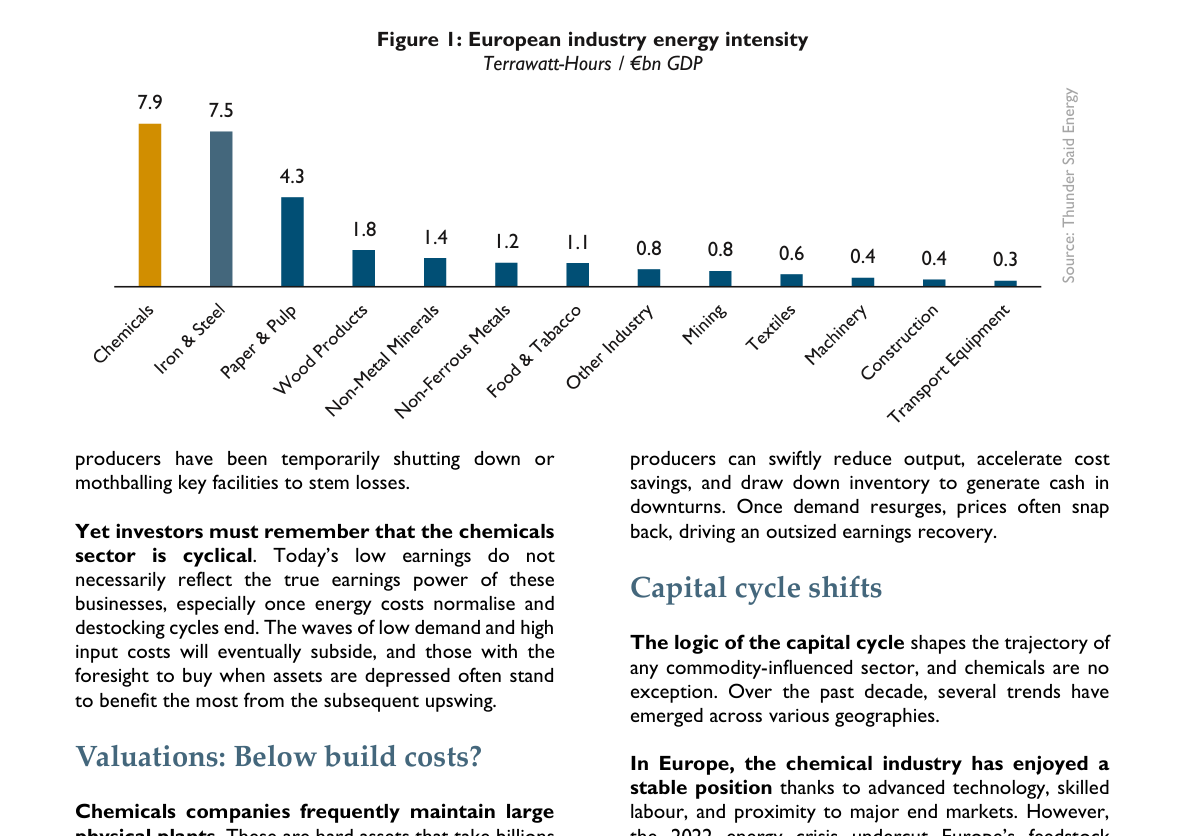
“Omnia mutantur, nihil interit.” responsible investment. Whether it is by reducing the (Everything changes, nothing perishes.) energy intensity of production, meeting demand for more sustainable products, or repurposing legacy assets for the Ovid challenges of the future – all while exhibiting capital allocation discipline – we believe these companies are Alchemy, the speculative precursor to modern- well-placed to capture the upside as the chemicals cycle day chemistry, sought to turn base metals into rebounds. gold. While that transmutation proved more useful as allegory than practical possibility, the modern chemicals The perfect storm industry is no stranger to transformative change. Today, the industry stands at the nexus of powerful global forces: In the wake of the pandemic, the chemicals the energy transition, geopolitical shifts, and an emerging industry found itself in an almost unprecedented trend towards European re-industrialisation. The predicament. Initially, as global supply chains faltered, products that chemicals companies produce underpin customers stockpiled raw materials: everything from much of modern life – from cosmetics and agriculture to basic feedstocks to high-end specialty chemicals. When medical and packaging – making their survival and supply chains began to normalise, these same customers evolution a matter of strategic importance. reversed course, rapidly destocking their inventories. Meanwhile, the surge in energy prices in 2022, Yet today’s market views European chemical exacerbated by geopolitical tensions, hit the energy- firms with pessimism, expecting sustained pressure intensive chemicals sector hard. This effect was multiplied from energy scarcity, restrictive ESG policies, and in Europe, where (largely Russian) natural gas had geopolitical volatility. These headwinds, accelerated by become both a critical primary feedstock and power the curtailing of Russian pipeline gas since the invasion of source, and where the energy cost per dollar of sectoral Ukraine, have resulted in a perfect storm for the sector, economic output is especially high (see Figure 1, next pushing earnings to near 15-year lows. But beneath the page). surface, a powerful shift is unfolding.

This collision of events represented a ‘double In this article, we explore the rationale behind an whammy’ for chemical manufacturers. First, they investment thesis that sees chemical companies as were forced to sell expensive inventory produced at high potential alchemists ready to conjure renewed value from energy prices. Second, they suffered from reduced a harsh downcycle. The Hosking Partners portfolio is operating leverage, as low utilisation rates meant that invested in a basket of four such companies: Lanxess, fixed costs were spread over fewer units of production. Synthomer, Croda, and LyondellBasell. For executives who have endured multiple recessions, many labelled this the worst downcycle of their careers. These businesses have management teams that Evidence can be seen in Europe’s largest chemical clusters embody the long-term mindset that we value in – such as Ludwigshafen in Germany – where major management teams, and which defines our approach to

Source: Thunder Said Energy 4.3

1.8 1.4 1.2 1.1 0.8 0.8 0.6 0.4 0.4 0.3

producers have been temporarily shutting down or producers can swiftly reduce output, accelerate cost mothballing key facilities to stem losses. savings, and draw down inventory to generate cash in downturns. Once demand resurges, prices often snap Yet investors must remember that the chemicals back, driving an outsized earnings recovery. sector is cyclical. Today’s low earnings do not necessarily reflect the true earnings power of these Capital cycle shifts businesses, especially once energy costs normalise and destocking cycles end. The waves of low demand and high The logic of the capital cycle shapes the trajectory of input costs will eventually subside, and those with the any commodity-influenced sector, and chemicals are no foresight to buy when assets are depressed often stand exception. Over the past decade, several trends have to benefit the most from the subsequent upswing. emerged across various geographies.

Valuations: Below build costs? In Europe, the chemical industry has enjoyed a stable position thanks to advanced technology, skilled Chemicals companies frequently maintain large labour, and proximity to major end markets. However, physical plants. These are hard assets that take billions the 2022 energy crisis undercut Europe’s feedstock of dollars in capital expenditures to build, maintain, and competitiveness. In response, many European players, operate. Yet the four companies in the Hosking Partners have announced closures of older, less efficient cracker portfolio currently trade below the tangible assets capacity (ethylene and propylene production units). Some recorded on their balance sheets. In other words, the industry estimates suggest that as much as 20% of market valuations for some of these firms are effectively Europe’s cracker capacity has been shuttered or pricing them below the cost it would take to rebuild their earmarked for closure over the last year. Beyond cyclical physical infrastructure from scratch. rationalisation, these closures also reflect a strategic shift. In a region increasingly focused on energy security, This is not simply a cyclical bottom, but a sign of industrial resilience, and decarbonisation, we see leading extreme market pessimism. In effect, the market is players selectively exiting commodity petrochemicals to pricing in the possibility that large swathes of the double down on specialty segments aligned with long- European chemical industry may not exist at all in a term demand – serving sectors such as life sciences, decade. And yet a shifting energy and supply chain construction, green materials, and food security. landscape, alongside efforts to rebuild regional industrial capacity, could act as powerful counter-currents to that In the US, the shale revolution led to a wave of consensus view. capacity expansions as cheap natural gas liquids provided a feedstock advantage. Yet the bulk of these In a normalised earnings environment where projects have now come online, and producers are demand is more robust, and feedstock prices stabilise, unlikely to greenlight major new projects until there is earnings could rebound significantly. The chemicals cycle evidence of improved margins. LyondellBasell, for typically reverts more quickly than traditional example, has publicly signalled caution on new build-outs, commodities like copper or iron ore, because chemical opting instead to focus on improving its existing footprint

Figure 1: European industry energy intensity

76% 74% 72%

and returning capital to shareholders. Furthermore, one Time to harvest? of LyondellBasell’s largest competitors, Dow, recently paused construction of its $10 billion cracker in Alberta. Over the last decade, many chemical companies embarked on aggressive M&A sprees, buying up Meanwhile, over the last five years, China has specialty firms and building or expanding plants to carve been the most significant driver of new supply out new markets. Today, confronted by tight capital globally, driven by government ambitions to become markets and lower share prices, management teams seem self-sufficient. As a result, the entire region has been to be entering ‘harvest mode’. Most of these firms have operating around break-even for four years, given soft scaled back capital expenditures for the next several local demand and a lack of regional feedstock advantage. years. In response, 10% of the nameplate Asian ethylene capacity has been taken offline, with the hope that pricing With fewer acquisitions in the pipeline, the will recover. Ultimately, we believe much of this capacity prevailing mood is one of consolidation and will be closed. While China is likely to continue to add optimisation. Executives in our basket have signalled capacity through to the end of the decade, LyondellBasell, that if valuations remain depressed even as earnings the global leader in the technology for new plants, is recover, they are ready to employ buybacks, which could seeing a slowdown in licensing sales in China. drive meaningful per-share value accretion. This shift in capital allocation strategy could also mean higher free Against this backdrop, capital expenditures are cash flow (FCF) generation in the next decade than in the declining across multiple regions: Europe is closing previous one, precisely because companies are not older and less efficient plants due to the energy cost spike spending as aggressively on expansions or acquisitions. and policy headwinds, and capacity utilisation is at Looking at the last 10 years of FCF for each company multiyear lows (see Figure 2, above); North America is relative to its current market cap, Synthomer stands out. nearing the end of a capacity expansion wave sparked by Its cumulative FCF for the period is equivalent to 372% the shale revolution; and Asia (particularly China) is of its present market cap. LyondellBasell follows with grappling with the reality of overbuilt facilities and sluggish 148%, Lanxess at 64%, and Croda at 36%. These ratios local demand. The combined effect is a slower pace of offer a glimpse into the dry powder these businesses have new capacity coming online, which should gradually historically been able to generate. If the next decade sees tighten the supply-demand balance. less capital outlay and a return to cyclical normalcy, that cash generation potential could be significant. When the next cyclical upswing in demand arrives (even if it’s modest), those producers who have kept their Downside protection facilities efficient, specialised their product lines, or judiciously rationalised excess capacity may see healthier Commodities like copper or oil often present margins. In other words, the industry’s inclination to rein investors with the ‘bleeding bucket’ problem: in a in capital spending now could end up positioning it for downturn, mines or wells can continue to produce at a stronger profitability once consumer and industrial loss, draining balance sheets as they wait for a price markets rebound.

Figure 2: EU27 Chemicals Capacity Utilisation

recovery. Chemicals, however, behave differently. Since already command contracted price premia from FMCG manufacturers can reduce throughput rapidly and scale buyers with sustainability mandates. Repurposing that down production runs, they can cut variable and some capital costs barely a tenth of annual capex. And under fixed costs more effectively. Additionally, the liquidation new leadership, Synthomer has sold or shut enough of existing inventory can free up cash. This dynamic can commodity units to shrink its site count by a third, re- result in record cash generation even when earnings are orienting the portfolio toward specialties that can sustain under pressure. higher returns. These actions are precisely the long-term, capital-disciplined behaviours we look for as responsible For example, when global demand for ethylene investors; they will not rewrite earnings overnight, but dropped dramatically in 2020, LyondellBasell idled they lay the foundations for a structurally higher ROIC certain facilities, cleared inventory, and focused on core when the cycle turns, a nuance that seems missed by a assets. Despite the drop in revenues, the company still market consensus hooked on quarterly numbers. managed to strengthen its balance sheet through prudent working capital management. Chemical prices are Conclusion notoriously volatile and can rebound with surprising speed, which is precisely why many investors are spooked The long-term investment thesis rests on three by the sector. Ironically, that is also the source of critical points. First, valuations are flirting with or even outsized opportunities. dipping below the cost to rebuild the physical assets, suggesting substantial upside if normal earnings return. Indicators of recovery? Second, capital allocation has entered a new phase of discipline, prioritising debt reduction, dividends, or Beyond the financial statements, there are buybacks over risky expansions. Finally, the nature of tangible signs that the cycle may be turning. chemical production allows for rapid capacity closure and Natural gas futures in Europe have fallen dramatically inventory liquidation in downturns, offering a form of from their peaks in 2022. If prices remain moderate, downside protection rarely seen in other commodity- European chemical plants will regain some cost related sectors. competitiveness. Meanwhile, although Chinese growth has not recovered to pre-pandemic levels, a steady return If history is any guide, cyclical troughs in this of consumer demand, especially for durable goods and industry often precede moments of remarkable automotive, is a positive signal for chemical end-markets. value creation, as was observed in the recovery Even modest improvements in construction or following the global financial crisis in 2009–2010 or the infrastructure spending tend to cause a positive knock-on rebound from the oil price slump in 2016. If European effect for base chemicals. Furthermore, many Western re-industrialisation gains traction – driven by producers continue to pivot toward increasingly protectionist trade policies, defence spending, and sustainable and ‘green’ processes, which can command reshoring of critical supply chains – then chemicals could price premiums and may insulate margins from be central to the next wave of industrial growth. In such commodity-like competition. a scenario, today’s valuations appear highly attractive.

Our portfolio holdings are distinguished by their Like the alchemists of old, today’s chemical management teams’ thoughtful approach to this companies may appear to be ‘base metals’ trading dynamic. Each is confronting Europe’s structural head- at depressed valuations. However, with patience and winds head-on and turning them into a competitive a clear eye on the longer-term supply-demand advantage while the market is fixated on the current fundamentals, they have the potential to undergo their earnings trough. Croda has doubled-down on critical own metamorphosis – an alchemy that could transmute ingredients for pharma, selling its last industrial chemicals today’s struggles into a new era of value creation for unit in 2022 and shifting capital toward drug delivery patient, contrarian investors. systems for vaccines and mRNA/gene-editing therapeutics where historical EBIT margins have been above 25%. Over the last eight years Lanxess has pruned out its burdensome commodity limbs (rubber, polyamides) to reveal nine niche franchises where it already holds a top-three market share and – crucially – are exposed to far lower energy and raw-material References intensity. LyondellBasell is running a hard strategic review of its European footprint, while cheaply repurposing References for any data or quotations included in this article and articles elsewhere in this report are available on request. uncompetitive assets to produce green feedstocks that