Masters of the Air
“First Europe, and then the globe, will be linked by flight, and nations so knit together that they will grow to be next-door neighbours. This conquest of the air will prove, ultimately, to be man’s greatest and most glorious triumph.”
Claude Grahame-White, The Aeroplane, 1914
W hat is Europe truly world class at? Regulation! I hear some of our American friends shout from across the pond (not without some justification). At times it does feel like ‘America innovates while Europe regulates’, especially in the Technology sector. But the question was aimed at European industry - Luxury goods springs to mind as an area of true strength. Italian and French brands such as Ferrari, Hermès and Cartier are envied around the world. Supply is tightly controlled and demand remains solid. Marathon has been a happy shareholder in Cartier (via Richemont) for over 30 years. Another area of somewhat off the radar European excellence is the Aerospace industry. Building aircraft and their engines is an area where Europe can proudly hold its own on the global stage. America also excels but China is not a credible competitor (yet…?) What is the history of European Aerospace and what is the outlook?
The continent’s rich past of aeronautical excellence traces back to July 1909 when Louis Blériot flew over the English Channel. It was the first successful flight over any large body of water, and he became a celebrity overnight. Throughout the early 20th century aeronautical technology developed at pace. 1909 saw the invention of the Gnome Rotary Engine, the ‘secret sauce’ of early European aviation. Unlike in a car where the cylinders stay still, the entire engine spun around the crankshaft, providing excellent cooling and a high power to weight ratio. Blériot’s original monoplane (one wing) design was left behind in favour of biplanes (with two wings) for better stability and lift. Planes were originally made from wood and canvas so were fragile in high winds. In 1915, Hugo Junkers built the world’s first all metal aircraft, the J1. In 1919 the first non-stop transatlantic flight took place. The interwar years of the 1920’s and 30’s saw the emergence of the designs that we would recognize as planes today. The Rolls-Royce Merlin engine was invented in Britain in 1933-35 and became the bedrock of the Allied Forces’ planes in World War II.
Fast forwarding to 1970, a number of fragmented European manufacturers were consolidated to form ‘Airbus’, to compete with the dominant Boeing. This duopoly has endured for over 50 years since. There was transatlantic co-operation as well as competition; in 1974 Snecma (now Safran) and GE Aviation formed a highly successful JV to create the CFM56 engine. This remains the most widely used aircraft engine in the world today. From the 1980’s onwards Europe built a world class, Tier-1 supply chain anchored by companies like Rolls-Royce (Marathon holding), Safran and Thales. In the 1990’s, government defence spending plummeted after the Cold War ended and a capital cycle took place: the industry was forced
to consolidate. This oligopolistic market structure has been a key reason why the engine OEM (Original Equipment Manufacturer) stocks have been so strong recently, more on that below.
Now we have a sense of the history, what about the outlook? As capital cycle investors focused on supply-side analysis, we think that tight supply of aircraft means continued blue skies ahead for the stocks, especially the engine OEMs. Rolls Royce is a large holding for Marathon’s European team and has outperformed its benchmark (MSCI Europe) by a remarkable +995% in the past 5 years. Shares in engine OEM’s Safran and MTU Aero Engines are also flying close to all-time highs. In the US, GE Aerospace trades on a 2026e price to earnings ratio of 41x (as does Rolls Royce in the UK). MTU trades on a more reasonable 24x PE and Safran on 30x. The outlook for these stocks is bright. They are well placed to grow into their high, near-term valuation multiples as they are compounding earnings per share (EPS) at a mid to high teens rate for the foreseeable future
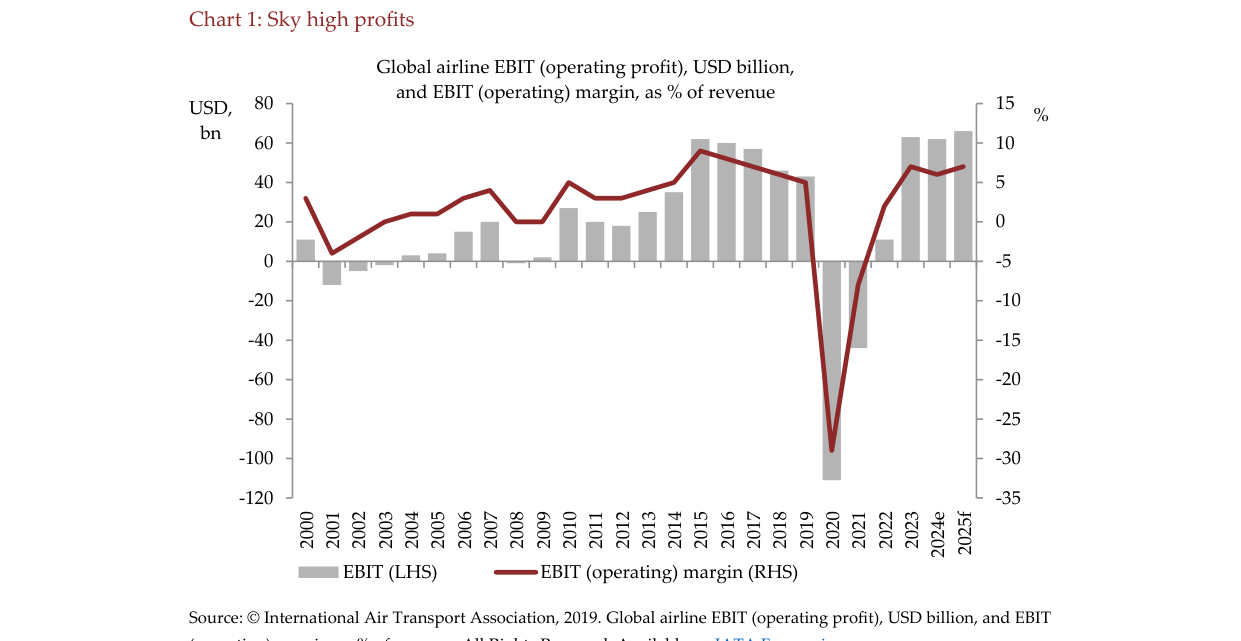
Demand for air travel remains solid today. Global travel demand has grown at +5% per year on average since 1990 and has rebounded after every major shock. There are positive structural drivers: emerging market demand is expected to converge with developed markets over time. Today the average number of flights per capita per year in the US is 2.2x and 1.9x in Europe but it is only 0.1x in India, 0.5x in Brazil and 0.6x for China. Strong demand means airlines are making healthy margins (Chart 1 below). There has been a degree of airline industry consolidation too helping competition to ease.

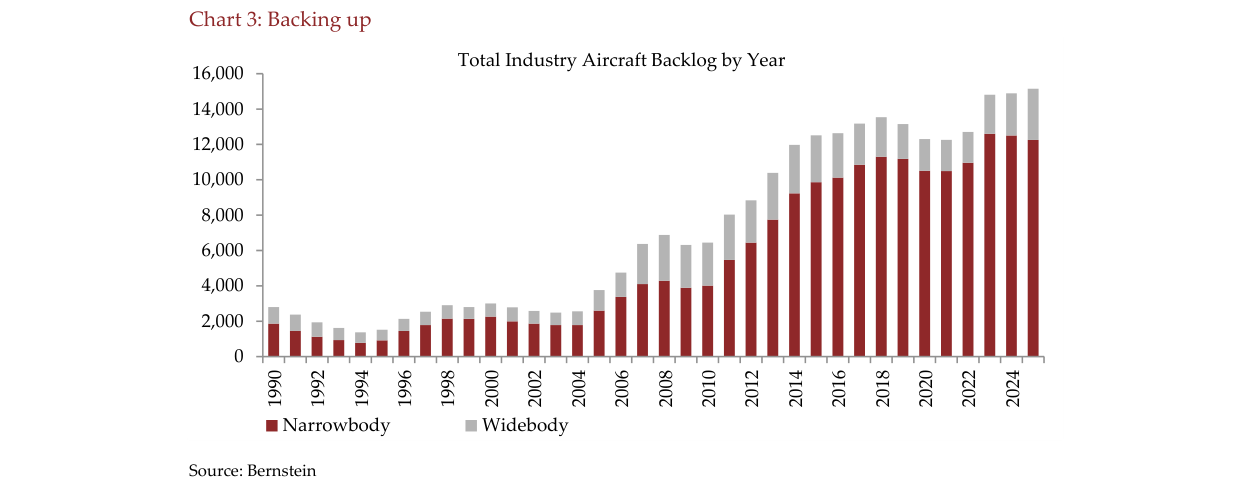
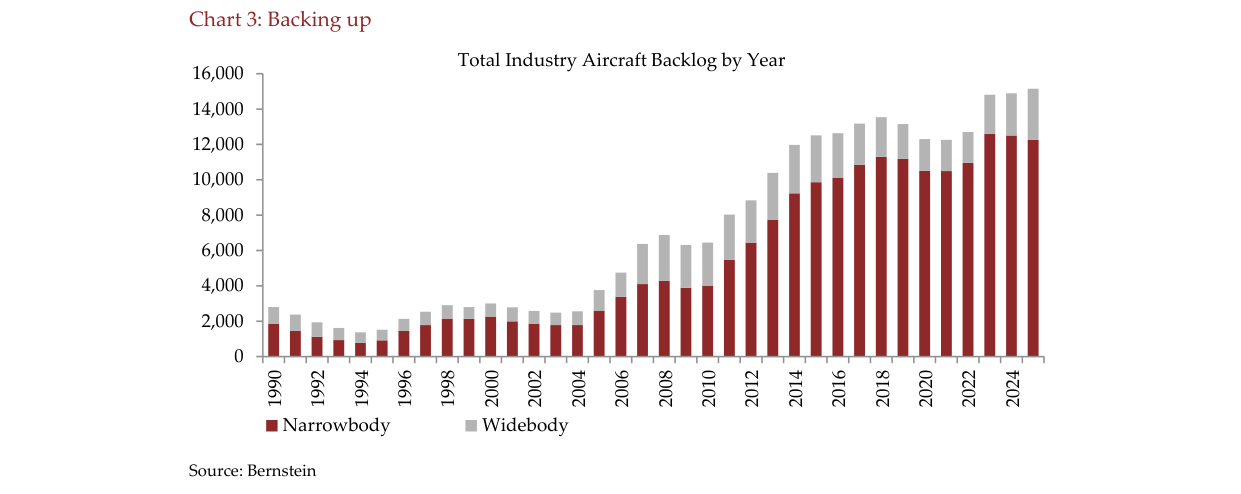
With airlines making good money, they are ordering new planes from their two main suppliers, Boeing and Airbus. However, their ability to meet the demand has been under pressure in recent years Supply of new aircraft remains incredibly tight. Both are sold out to the 2030’s. The industry’s order backlog has risen to record levels. For example, the time one has to wait for a new widebody jet has more than doubled from c.2 years to 5 years, (Chart 2). Airlines are scared to lose their place in the queue such is the competition for new planes. Boeing has had several well publicised production issues. Airbus’s supply chain was disrupted after covid and has struggled to ramp back up: it is aiming to produce 75 planes per month by 2027 but consensus doubts it can get there, based on its mixed track record. Even 75 new planes per month pales into insignificance against the existing global fleet of over 14,000. In a volatile world, it is rare to find businesses with such visibility.


The major winners from this tight supply situation are the engine OEMs, especially Rolls Royce and Safran. They are the suppliers to the suppliers, Boeing and Airbus. They are benefitting from the industry consolidation that took place in the 1990’s. There has been a lack of new entrants, due to the complex technical requirements and huge amounts of capital that would be required to design a new aeronautical engine from scratch. Failure mid-flight cannot be tolerated. The barriers to entry are very high indeed.
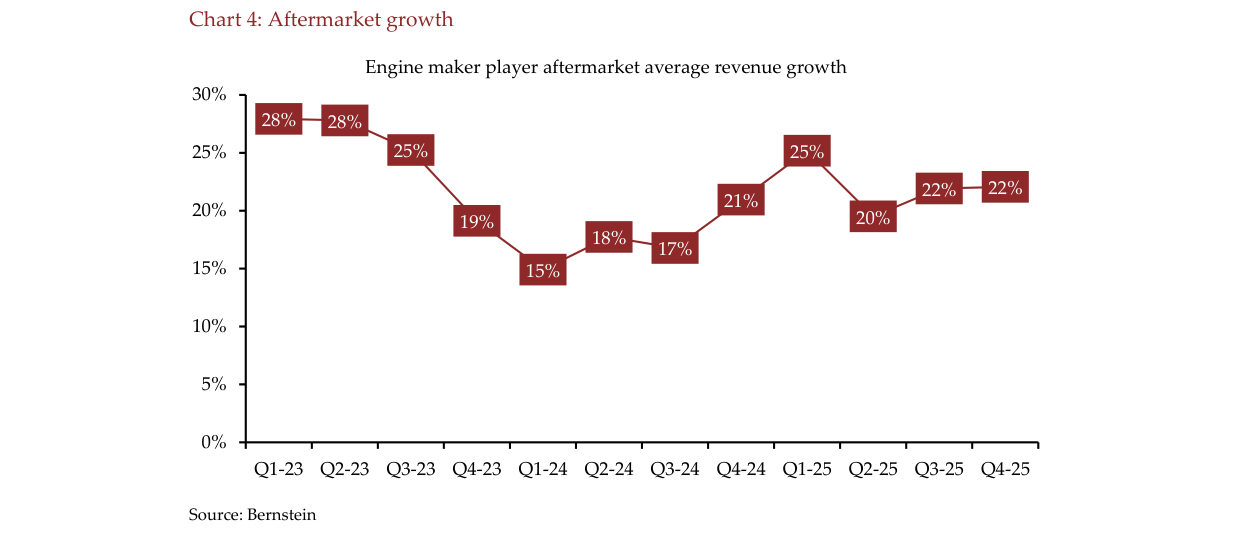
The engine OEMs operate a razor-razorblade model. They incur the costs of developing a new engine. They then sell it for little margin upfront and make their margin mainly from aftermarket services. The OEMs get paid for ‘Time and Materials’ when the engines are mended at their repair shops and they get paid per flight hour under LTSA’s (Long Term Service Agreements.) The lack of new aircraft means that the current engines in use are being flown for longer and requiring more aftermarket services, boosting revenues, profits and free cash flow for the OEMs (Chart 4). Their balance sheets are in great shape enabling them to increase shareholder payouts via dividends and share buybacks ahead of consensus expectations. Rolls, Safran and MTU have all been strong stocks in recent years. However, the sector has not been entirely without turbulence in Marathon’s European portfolios. A small holding in Alten has unfortunately underperformed. Alten is a technology consulting company to a range of industries including the automotive and aeronautics sectors. European Autos have been weak customers recently in the face of increased Chinese competition and weak consumer demand in an inflationary backdrop.
In conclusion, Aerospace is one industry where Europe is truly world class for historical reasons. Market structure is attractive with aircraft a duopoly and aircraft engines an oligopoly. There are a number of large, liquid, listed stocks enabling investors to benefit from Europe’s strength in this industry: Airbus, Rolls Royce, Safran and MTU Aero Engines amongst others.

Demand for air travel remains strong and is set to structurally increase as Emerging Market consumers become wealthier and fly more. Supply of new aircraft from Boeing and Airbus remains tight with backlogs at record levels. This is good news for engine providers who can harvest more cash for longer from their existing fleet. Marathon continues to hold a significant position in Rolls Royce. The stock has been a capital cycle winner, generating a total return of +1153% in the past 5 years. The current CEO has executed one of the most successful turnarounds in European corporate history. He understands the industry’s capital cycle and has exploited the imbalances to exert pricing power and boost margins. With no end to the supply shortages in sight, the shares look well placed to continue to soar.
An interview with the author of this article is available on The Capital Cycle Podcast. Please see overleaf for links.