观石录STONERECORD

See what the world's top investors are buying and saying

StoneRecord aggregates the holdings, letters, and earnings calls of Buffett-style value investors and distills them into AI summaries — no wading through English filings, no hunting around.

New here? Start with the guide →
InsightsHoldingsStocksSignalsGuide?
Updated 21 min agoSEC EDGAR · 13F/13D · manager sites
← Back to list
Starboard Value LPLetter9 Mar 2026Source: starboardvalue.com

Starboard Value LP Letter to LW Board and CEO

Starboard Value is a New York activist hedge fund that Jeff Smith and partners spun out as an independent firm in 2011 (the strategy dates to 2002 at Ramius). It targets undervalued U.S. small- and mid-caps, pushing board overhauls and operational fixes — famously its ~300-page Darden/Olive Garden deck.

Jeff Smith · 2011 · 美国纽约Operational activist

Starboard Value LP Letter to LW Board and CEO

In plain words

This is an activist investor letter to Lamb Weston, a frozen potato giant. Starboard Value says the company has improved but isn't reaching its full profit potential. They want deeper cost cuts (especially in overhead), selling the weak Asia business, and a clear 25% profit margin target. For regular investors, if the company follows through, the stock could rise significantly because it's currently cheap. Worth reading because activist pressure often leads to changes that boost shareholder value.

AI SummaryAI-generated · may contain errors · verify against the original

Starboard Value sent a letter to Lamb Weston's management, arguing that while the company has made progress in pricing discipline, volume recovery, and capacity reduction, there remains significant room for value creation. It recommends expanding the current annualized cost reduction plan of at leas

~7 min full read · 5 sections
Deep Analysis

Theme & Background

This chapter is the introduction to Starboard Value's open letter to Lamb Weston's management and board. The author acknowledges that the company has made initial progress under new leadership in pricing discipline, volume recovery, and capacity reductions, but argues these efforts amount only to a "return to normal" and fall far short of unlocking the full earnings potential. The core context is that Lamb Weston operates in a supply-constrained industry with low valuation, yet its cost structure remains bloated and its international operations drag on overall profitability.

Core Arguments

  • Must move from "stabilization" to "structural value creation": Normalizing industry conditions alone is insufficient; systematic improvements in margins, capital allocation, and earnings quality are required.
  • Expand cost-cutting program to a total of $550 million (with approximately $250 million in incremental cuts), focusing on SG&A (selling, general & administrative expenses) rather than just cost of goods sold.
  • Conduct a strategic review of the Asia-Pacific (APAC) business, where competition is intensifying and profit contribution is minimal; a divestiture could unlock value.
  • Set a medium-term target of 25% EBITDA margin, using it as the anchor for performance measurement and incentives, rather than focusing solely on cost reduction numbers.

Key Arguments & Data

1. Lack of Operating Leverage

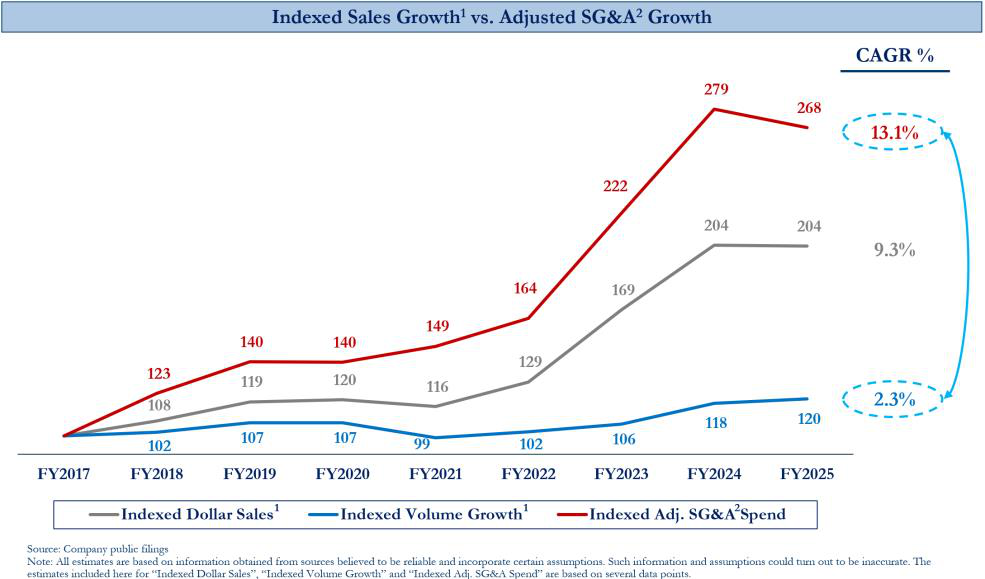
  • Since its IPO, Lamb Weston's sales have roughly doubled (indexed sales growth ~200%), yet the company has generated almost no operating leverage. Most growth has come from price rather than volume, which should have produced meaningful operating leverage, but it did not.

2. SG&A as a Percentage of Revenue Is Too High

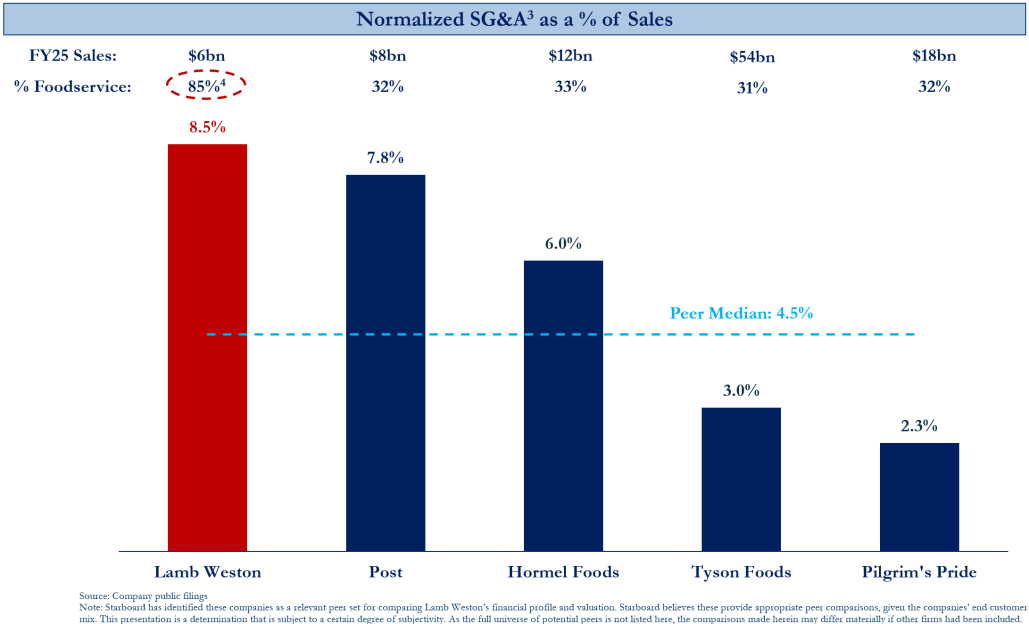
  • Lamb Weston's SG&A as a percentage of net sales has already exceeded the peer median. Its foodservice channel revenue share is significantly higher than peers, a channel that theoretically should support a leaner sales model, yet its SG&A intensity is higher.

Recommended Target: Reduce adjusted SG&A to 4.5% of net sales. Even at this target, Lamb Weston's SG&A intensity would still be higher than some foodservice-heavy peers (e.g., Tyson Foods, Pilgrim's Pride).

Peer SG&A Intensity Comparison (based on chart descriptions from the original text):

Company Characteristic Notes
Lamb Weston Adjusted SG&A / Net Sales ~4.5% (target) Still higher than the two below
Tyson Foods Below Lamb Weston's target level High foodservice revenue share
Pilgrim's Pride Below Lamb Weston's target level High foodservice revenue share

3. Cost Reduction Target Breakdown

  • Already announced: At least $250 million in annualized run-rate savings (by FY2028), primarily from cost of goods sold.
  • Proposed incremental: Approximately $250 million, mainly from SG&A.
  • Total: Approximately $550 million.

4. APAC Business Current State

  • Minimal earnings contribution ("little in terms of earnings").
  • Facing rising competitive pressure, dragging on overall margins, and diverting management attention.
  • If sold, local players have strong interest.

5. Target Margin & Valuation

  • If a 25% EBITDA margin is achieved, pro forma EV/NTM EBITDA would be only 6.7x, which the author considers "extremely attractive."

Companies/Assets Involved

Company/Asset Role Bullish/Bearish Key Data
Lamb Weston Holdings, Inc. Target company. High-quality business in a structurally attractive industry. Bullish (but calling for reforms) Current valuation 6.7x EV/NTM EBITDA (pro forma 25% margin); SG&A ratio above peers; APAC profitability negligible
Tyson Foods Peer benchmark for comparison. Neutral (as baseline) SG&A intensity below Lamb Weston's target level
Pilgrim's Pride Peer benchmark for comparison. Neutral (as baseline) SG&A intensity below Lamb Weston's target level
APAC business (unnamed) Asset recommended for divestiture. Bearish (recommend sale) Minimal earnings contribution, rising competition; local buyers show interest

Investment Implications

Chart Chart
  • Bullish on near-term catalysts: Cost reductions and business restructuring (especially SG&A compression and APAC divestiture) can push EBITDA margin from current levels toward 25%, generating significant earnings improvement.
  • Attractive low valuation: At 6.7x EV/EBITDA (adjusted), in a supply-constrained, stable industry, the stock appears "extremely cheap." If reforms are implemented, there is substantial room for valuation recovery.
  • Clear catalysts: Management needs to announce an expanded cost-cutting plan, set a 4.5% SG&A-to-revenue target and a 25% EBITDA margin target, and initiate a strategic review of APAC. These actions alone could trigger a stock re-rating.
  • Risk factors: If the company settles for "stabilization" without pursuing more aggressive structural reforms, earnings potential will remain untapped, and the valuation may stay depressed for an extended period. Investors should monitor whether SG&A ratio and EBITDA margin targets are publicly set and executed.

📝 Full Text

Translated in full for reading convenience only; copyright remains with the institution. Removed immediately upon a rights holder's request.

March 8, 2026

Lamb Weston Holdings, Inc.

599 S. Rivershore Lane

Eagle, Idaho, 83616

Attention: Mike Smith, Chief Executive Officer

CC: Board of Directors

Dear Mike,

We appreciate the time you and the Lamb Weston team have spent with us over the past year.

As we have discussed, we believe Lamb Weston Holdings, Inc. (“Lamb Weston” or the “Company”) is a high-quality business operating in a structurally attractive industry. Since the leadership transition, we have been encouraged by the significant progress the Company has made in improved pricing discipline, a clear inflection in volumes, and prudent capacity removals, which have begun to bring utilization rates back to normalized levels.

In our view, the opportunity extends beyond the initial recovery. The return of volume growth and more rational capacity behavior are important milestones, but stabilization alone is insufficient to unlock Lamb Weston’s full earnings potential. We believe the Company is now well positioned to enter a new phase of value creation — one characterized not just by normalization of industry conditions, but by structural improvements in margins, capital allocation, and profitability. Specifically, we believe you should expand the announced cost reduction program and conduct a strategic review of select international operations, particularly in the Asia Pacific (“APAC”) region.

The Company has announced a cost reduction program targeting at least $250 million in annual run-rate savings by the end of fiscal 2028. While this is a welcome first step, it is important to recognize that the vast majority of the announced savings are expected to come from cost of goods sold, with a relatively limited impact on selling, general, and administrative (“SG&A”) and overhead expenses. We believe the larger future opportunity lies within SG&A.

As shown in the table below, since its IPO, Lamb Weston’s sales have roughly doubled, yet the Company has generated almost no operating leverage. A substantial portion of the Company’s revenue growth since the IPO has been driven by price rather than volume. As a result, we would have expected Lamb Weston to realize significant operating leverage. But you have not. It is time to catch up.

Lamb Weston’s SG&A burden relative to its revenue base has now exceeded the median for its peer group on an annual basis. This is particularly striking given that Lamb Weston derives a much higher percentage of its revenue from foodservice channels than its peers — a channel that should inherently support a leaner go-to-market model and lower SG&A intensity — while its peers have greater exposure to branded products and retail sales.

We believe Lamb Weston should target total cost reductions of approximately $500 million, representing an additional ~$250 million in savings on top of the already announced program. Achieving this level of savings would bring adjusted SG&A² to approximately 4.5% of net sales, which we view as more appropriate for the Company’s business model and customer mix. Notably, even at this level, Lamb Weston’s SG&A intensity would remain above that of certain foodservice-focused peers, including Tyson Foods and Pilgrim’s Pride.

¹ Indexed sales growth, indexed dollar sales growth, and indexed volume growth include the impact of acquisitions and the 53rd week.

² Adjusted SG&A refers to the Company’s reported non-GAAP SG&A. Adjusted SG&A is adjusted for unrealized derivative losses, foreign currency exchange losses, stock-based compensation, pension settlements, acquisition expenses, and other SG&A-related adjustments as reported by the Company. Starboard has calculated the Company’s adjusted SG&A for fiscal years 2017 through 2020 based on these criteria.

³ Normalized SG&A is defined as reported adjusted SG&A excluding research and development, transportation and handling, and advertising expenses; also excludes stock-based compensation.

⁴ As of fiscal 2023; foodservice revenue calculation includes Global and Foodservice segment revenue for fiscal 2023.

Sincerely,

Ward

Executive Chairman

Starboard Value LP

In our view, a total cost reduction program of $500 million is both achievable and necessary to ensure that margin expansion reflects not just improved industry conditions, but lasting structural discipline. To be clear, we do not want you to simply focus on a cost reduction target in dollar terms, as that can often become opaque in reported results. We want you to announce a target of 4.5% adjusted SG&A as a percentage of revenue and want the Board to focus on and incentivize achieving the 4.5% adjusted SG&A target.

Beyond cost optimization, we believe the Board should conduct a focused strategic review of the Company’s international portfolio, particularly select APAC operations. While international diversification has its merits, certain APAC operations face intensifying competitive pressures that are weighing on overall profitability and adding unnecessary distractions to the turnaround process. We believe a thoughtful evaluation of these operations will optimize capital allocation, improve consolidated margins, and unlock additional value. Importantly, our due diligence indicates that the Company’s APAC operations are only marginally profitable, but local players would have strong interest should the Company seek to divest these operations.

We believe that expanding cost savings with a focus on the SG&A opportunity, combined with thoughtful divestitures of underearning APAC operations, provides a clear path for Lamb Weston to restore EBITDA margins to 25%. Critically, this level of profitability is not dependent on revenue growth, but rather on the Company’s cost discipline and ability to concentrate its portfolio in high-return geographies. We therefore recommend the Board adopt a 25% EBITDA margin target as a medium-term goal, and budget and incentivize accordingly. Again, a margin target rather than a cost reduction target provides transparency and accountability by allowing investors to easily track the Company’s long-term progress through a measurable earnings outcome.

Mike, we greatly appreciate the hard work you have done so far and are excited to build a significant position at this valuation. We believe that on a pro forma basis for 25% EBITDA margins, a 6.7x EV/NTM EBITDA valuation is highly attractive, particularly for a high-quality business in a stable and capacity-constrained industry. While we are pleased with the progress to date, we believe more remains to be accomplished, and we are excited to participate at this valuation. We look forward to working with you and the Board, with a focused commitment to achieving and exceeding this margin target.

Lamb Weston remains a strong business with durable competitive advantages in a concentrated industry. We look forward to constructive engagement as the Company enters its next phase of value creation and stand ready to support actions that strengthen Lamb Weston’s performance and long-term shareholder value.

Sincerely,

Jeffrey Smith

Managing Member

Starboard Value LP

⁵ Source: Bloomberg. Note: Includes Starboard’s estimate of APAC business earnings contribution.

Read next
Same manager · Starboard Value LPStarboard Value LP Letter to RIOT CEO & Executive Chairman18 Feb 2026Same manager · Starboard Value LPStarboard Value LP Letter to TRIP Board & CEO17 Feb 2026Same stock · LWStarboard Value LP Letter to LW Board30 Apr 2026
New content every Monday — follow along:RSS·RedNote
← PreviousGold Rises Above $5,000 in an Evolving Monetary RegimeNext →Lithium Enters a New Era of Strategic Demand and Policy Support
Contents ~7 min
Quick links
Original ↗Starboard Value LP 13F holdings →Starboard Value LP letters archive →Back to list →Spot an error? Tell us
Summaries are AI-generated and may contain errors — verify against the original. Not investment advice, nor an endorsement of any institution's views. These managers run 3-10 year horizons and tolerate 30-50% drawdowns; assess your own before following. Originals remain the property of their institutions; removed promptly upon request.
Sources: SEC EDGAR (13F · 13D/G) · manager sites · Motley Fool transcripts · auto-updated daily·For research only · not investment advice观石录 · STONERECORD
观石录 STONERECORD

Professional investment research · AI summaries · Holdings tracking

Guide →
ContactEmail·RedNote·RSS · Research·RSS · Signals
© 2026 观石录 STONERECORD