Starboard Value LP Letter to KNF CEO and Board
Starboard Value is a New York activist hedge fund that Jeff Smith and partners spun out as an independent firm in 2011 (the strategy dates to 2002 at Ramius). It targets undervalued U.S. small- and mid-caps, pushing board overhauls and operational fixes — famously its ~300-page Darden/Olive Garden deck.
In plain words
This is about activist investor Starboard Value giving Knife River an ultimatum: either boost profit margins from 15% to 22% by 2029, or sell the company. Starboard says management has failed badly—the company has great assets (like 1.3 billion tons of gravel reserves) but makes far less money than rivals, and its stock is cheap. They're focused on one stock: Knife River (ticker KNF), demanding a turnaround or a sale.
At a Glance
Starboard Value issues an ultimatum to Knife River management: either raise margins to 22% by FY2029 or sell the company [Stance: bearish on management, bullish on asset value].
- Since the spin-off, the EBITDA margin gap between Knife River and its peers has widened from approximately 1,053 basis points to nearly 1,400 basis points, with shareholder returns described as "lackluster and unacceptable."
- Management's entrenched static margin target of 15% is outdated; Starboard demands a shift to a relative benchmark, targeting at least 22% by FY2029.
- Knife River currently trades at just 8.0x 2027E EBITDA, while the median comparable M&A transaction stands at 12.4x, representing a discount of over 55%.
- If the 22% margin is achieved, the pro forma transaction multiple would drop to 5.9x, leaving significant room for valuation recovery.
Post-Spin Margin Gap Widens from 1,053 bps to Nearly 1,400 bps
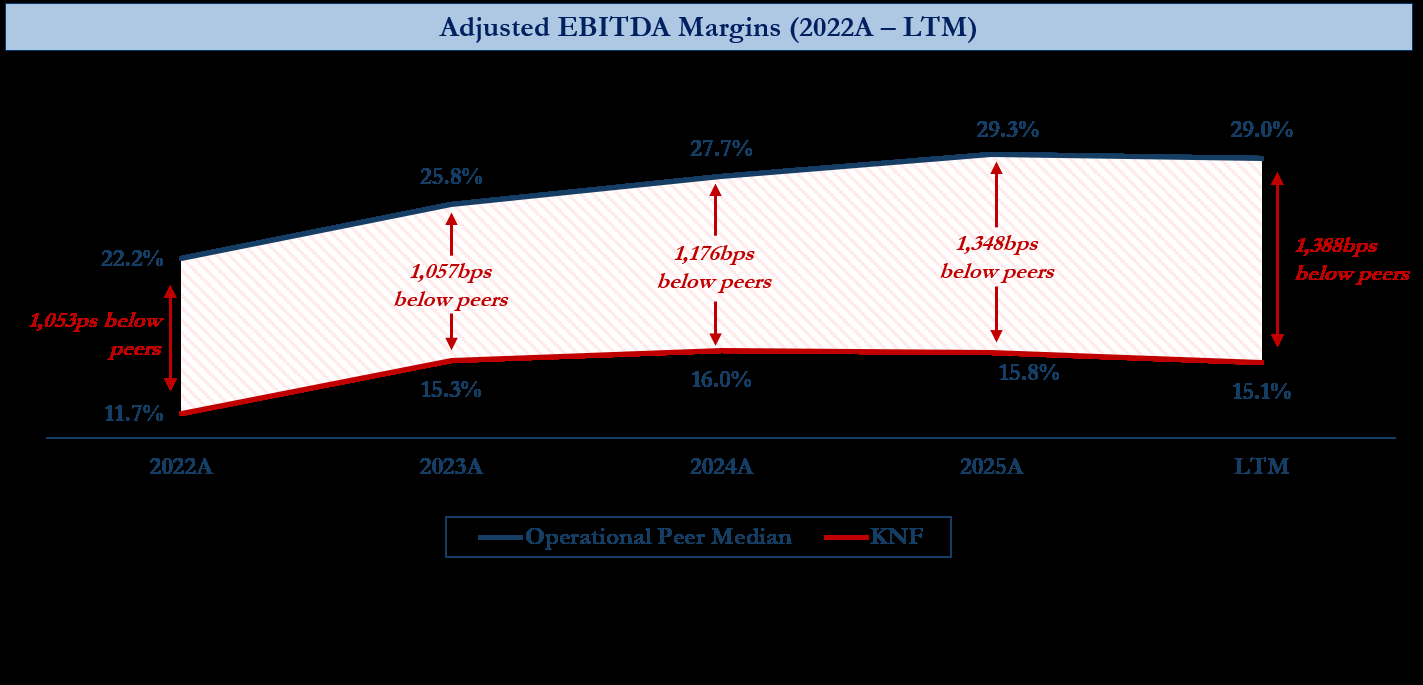
Starboard points out that since Knife River was spun off from MDU in 2023, it has not only failed to close the margin gap with peers but has actually widened it from approximately 1,053 basis points to nearly 1,400 basis points, calling shareholder returns "lackluster and unacceptable." The report argues that the company holds approximately 1.3 billion tons of aggregate reserves, with high industry entry barriers and strong pricing power, but that poor management execution is the root cause.
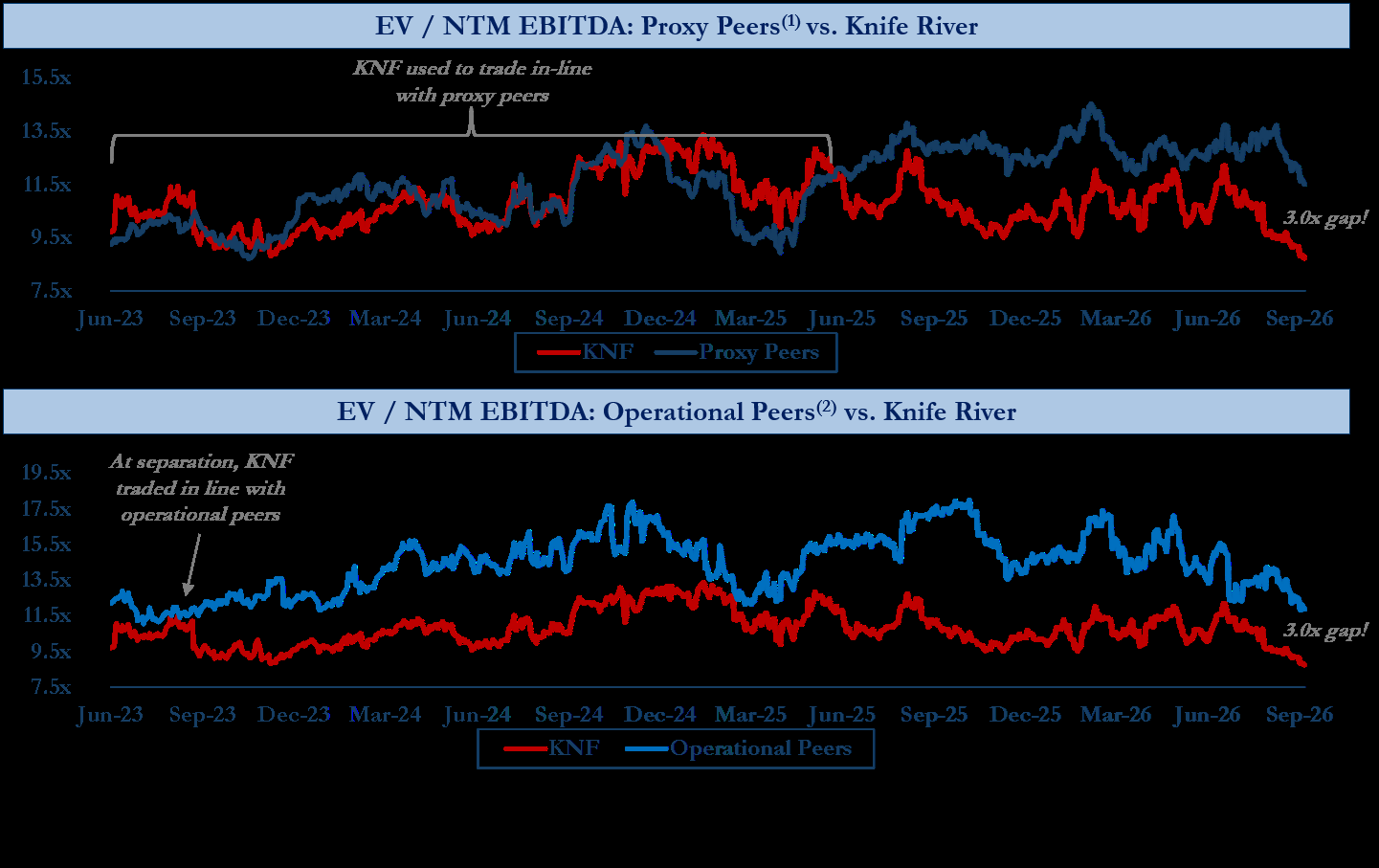
- Performance comparison: At the time of the spin-off, Knife River's adjusted EBITDA margin lagged peers by 1,053 bps; by 2026, the gap had widened to nearly 1,400 bps. Over the same period, the stock significantly underperformed peers, and the valuation discount continued to expand.
- Analyst view: Management viewed the spin-off as a "turning point" and pledged to close the gap, but actual execution has been "disappointing." The author's original words: "This failure cannot be attributed to the quality of Knife River’s assets or the attractiveness of its markets."
- Risk note (self-identified by the author): Industry margins are cyclical; a fixed absolute target (e.g., 15%) may quickly become obsolete and should be measured against a relative benchmark.
Static 15% Margin Target Is Outdated; Shift to Relative Benchmark Needed
Starboard argues that the 15% adjusted EBITDA margin target management claims to have achieved was set at a cyclical low point in the industry. As peer margins have rebounded significantly, this static target has become "meaningless." The author demands that the board develop a credible plan to achieve at least a 22% adjusted EBITDA margin by FY2029.
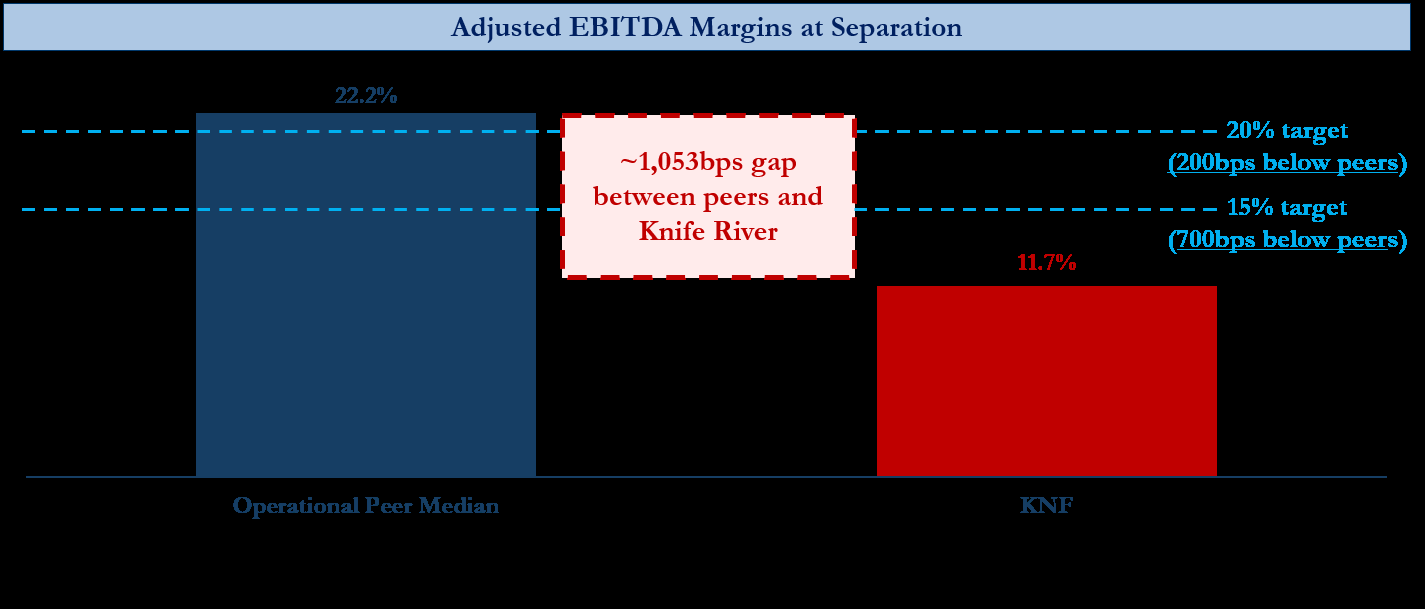
- Author's logic: At the time of the spin-off, peer margins were approximately 22%, implying Knife River's 15% target would narrow the gap to about 700 bps; the long-term 20% target implied narrowing to about 200 bps. However, the actual result was a widening of the gap.
- Key data: During the industry normalization period from FY2022 to FY2023, peer margins rose from approximately 22% to 26% (an increase of nearly 400 bps), while Knife River improved by only about 350 bps. Since then, peers have expanded by another approximately 300 bps, but Knife River has failed to sustain its initial improvement, with current margins below FY2023 levels.
- Author's original words: "Attaining the static and obsolete target of 15% was not progress; measured against the industry, it represented considerable, and unacceptable, underperformance."
- Forward view: If management and the board lack confidence in achieving the target, Starboard requires the board to evaluate all strategic alternatives, including a sale. The author emphasizes, "Knife River is simply too valuable a business to accept subpar performance."
Position Moves
| Position | Action | Logic & Data |
|---|---|---|
| Knife River Corporation | Hold & Monitor (Apply Pressure) | Demand at least 22% adjusted EBITDA margin by FY2029; if unachievable, evaluate a sale. Post-spin margin gap widened from 1,053 bps to nearly 1,400 bps. |
New Analysis: A Paradigm Shift from "Absolute Target" to "Relative Benchmark" and the Path to Value Creation
The core of the continuation is its systematic deconstruction of management's defense — the absolute target of a "15% adjusted EBITDA margin" — and its proposal of a more challenging, value-oriented evaluation framework centered on "relative performance versus peers." This marks a paradigm shift from "self-comparison" to "competitive comparison."
1. Refuting the Fallacy of the "15% Margin": Ironclad Evidence of Relative Underperformance
Starboard's central argument is that management's entrenched "15% margin" is a moving target, whose success metric has already been surpassed by peer developments. The article redefines this "success" as "failure" through a clear logical chain:
- Implied Target of the Original Commitment: At the 2023 Investor Day, management committed to narrowing the margin gap to 700 basis points. At that time, the peer margin was 22%, so the 15% target implied a 700 bps gap.
- Current Expected Level: Today, the peer margin has risen to approximately 29%. To maintain the same 700 bps gap, Knife River's margin should be 22%.
- Actual Performance and the New Gap: Knife River's current margin is approximately 15%, meaning a new gap of 700 bps has emerged relative to the level it "should have reached under the original framework."
Key Data Comparison:
| Metric | Original Target (2023) | Current Actual (2026) | Level Required Under Original Framework |
|---|---|---|---|
| Knife River Target/Actual Margin | 15% | ~15% | 22% |
| Peer Average Margin | 22% | ~29% | ~29% |
| Relative Gap (bps) | 700 | ~1400 | 700 |
Conclusion: Management's claimed "success" (reaching 15%) is actually a smokescreen for "relative failure" (the gap widening from 700 bps to 1400 bps). Starboard labels this logic a "flawed absolute target" and accuses the board and management of being "comfortable hiding behind" this false benchmark.
2. A Clear Path: 22%+ Margin and Value Creation
Starboard not only identifies the problem but also proposes a specific, quantifiable solution: achieving a 22% adjusted EBITDA margin by FY2029. This target rests on two core pillars:
- Pricing Power Recovery (Aggregates Segment):
- Problem: During the MDU era, Knife River failed to raise prices as aggressively as peers, resulting in a "substantial pricing gap" at the time of separation. Post-separation, price increases have been only the "bare minimum," failing to close the gap.
- Data Support: The article notes that post-separation, the gap in "price per ton" between Knife River and its peers has actually widened. This directly refutes management's defense that "prices are rising."
- Solution: The board is urged to set "clear pricing targets relative to the overall market" and to utilize better pricing tools, clearer accountability, and stronger commercial discipline to recoup years of "underpricing."
- Cost Structure Optimization (Rightsizing Cost Structure):
- Problem: Knife River's adjusted SG&A is significantly higher than peers, indicating substantial room for optimization in "corporate overhead" and "local operating costs."
- Citation: The report cites Martin Marietta's CEO Ward Nye on "operational excellence" and being a "low-cost producer," providing industry best-practice endorsement for cost reduction.
- Solution: Management is required to set specific cost reduction targets, identify responsible parties, and report progress against a timeline.
The Multiplier Effect of Value Creation:
The article further argues that achieving a 22% margin will generate dual value creation:
1. Earnings Growth: Directly drives substantial earnings growth.
2. Valuation Re-rating: Knife River's current valuation (approximately 8x 2027E EBITDA) is far below peers. If margins improve to 22%, its pro forma trading multiple would drop to 5.9x, further widening the valuation gap with peers, which in itself implies significant re-rating potential.
3. Strategic Scarcity and M&A Value: An Undervalued Asset
The article positions Knife River as a "Strategic Asset," whose value lies not only in operational improvement but also in its scarcity as an M&A target.
- Scarcity Argument: Due to "extensive permitting requirements" and "substantial time and capital" constraints, replicating a portfolio of comparable scale and quality within a reasonable timeframe is "extraordinarily difficult, if not outright impossible." This scarcity value is increasingly prominent as industry giants seek large-scale M&A to deploy capital.
- Transaction Multiple Comparison: The article provides a key data table showing M&A transaction multiples for recent comparable assets, starkly contrasting with Knife River's current low valuation.
| Transaction | Acquirer | Transaction Multiple |
|---|---|---|
| Lhoist (2026) | Martin Marietta | 17.2x |
| Arcosa (2026) | CRH | 15.0x |
| Summit Materials (2024) | Quikrete | 11.7x |
| Stavola (2024) | Arcosa | 12.0x |
| MLM Texas Assets (2023) | CRH | 12.4x |
| Median | 12.4x | |
| Average | 13.7x | |
| KNF Current Trading Multiple (2027E) | 8.0x | |
| KNF Pro Forma Trading Multiple (2027E, 22% margin) | 5.9x |
Analysis: The table clearly shows a discount of 55% to 71% between Knife River's current valuation (8.0x) and comparable transaction multiples (median 12.4x, average 13.7x). Even without operational improvement, valuation re-rating alone could generate significant returns. Furthermore, if the 22% margin is achieved, its 5.9x pro forma multiple suggests that market skepticism about its future profitability has driven its valuation to an unreasonably low level.
4. Conclusion: An Ultimatum to the Board
The tone of the conclusion is firm, upgrading Starboard's stance from "suggestion" to "demand." It requires the board to:
- Provide a Clear Plan: No longer accept the vague "15%" target.
- Define Clear Accountability: Directly link the narrowing of the margin gap to executive compensation and positions.
- Take Decisive Action: No longer tolerate "years of underperformance."
Summary: By introducing a "relative performance" evaluation framework, proposing a specific 22% margin target, demonstrating a dual path of cost and pricing improvement, and revealing its significant value as an M&A target, the continuation constructs a logically rigorous and data-rich offensive narrative. It successfully redefines management's "success story" as a "failure case" and forces the board to choose between "proactive reform" and "passive acceptance of an acquisition," thereby maximizing value for shareholders.
Position Moves
| Ticker | Direction | Author's One-Sentence View | Key Data |
|---|---|---|---|
| Knife River Corporation | Hold & Monitor (Pressure) | Demand the board develop a credible plan to achieve at least 22% adjusted EBITDA margin by FY2029; if unattainable, evaluate a sale. | Margin gap widened from 1,053 bps to nearly 1,400 bps; current valuation 8.0x vs. comparable M&A median 12.4x; pro forma multiple 5.9x. |