4Q25 Quarterly Market Review
Patient Capital Management is a Baltimore asset manager founded in 2020 by Samantha McLemore, CFA — Bill Miller's long-time co-manager (working together since 2002, running the flagship Opportunity Equity strategy since 2014). Continuing the Miller-school contrarian tradition, it practices "time arbitrage": exploiting behavioral mispricing to concentrate in controversial growth names (tech, healthcare, Bitcoin-related) at deep discounts to intrinsic value. Its site preserves Bill Miller's complete 1995-2022 market letters, alongside ongoing quarterly letters and webinars.
In plain words
US stocks rose about 18% in 2025 despite a 21% drop in April. The Fed cut interest rates twice even as the government shut down for 43 days. Consumers spent more during holidays, but confidence fell to a record low. Many fear an AI bubble, but the report says such skepticism is actually a good sign — historically, markets tend to rise when doubts are high. For investors, this suggests sticking with large US growth stocks, while also watching opportunities from a weaker dollar (gold surged 55%) and overseas. But watch out: if low consumer confidence eventually hurts spending, risks could appear. Worth reading for its contrarian view and data.
In the fourth quarter of 2025, the market continued to rise, albeit with more volatile movements, reaching a new all-time high on December 24. Despite a peak-to-trough drawdown of -21.4% in April, U.S. stocks still posted a full-year gain of 17.9%, marking the seventh-best three-year return since 19
Theme and Background
This chapter reviews market performance in the fourth quarter and full year of 2025, focusing on the Federal Reserve's monetary policy path, the divergence between consumer spending and confidence, and the return differences across various asset classes against the backdrop of a government shutdown and delayed data releases. The report argues that despite concerns over an AI bubble and elevated valuations, historically high levels of skepticism have often been a constructive force for markets, and the starting backdrop for 2026 remains favorable.
Core Views
- Market resilience exceeded expectations: Despite a peak-to-trough drawdown of -21.4% in April, U.S. stocks still rose 17.9% for the full year, marking the seventh-best three-year return since 1929.
- Fed continues easing: With a 43-day government shutdown and delayed data releases, the Fed cut rates by 25 basis points each in October and December, bringing the year-end federal funds target range to 3.50%-3.75% (the lowest since 2022).
- Severe divergence between consumer spending and confidence: Holiday sales grew 3.9% year-over-year, but consumer confidence fell to 52.9 in December, below 99% of historical readings.
- Counterintuitive judgment: The report argues that concerns over an AI bubble and excessive valuations (i.e., high skepticism) have historically been a constructive force for markets rather than a topping signal, supporting further upside.
Key Arguments and Data
- Employment and inflation: The U.S. unemployment rate rose to 4.6% in November (the highest since 2017, excluding the pandemic period); CPI fell from 3.0% in September to 2.7% in November, but data disruptions raised concerns that the improvement might be temporary. The market has fully priced in two more rate cuts in 2026.
- Sector performance: All 11 sectors posted positive returns for the full year, with telecom (+33.6%) and information technology (+24.0%) leading.
- Style and size: Large-cap stocks outperformed small- and mid-caps, and growth stocks outperformed value stocks.
- Cross-asset comparison:
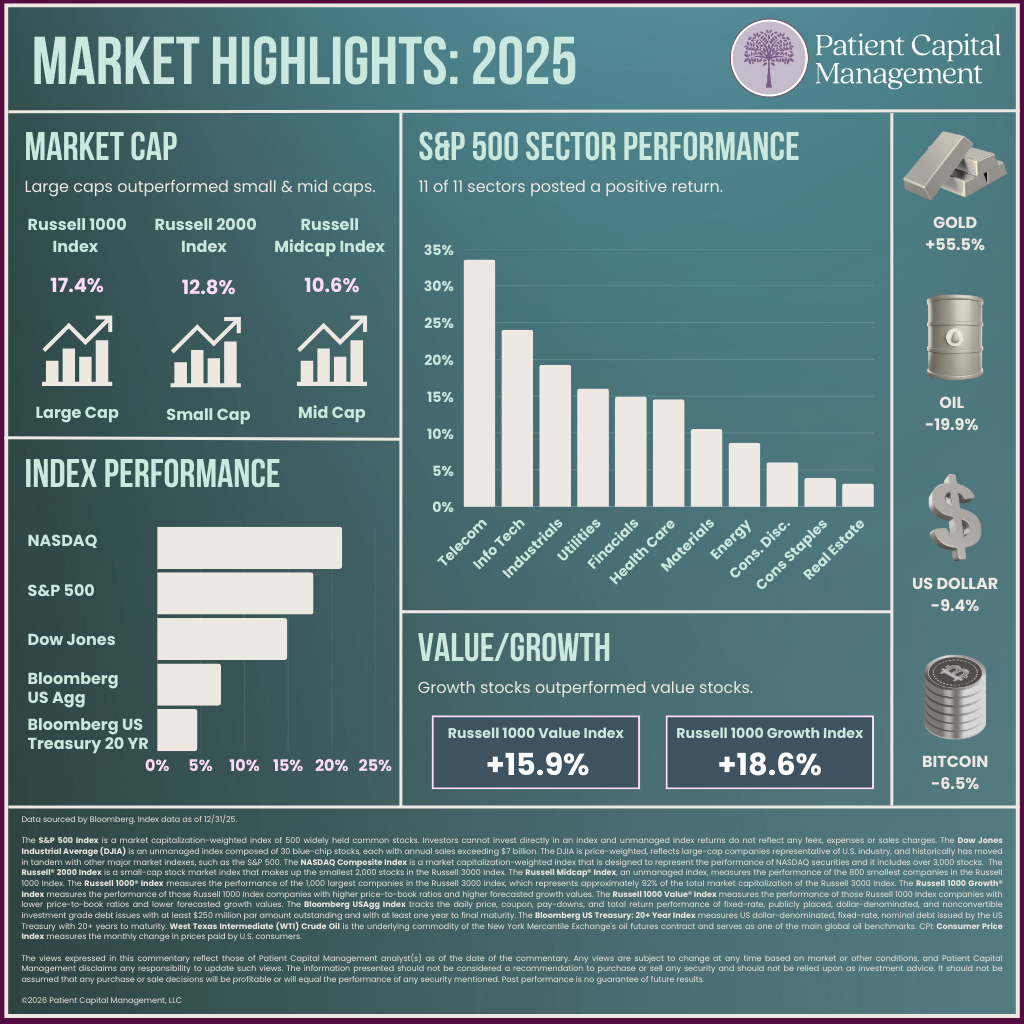
| Asset Class | 2025 Return |
|---|---|
| Nasdaq Composite Index | +21.2% |
| S&P 500 Index | +17.9% |
| Dow Jones Industrial Average | +14.9% |
| Russell 1000 Index | +17.4% |
| Russell 2000 Index | +12.8% |
| Russell Midcap Index | +10.6% |
| Russell 1000 Growth Index | +18.6% |
| Russell 1000 Value Index | +15.9% |
| Bloomberg Aggregate Bond Index | +7.3% |
| U.S. Treasury 20+ Year | +4.6% |
| U.S. Dollar | -9.4% |
| Gold | +55.5% |
| WTI Crude Oil | -19.9% |
| Bitcoin | -6.5% (closed at $87,648) |
- Historical probability: The report notes that U.S. stocks rise in approximately 70% of years, and the current backdrop favors further gains.
Companies/Assets Involved
- Mastercard SpendingPulse: Serves as a source of consumer spending data, showing holiday sales up 3.9% year-over-year.
- Bitcoin: Hit an all-time high in October but ended the year down 6.5% at $87,648.
- Gold: Surged 55.5% for the full year, a standout performer.
- WTI Crude Oil: Fell 19.9% for the full year, one of the worst-performing major asset classes.
Investment Implications
- Continue overweighting U.S. stocks, especially large-cap growth stocks: The report views high skepticism as a constructive force rather than a risk signal, and historical data shows a high probability of further gains in U.S. stocks.
- Bond appeal is relatively limited: Bond returns (7.3%) significantly underperformed all major equity indices, with long-duration Treasuries (+4.6%) performing even weaker.
- Focus on non-U.S. asset opportunities from a weaker dollar: The dollar fell 9.4% for the full year, while gold surged 55.5%, suggesting that dollar weakness may continue to support commodities and overseas assets.
- Watch for the divergence between consumer confidence and spending: Consumer confidence has fallen to historic lows (below 99% of readings). If spending follows confidence lower, it could pose a downside risk to the economy.