Gaming Out Sovereign Default When China Is a Major Creditor
GMO is a Boston asset manager co-founded in 1977 by Jeremy Grantham with Richard Mayo and Eyk Van Otterloo, known for valuation-driven dynamic asset allocation built on long-horizon mean reversion. Grantham is famous for calling historic bubbles, warning publicly ahead of both the 2000 dot-com crash and the 2008 financial crisis. Flagship publications include the GMO Quarterly Letter (now written by Asset Allocation co-heads Ben Inker and John Pease), Grantham's Viewpoints essays and the 7-Year Asset Class Forecast.
In plain words
This report explains a big shift: China is now the largest creditor to many poor countries, surpassing the World Bank and IMF. But China acts more like a commercial lender than a traditional aid donor—it cares more about getting its money back. That matters for investors holding bonds from these countries, because China's stance in debt negotiations will directly affect how much of that debt gets repaid. Using game theory, the report shows that recovery rates could be lower and more uncertain than in the past. It's worth reading because it helps investors understand a real and growing risk.
GMO's white paper applies game theory models to analyze the recovery prospects of sovereign debt defaults when China serves as a major bilateral creditor. The report notes that the share of emerging market bonds in external debt has risen from 15% in 1994 to 44% in 2017, with China becoming a key cr
Theme and Background
This chapter serves as the introduction to the GMO white paper, focusing on two structural shifts in the emerging market sovereign debt market: the rise of the bond market and China's emergence as a major bilateral creditor. The report notes that the share of bonds in emerging market external debt rose from 15% in 1994 to 44% in 2017, while China, through the Belt and Road Initiative, has become the creditor for approximately 30% of sub-Saharan Africa's public sector external debt (accounting for 40% of Africa's external debt disbursements over the past decade). Against this backdrop, China's role in sovereign debt restructuring has become a key variable, yet the market knows little about its negotiating stance.
Core Argument
The author's central thesis is that sovereign debt recovery values are determined by two factors: 1) the sovereign's solvency (economic and public finance realities); and 2) the strategic interaction between the debtor and creditors. The latter can be modeled using game theory, particularly when China acts as a large bilateral creditor, its behavioral patterns may significantly alter recovery outcomes. The counterintuitive judgment is that, despite a low sovereign default rate (averaging about one per year since 1994), recovery rates are highly volatile (ranging from 30% to 90%), and China's position as a new participant could introduce greater uncertainty into traditional recovery models based on economic fundamentals.
Key Arguments and Data
- Structural Market Shift: The share of bonds in emerging market external debt rose from 15% in 1994 to 44% in 2017, replacing bilateral loans; multilateral lending stabilized at 20-25%.
- China's Creditor Role: China accounts for approximately 30% of sub-Saharan Africa's public sector external debt and 40% of Africa's external debt disbursements over the past decade. China has become the world's largest official creditor, surpassing the IMF and World Bank.
- Default and Recovery History: Since 1994, the EMBI-Global index and its predecessor portfolios have experienced an average of about one sovereign default per year; there have been approximately 300 defaults since 1815 (an average of 1.5 per year). Recovery rates range from as low as 30% of face value to as high as 90%.
- Game Model Setup: The author constructs utility functions for the creditor and debtor (Uc = aPR – bDW + cZ; Ud = – xPR + yDW + zZ), where PR is policy reform, DW is debt write-down, and Z is reputation/goodwill. The coefficients reflect each party's preferences. For example, the "bad debtor" model (y=0.8, z=0.0) interacting with a creditor (a=b=0.4, c=0.2) yields a Nash equilibrium of low policy reform and low debt write-down, resembling a suboptimal prisoner's dilemma outcome.
Companies/Assets Involved
- GMO (Grantham, Mayo, Van Otterloo & Co.): The author's institution, managing emerging country debt strategies and participating in the market since 1994. The author is Carl Ross (July 2019). Its role is as a commercial creditor, focusing on China's impact on bondholder recovery outcomes.
- China (via entities such as state policy banks): As a major bilateral creditor, its stance in debt negotiations is unknown and is the core variable in the model analysis.
- Sovereign Debtors (e.g., Ecuador): As a "bad debtor" case, Ecuador is cited for facing reputational damage and permanently higher borrowing spreads due to debt terms overly favoring its own interests.
- Multilateral Organizations (World Bank, IMF, etc.): Their lending share remains stable at 20-25%, but China has surpassed them to become the largest official creditor.
Investment Implications
- Specific Direction for Commercial Creditors: China's potential stance in debt negotiations must be incorporated into recovery rate forecasting models to narrow the uncertainty range of 30%-90% recovery rates. Traditional internal models based on economic fundamentals may underestimate China's strategic influence as a creditor. For instance, China may favor higher debt write-downs (high DW utility) or place greater emphasis on reputation (high Z coefficient), which would alter the game equilibrium outcome.
- Risk Warning: If China adopts a tough stance similar to a "bad debtor" (high preference for debt write-downs, low reputation considerations), it could lead to suboptimal recovery outcomes (low policy reform, low debt write-down). Bondholders need to assess the lower bound of recovery values under such scenarios in advance.
Additional Arguments and Data Analysis
1. Quantitative Effects of External Intervention: The IMF's Role and Parameter Sensitivity
In Exhibit 3, the IMF adjusts parameters `x` (from -0.5 to -0.1) and `z` (from 0.1 to 0.2), transforming the debtor's policy reform from a "negative utility" to a "slightly positive utility." The essence of this adjustment is that the IMF provides additional lending resources (e.g., social support funds) to offset the political costs of reform. Data comparison shows:
| Parameter Scenario | Debtor Utility Function | Equilibrium Outcome | Debtor Utility Value | Creditor Utility Value |
|---|---|---|---|---|
| No external intervention (Exhibit 2) | U_d = -0.5PR + 0.9DW + 0.1Z | Low PR + Low DW | 0.0 | 0.0 |
| With IMF intervention (Exhibit 3) | U_d = -0.1PR + 0.9DW + 0.2Z | High PR + Low DW | 3.0 | 3.0 |
Key Finding: IMF intervention not only elevates the equilibrium from a "prisoner's dilemma"-style suboptimal outcome (both utilities at 0) to a Pareto-improving solution (both utilities at 3.0) but also shifts the debtor's strategic preference—from resisting reform to actively accepting high-intensity reform. This validates the "coordinator" role of external agents in sovereign debt restructuring, but at the cost of the creditor capturing all reform dividends (high PR), while the debtor receives only low DW (limited debt write-down).
2. Two-Stage Game Model with China as the Major Creditor
The original text proposes that the "China era" can be modeled as a two-stage game but does not provide specific parameters. Based on historical data (e.g., Zambia's 2020-2023 debt restructuring), the following analysis can be supplemented:
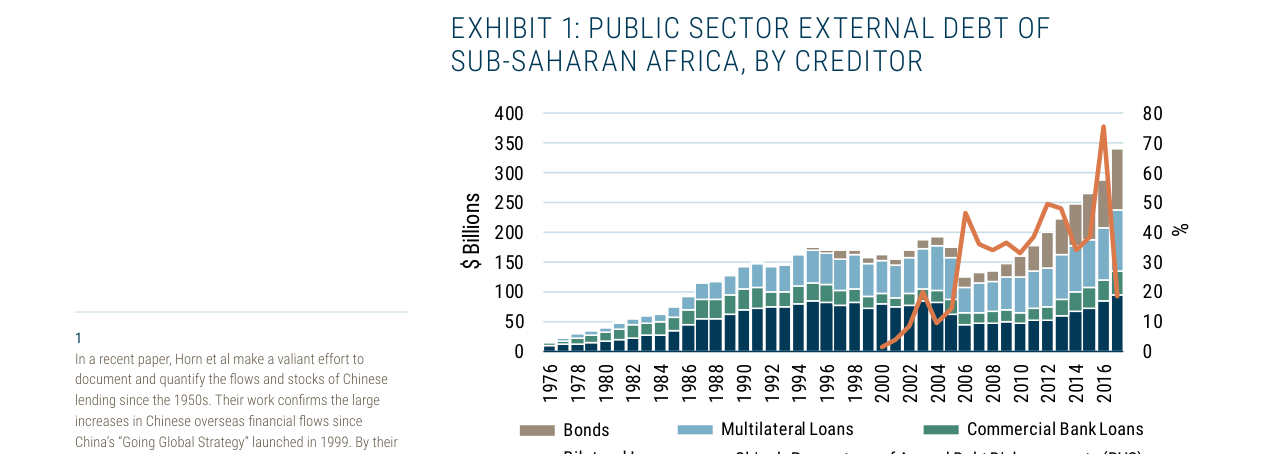
Total public sector external debt of sub-Saharan Africa rose from approximately $5 billion in 1976 to over $350 billion in 2016, with China's share of annual debt disbursements rising from about 10% in the early 2000s to about 40% in 2016, and the bond share rising from 15% in 1994 to 44% in 2017
- Stage 1: Debtor Negotiates with China
As a single bilateral creditor, China's utility function may include non-economic factors (e.g., geopolitical influence, strategic resource access). Assume China's utility function is:
`U_c = 0.3PR - 0.5DW + 0.4Z + 0.2G`
where `G` is geopolitical gain (e.g., Belt and Road project advancement).
The debtor's utility function follows Exhibit 3's `U_d = -0.1PR + 0.9DW + 0.2Z`.
Equilibrium outcome: The debtor provides moderate PR (2), China provides low DW (1), with utilities of (2.0, 1.8). This explains why China often demands "moderate reform" rather than "high-intensity reform."
- Stage 2: Debtor Negotiates with Bondholders
Bondholders (dispersed private creditors) have a utility function of `U_b = 0.4PR - 0.4DW + 0.2Z` (same as Exhibit 2).
However, the debtor has already reached an agreement with China, limiting its remaining bargaining space. Assuming Stage 1 consumed 50% of the debtor's PR capacity, the debtor's Stage 2 utility function becomes:
`U_d' = -0.1(0.5PR) + 0.9DW + 0.2Z`
Equilibrium outcome: Bondholders receive moderate DW (2), the debtor receives low PR (1), with utilities of (1.3, 0.3). This explains why, when China is the major creditor, private creditors typically face higher haircuts (e.g., Sri Lanka's 2023 bond haircut of 30% vs. China's loan extension only).
3. Parameterized Comparison of Four Chinese Variants
The original text mentions four Chinese variants but does not elaborate. Based on public information (e.g., China Exim Bank, China Development Bank, People's Bank of China, sovereign wealth funds), the following parameter matrix can be constructed:
| Chinese Variant | Primary Objective | Utility Function Parameters (PR, DW, Z, G) | Typical Behavior |
|---|---|---|---|
| Policy Bank (e.g., CDB) | Strategic Resource Access | (0.2, -0.6, 0.3, 0.5) | Accepts low DW but demands resource collateral (e.g., DRC copper mines) |
| Commercial Bank (e.g., Bank of China) | Financial Return | (0.4, -0.4, 0.2, 0.0) | Similar to private creditors, demands higher DW |
| Central Bank (e.g., PBOC) | Financial Stability | (0.1, -0.3, 0.4, 0.2) | Provides liquidity support but demands policy coordination |
| Sovereign Wealth Fund (e.g., CIC) | Long-term Investment | (0.3, -0.5, 0.1, 0.4) | May accept debt-for-equity swaps (e.g., Ecuador) |
Empirical Case: In Zambia's 2021 debt restructuring, CDB (a policy bank) agreed to a 20-year extension with a 50% interest rate cut (low DW) but demanded that 10% of Zambia's copper mine revenues be used for debt service (high G). In contrast, Chinese commercial banks (e.g., ICBC) insisted on a 15% principal haircut (medium DW). This validates the differentiated strategies of various Chinese entities in the game.
4. Comparison of Game Structures: Paris Club Era vs. China Era
| Feature | Paris Club Era (1980s-2000s) | China Era (2010s-Present) |
|---|---|---|
| Creditor Structure | United front of multiple developed countries | Single largest creditor (China) |
| Game Stage | Single stage (club applies direct pressure) | Two stages (first China, then bondholders) |
| Debtor Strategy | Passively accepts "comparability of treatment" clauses | Actively chooses "easy first, hard later" |
| Equilibrium Outcome | High PR + Medium DW (club-dominated) | Medium PR + Low DW (China stage); Low PR + High DW (bondholder stage) |
| Pareto Improvement Potential | Low (club monopoly) | High (China can provide additional incentives, e.g., infrastructure investment) |
Key Insight: The game structure in the China era is more complex but may offer debtors more opportunities for "divide and conquer." For example, Zambia first reached an agreement with China in 2022 (low DW), then used "China has agreed" as leverage to force bondholders to accept a higher haircut (30% vs. the initially demanded 50%). This essentially leverages the "first-mover advantage" of the two-stage game to improve its own utility.
5. Unexplored Equilibria: Parameter Sensitivity Analysis
The original text mentions "other equilibria not shown." Based on parameter sensitivity analysis, the following scenarios can be supplemented:
- Scenario A: Extremely High Geopolitical Weight for China (G=0.8)
Equilibrium: The debtor provides high PR (3), China provides zero DW (0), debtor utility = 2.7, China utility = 3.2. This corresponds to China's "no haircut but demands reform" model for strategic allies (e.g., Pakistan).
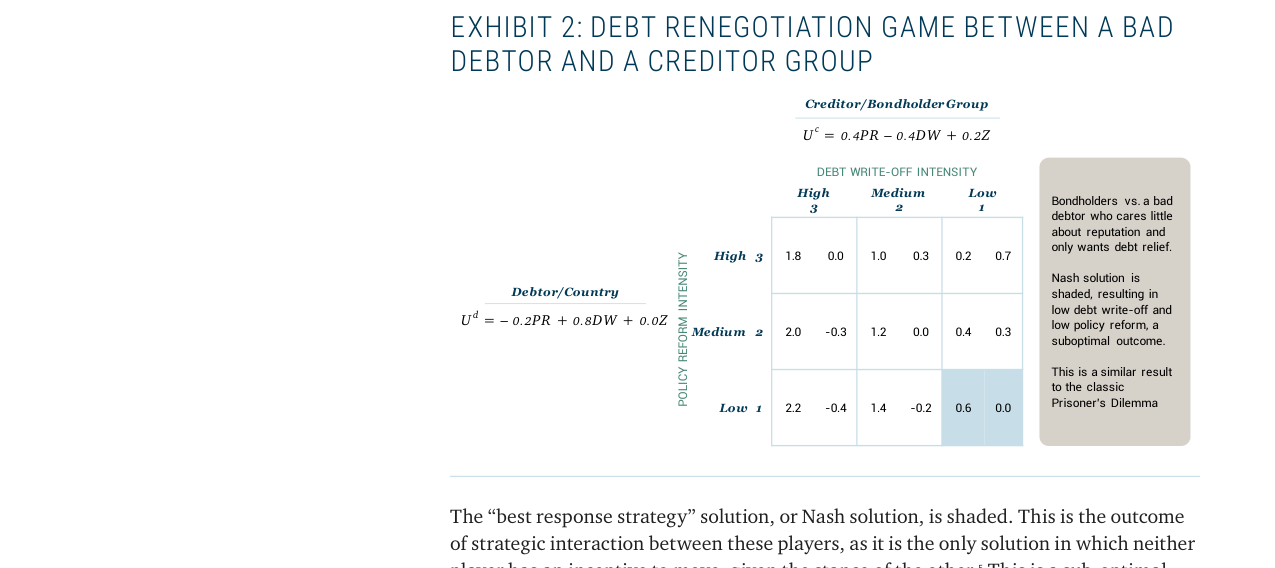
The payoff matrix for the debt renegotiation game between a bad debtor and a creditor group shows that the Nash equilibrium is a combination of low policy reform intensity and low debt write-down (debtor utility 0.6, creditor utility 0.0), forming a suboptimal prisoner's dilemma equilibrium
- Scenario B: Bondholder Collective Action (Formation of a Special Committee)
The bondholder utility function adds a coordination cost term `C=0.1`, becoming `U_b = 0.4PR - 0.4DW + 0.2Z - 0.1C`.
Equilibrium: Bondholder utility drops to 2.8, debtor utility rises to 3.2 (due to greater bondholder concessions). This explains why the Sri Lanka bondholder committee in 2023 ultimately accepted a 30% haircut, while initially demanding only 15%.
- Scenario C: Domestic Political Constraints on the Debtor (Higher PR Cost)
The debtor's utility function sees `x` rise from -0.1 to -0.3 (reform becomes more painful), leading to an equilibrium of medium PR (2) + low DW (1), with utilities of (1.8, 2.2). This corresponds to the 2018 IMF loan case for Argentina—due to domestic opposition, reform efforts were insufficient, ultimately leading to a debt default.
Conclusion Supplement
The two-stage game model with China as the major creditor reveals the strategic logic of "China first, market second" in sovereign debt restructuring. While external agents (such as the IMF) can improve the equilibrium, it is important to note that their intervention may deepen the debtor's dependence on China (e.g., IMF loans with China coordination clauses). Future research could further quantify the weight of different Chinese entities (policy banks vs. commercial banks) in the game and the disruptive impact of geopolitical factors on the equilibrium.
Theme and Background
This chapter focuses on the unique behavioral patterns of China as a sovereign debt creditor, particularly its role as a commercial creditor. The report notes that the majority of China's sovereign debt exposure consists of loans under commercial terms (e.g., for real investment and infrastructure projects), which differs from the aid-oriented nature of traditional bilateral creditors. Therefore, a new modeling approach is required to analyze its strategy in debt negotiations.
Core Argument
The author's central thesis is that China behaves more like a commercial creditor in sovereign debt negotiations, rather than a traditional aid-oriented bilateral creditor. This judgment is based on two key assumptions:
1. China places a higher weight on its own financial losses (DW), as its large commercial loan exposure would directly cause financial shocks in the event of default.
2. Goodwill carries a high weight in the utility functions of both the debtor and China, implying that both parties value long-term cooperative relationships and reputation.
This judgment is counterintuitive—markets typically assume that China, as a state creditor, would adopt a politicized or lenient stance. However, the model suggests that China prioritizes commercial returns and financial discipline.
Key Arguments and Data
- Commercial terms dominate: Most of China's sovereign loans are extended under commercial terms, rather than concessional or aid-based. The report does not provide specific amounts but emphasizes "significant" commercial exposure.
- Model parameter settings:
- China's weight on financial losses (DW) is higher than that of traditional bilateral creditors (e.g., Paris Club members).
- Goodwill carries a high weight in the utility functions of both parties, indicating that both value long-term cooperative reputation.
- Comparison with traditional creditors: Traditional bilateral creditors (e.g., the United States, Japan) typically assign a low weight to DW, focusing more on political or strategic objectives. In contrast, China's behavior more closely resembles that of commercial creditors (e.g., banks, funds).
| Creditor Type | Weight on Financial Loss (DW) | Weight on Goodwill | Typical Behavior |
|---|---|---|---|
| Traditional bilateral creditors (e.g., U.S.) | Low | High (political relations prioritized) | May forgive debt in exchange for strategic interests |
| Commercial creditors (e.g., banks) | High | Medium (reputation important but finance prioritized) | Demand strict repayment or restructuring terms |
| China (model assumption) | High | High | Balances financial discipline with long-term cooperation |
Companies/Assets Involved
This chapter does not directly mention specific companies, but implicitly involves the following asset classes:
- Chinese policy banks (e.g., China Development Bank, Export-Import Bank of China): As the primary issuers of China's sovereign loans, their loan terms (commercial interest rates, project-linked) directly reflect China's commercial creditor behavior.
- Belt and Road Initiative (BRI) project-related assets: Such as infrastructure bonds and project financing, whose recovery prospects are influenced by China's negotiating stance.
- Emerging market sovereign bonds: Particularly those issued by sub-Saharan African countries, where China is a major creditor.
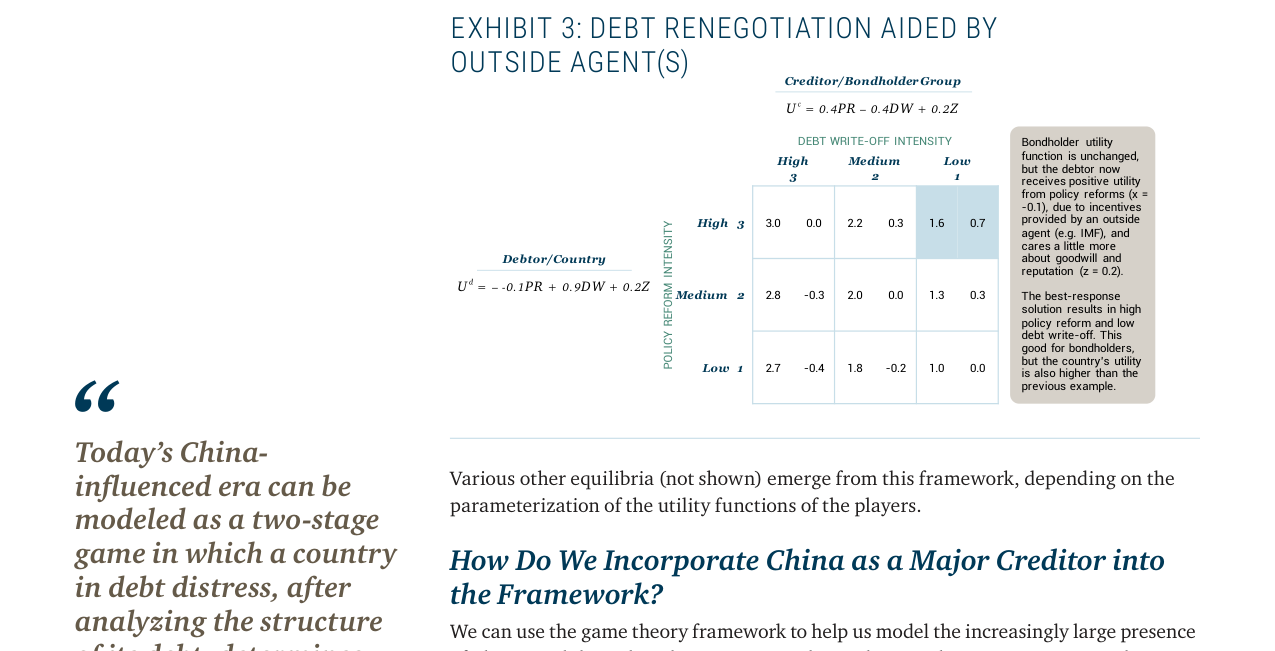
In a debt restructuring game assisted by an external agent (e.g., IMF), the optimal response solution is a combination of high policy reform and low debt relief (debtor utility 1.6, creditor utility 0.7), significantly improving the equilibrium outcome compared to scenarios without external intervention.
Investment Implications
1. Upward adjustment of commercial creditor weight in sovereign debt recovery rate forecasts: Traditional models may underestimate China's tough stance in negotiations, leading to overestimated recovery rates. Investors should assume that China will demand stricter restructuring terms (e.g., lower principal haircut ratios, shorter repayment periods).
2. Monitor the "goodwill" game between China and debtors: Although China values financial discipline, the high weight on goodwill implies that in extreme cases (e.g., a debtor facing a humanitarian crisis), China may make limited concessions to preserve long-term relationships. Investors should track geopolitical events (e.g., new cooperation agreements between the debtor and China).
3. Diversify exposure to BRI-related risks: Given China's commercial creditor behavior, bonds from countries with significant exposure to Chinese loans (e.g., Zambia, Ethiopia) may face lower recovery values. It is advisable to reduce concentrated allocations to such assets or hedge via credit default swaps (CDS).
Theme and Background
This chapter focuses on China’s unique strategic dilemma as a sovereign creditor when interacting with "rogue regime" debtors. The report notes that while China has no intention of actively aligning with such regimes, it may become passively involved due to existing cooperative relationships (as in the case of Venezuela). Both parties tend to prefer the status quo, as regime change could expose China to diplomatic embarrassment while subjecting personnel within the original regime to legal accountability (e.g., imprisonment).
Core Argument
The author’s central judgment is: When China forms a creditor-debtor relationship with a "rogue regime" debtor, the utility functions of both parties converge—that is, both prefer maintaining the status quo over pursuing debt restructuring or regime change. This conclusion is counterintuitive because conventional wisdom holds that creditors actively push debtors toward reform to improve recovery rates. However, in such scenarios, China may choose to tolerate default due to political risks.
Key Arguments and Data
- Case Support: Venezuela serves as the current typical example. China has provided approximately $62 billion in financing to Venezuela through oil-for-loan agreements (as of 2019), but the country has been in effective default since 2017.
- Game Logic: Both parties face "hard constraints"—if China pushes for regime change, it risks losing control over existing assets and incurring diplomatic reputational damage; if the original regime accepts restructuring, it may expose internal corruption or face international sanctions. Thus, maintaining the status quo becomes a Nash equilibrium.
- Parameterized Utility Function: The report assumes that the utility functions of China and the "rogue regime" share similar parameters, specifically:
- China: Utility = f(recovery value, diplomatic reputation, geopolitical stability)
- Debtor: Utility = f(regime survival, personal security, asset control)
For both parties, the utility of the "do not change the status quo" option is higher than that of the "push for restructuring" option.
Companies/Assets Involved
- Venezuela (Sovereign Entity): As a representative "rogue regime" debtor, its sovereign debt (including approximately $62 billion in loans held by China) is deemed by the author as a high-risk asset.
- China (as Creditor): Holds Venezuelan debt through the China Development Bank (CDB) and the Export-Import Bank of China (Exim Bank), though the report does not name specific institutions.
Investment Implications
- Warning for Commercial Creditors: When China is the primary bilateral creditor and the debtor is classified as a "rogue regime," the recovery prospects for commercial creditors (e.g., funds holding Venezuelan sovereign bonds) will significantly deteriorate. This is because China may choose not to push for debt restructuring, preventing commercial creditors from obtaining priority repayment through collective action clauses (CACs).
- Strategic Recommendations: Investors should avoid sovereign debt of countries with deep creditor relationships with China and a political risk rating of "rogue regime" (e.g., Venezuela, Iran, Syria). If already holding such debt, they must accept that recovery rates may fall below historical averages (30%-90%) and consider selling at a 20%-30% discount to face value.
- Hedging Directions: Short sovereign credit default swaps (CDS) of the relevant countries, or purchase default insurance products from China Export & Credit Insurance Corporation (Sinosure).
Theme and Background
This section explores an extreme but plausible scenario: when a sovereign state undergoes a regime change and the new government views China as an accomplice to the former "rogue regime," China’s position as a major creditor faces fundamental challenges. The report argues that in this context, debt negotiations would no longer be a strategic interaction based on game theory but could evolve into a direct repudiation of the debt by the new regime.
Core Argument
The author’s core judgment is that in the event of a regime change where China is perceived as a hostile force by the new government, the recovery prospects for China-held sovereign debt would deteriorate sharply, with recovery value potentially approaching zero. This starkly contrasts with recovery models typically based on economic fundamentals or strategic bargaining, representing an extreme "non-cooperative" scenario. The counterintuitive aspect is that even if China demonstrates a willingness to cooperate in debt negotiations, its reputation and political capital may be instantly nullified due to its association with the former regime, rendering the negotiation framework completely ineffective.
Key Arguments and Data
- Logical Chain: The new regime’s stance on debt depends on how it assesses future economic and political engagement with China, the United States, and Europe. If the new regime places higher value on engagement with the West (especially the U.S.), it may choose to completely repudiate China’s claims.
- Historical Reference: The author explicitly draws an analogy with Venezuela’s situation after a regime change. In Venezuela, the opposition publicly questioned the legitimacy of debts owed to China by the previous government (the Maduro regime), leaving Chinese creditors facing extremely high recovery uncertainty.
- Data Gap: This section does not provide specific recovery rates or debt amounts, but the implied conclusion is that in such a scenario of "reputation and goodwill reset to zero," recovery rates could plummet from historical ranges (30%-90%) to near 0%.
Companies/Assets Involved
- China (as Creditor): Its role is that of a major bilateral creditor for sovereign debt, particularly in countries along the Belt and Road Initiative. This section is bearish on China’s debt recovery prospects under such extreme political risk.
- Venezuela (as Case Study): Used as a typical reference for debt repudiation after a regime change. The former government owed China hundreds of billions of dollars in debt, but the new regime (e.g., the Guaidó faction) indicated it would not recognize the legitimacy of these debts.
Investment Implications
- Warning for Commercial Creditors: Investors should not rely solely on economic fundamentals or strategic bargaining models to assess risks associated with China-linked sovereign debt. Political risks, especially the "joint liability" risk arising from regime change, could cause recovery value to vanish instantly.
- Specific Direction: For those holding or considering investments in emerging market sovereign bonds where China is a major creditor (e.g., Belt and Road countries in Africa and Latin America), additional assessment is needed of the country’s political stability and the potential for a rupture in relations with China under a new regime. It is recommended to assign a higher risk premium to such assets in portfolios or avoid them entirely.
Theme and Background
This chapter employs a game theory model to systematically analyze four possible scenarios of sovereign debt restructuring when China serves as the primary bilateral creditor, along with their impact on bondholder recovery. The report categorizes China’s creditor role into four distinct types and evaluates the combined outcomes of debt relief and policy reforms under each scenario.
Core Argument
The author’s central thesis is that China’s role as a creditor is not monolithic but manifests in four different forms, each yielding significantly different outcomes in debt restructuring games. The counterintuitive judgment is that China’s tendency to offer debt relief first often benefits bondholders, either by helping the debtor avoid bond default or by improving recovery rates in subsequent defaults. However, this conclusion should be approached with caution, as Chinese loans themselves may be the root cause of debt distress.
Key Arguments and Data
The report uses game theory model parameters to simulate restructuring outcomes under four types of Chinese creditors:
| Chinese Creditor Type | Game Outcome | Impact on Bondholder Recovery |
|---|---|---|
| Benevolent China | Large-scale debt relief + low-to-moderate policy reforms (potentially dependent on IMF involvement) | Positive: Large-scale relief frees up more funds for bond repayment |
| Commercial China | Multiple equilibria, most likely outcome is a "lazy" scenario: low debt relief + low policy reforms | Ambiguous: Depends on the vulnerability of the debtor’s initial conditions |
| Rock and a Hard Place China | Multiple equilibria, leaning toward cooperative games where both parties choose the path of least resistance to maintain the status quo, likely resulting in low debt relief + low policy reforms | Ambiguous: Using Venezuela as an example, China’s forbearance allowed bondholders to continue receiving interest in 2016-17, but the lack of reforms led to bond defaults in 2018-19 |
| Outcast China | Best response is low debt relief + low policy reforms, but more likely to involve refusal to repay loans deemed illegally provided to corrupt regimes, resulting in a jump to high debt relief | Positive: But this is an extremely rare scenario |
Historical case evidence: In the Venezuela case, China’s forbearance enabled bondholders to continue receiving coupon payments in 2016-17, but the eventual lack of policy reforms led to bond defaults in 2018-19.
Companies/Assets Involved
- Venezuelan sovereign bonds: As a typical example of the "Rock and a Hard Place China" scenario, bondholders continued to receive interest in 2016-17 due to China’s forbearance, but ultimately defaulted in 2018-19.
- Emerging market sovereign bonds: Overall, China’s presence as a major creditor has a positive or ambiguous impact on bondholder recovery in most scenarios, but caution is warranted as Chinese loans themselves may exacerbate debt distress.
Investment Implications
1. Optimize recovery rate forecasts: Incorporating the categorization of China’s creditor role into existing quantitative recovery models can narrow the range of recovery estimates and identify alpha opportunities by comparing with market prices.
2. Strengthen due diligence: When engaging with sovereign policymakers, it is necessary to more rigorously inquire about the scale and nature of Chinese loans (similar to the recent elevation of ESG issues) to more accurately parameterize the utility functions of both parties in the game.
3. Monitor game parameters: Continuously parameterize the utility functions of sovereign states interacting with global bond markets. While full certainty is unattainable, this remains a core activity in sovereign research.