Cosmo Energy
Hosking Partners is a London boutique founded in 2013 by Jeremy Hosking, a portfolio manager at Marathon Asset Management for over 25 years. It runs a single global equity strategy built on the capital-cycle, supply-side approach — contrarian, long-term, and unusually diversified (350+ holdings) under a multi-counsellor model, managing around $5.5bn.
In plain words
This report argues global refinery assets are undervalued, especially in Japan. Hosking Partners is bullish, saying markets are too pessimistic: replacement costs far exceed stock prices, and Japan's industry consolidation and better shareholder returns create opportunity. Three key holdings: Cosmo Energy (Japanese refiner, trades at 5.3x earnings, activist investor Murakami owns 20%, promises to return ≥60% of profits); Tüpraş (Turkish refiner, replacement value 11x book value, showing deep undervaluation); Idemitsu (Japanese refiner, bought rival Toa Oil, raising concentration and risk of supply squeeze).
At a Glance
One-sentence summary: Global refining asset values are systematically undervalued, and Japan's refining industry presents asymmetric opportunities amid supply constraints and improved shareholder returns. Hosking Partners has raised its Japan allocation to a record 9.5%. [Bullish]
- The replacement value of Turkey's Tüpraş's four refineries stands at $19.5 billion, 11 times its book PP&E; Japan's Cosmo Energy has a pro-rata replacement cost of approximately $14 billion, twice its enterprise value.
- Actual exploration capital expenditure by the five major oil majors fell from about $5 per barrel in 2013 to a historic low of $1/boe in 2022, creating a supply-demand gap.
- Japan's refining industry leads in complexity, with a desulfurization equipment-to-nameplate capacity ratio of approximately 90%, gaining a structural advantage under environmental regulations such as IMO2020.
- The "keep complex, close simple" consolidation led by Japan's Ministry of Economy, Trade and Industry has entered the "11th inning," with Idemitsu Kosan's acquisition of Toa Oil's Keihin refinery (2022) significantly boosting industry concentration.
- Cosmo Energy's largest shareholder, Yoshiaki Murakami, holds a 20% stake; the company has committed to returning ≥60% of earnings to shareholders over the next three years, currently trading at 5.3 times earnings.
Refining Assets Generally Below Replacement Cost, Investment Severely Insufficient
Hosking Partners argues that asset values in the global refining industry are systematically undervalued, with the core evidence being that replacement costs far exceed book values. The author cites Turkey's Tüpraş (a subsidiary of Koç Holdings) as an example: management estimates the replacement value of its four refineries at $19.5 billion, a significant increase from the pre-pandemic level of $12 billion, and nearly 11 times the book value of PP&E (property, plant, and equipment). Japan's Cosmo Energy (with a capacity of 400,000 barrels per day and a 12% domestic market share) has a complexity similar to Tüpraş—approximately 40% of its capacity comes from the most complex refineries (Tüpraş's Izmit and Cosmo's Yokkaichi, the latter reportedly being Japan's second most complex refinery). Scaled by output, the replacement cost of Cosmo's three refineries is estimated at approximately $14 billion, which is twice its enterprise value and more than double the book value of PP&E. The author states: "Given the similarities, it is not unreasonable to apply Tüpraş’ estimate of replacement value to Cosmo, scaled to output, which implies a replacement cost of $14 billion for its three refineries, double the company’s enterprise value and more than double the carrying value of net PP&E on the balance sheet." This means: "Given the similarities, applying Tüpraş's replacement value to Cosmo on a scaled output basis is not unreasonable, implying a replacement cost of $14 billion for its three refineries, twice the company's enterprise value and more than double the net PP&E book value on the balance sheet." Part of the discount stems from geopolitical and economic concerns and currency depreciation in the Turkish and Japanese markets, but the author emphasizes that "a significant portion of the discount reflects investor sentiment towards refineries."
Exploration Capital Expenditure Hits Historic Low, Supply-Demand Gap Emerging
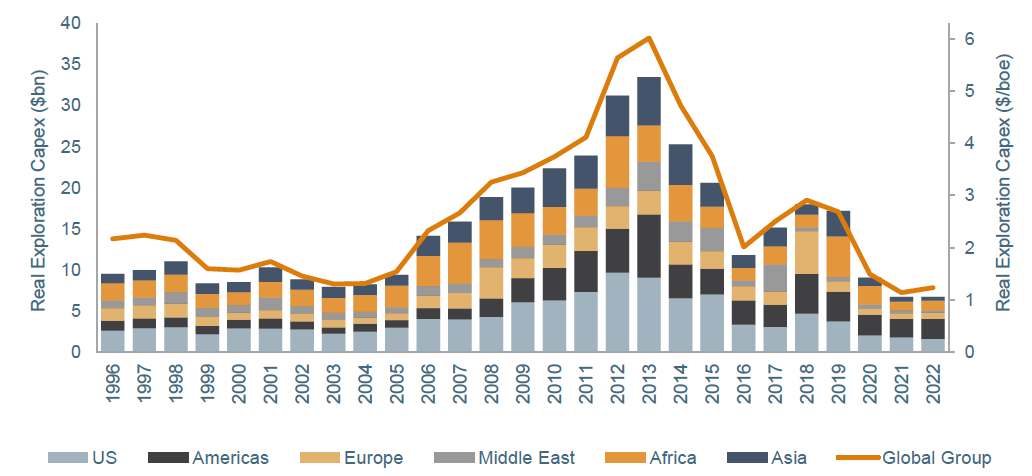
The real exploration capital expenditure of the five Super Majors fell from approximately $5 per barrel in 2013 to a historic low of $1/boe in 2022. The author notes that despite demand reaching a record high in 2022, the market has depressed asset valuations due to expectations of future demand decline. Among the 14 major demand forecasts reviewed by the International Energy Forum (IEF), the median oil demand for 2050 is 84 million barrels per day, a moderate decline of about 15% from current levels. However, the author argues that the asset discount indicates this median view is not a consensus—"the fact that implied asset values remain at large discounts to replacement cost tells us this median view is not consensually held." Management incentives have shifted from growth targets a decade ago to capital return and shareholder return objectives, constraining production growth. The United States has lost 1.1 million barrels per day of refining capacity over the past few years (out of a total capacity of 19 million barrels per day), with the last major refinery, Marathon's Garyville facility, built in 1977.
Complex Refineries Gain Structural Advantage from Environmental Regulations, Japan Particularly Benefits
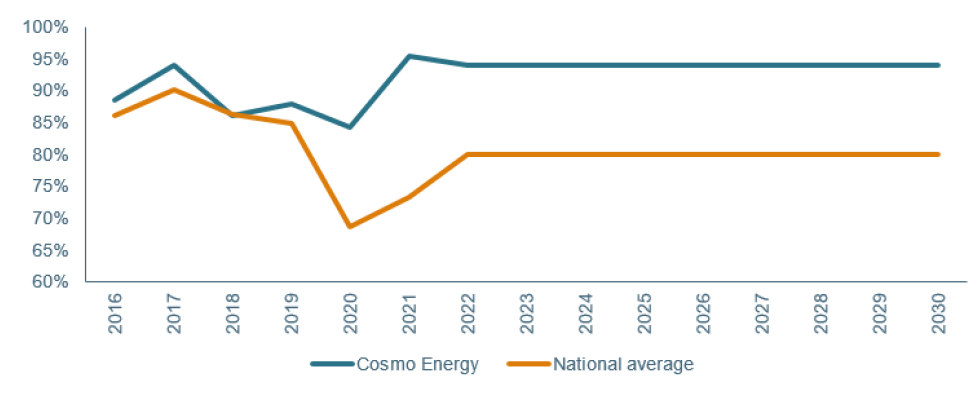
Environmental regulations are creating demand for complex refineries, and Japan's refining industry holds an advantage due to early investments in desulfurization equipment. The author points out that Japan's refining industry leads globally in complexity, with a desulfurization equipment-to-nameplate capacity ratio of approximately 90%, stemming from regulations enacted decades ago to address pollution from imported Middle Eastern crude oil. This positions the industry favorably for subsequent environmental policies, such as IMO2020, which lowered the sulfur content cap for marine fuel from 3.5% to 0.5%. Cosmo Energy's high complexity has enabled its refinery utilization rates to consistently exceed the industry average (as shown in the original chart). The author also observes that state-owned enterprises in the Middle East, China, and India are investing in upstream and downstream capacity, while the International Energy Agency (IEA) expects global net capacity additions of about 1.7 million barrels per day this year. However, ongoing closures in developed regions will offset this growth, leading the U.S. and Europe to import more refined products in the future—a rationale behind the author's investment in product tanker companies.
Investment Implications
Hosking Partners believes the refining industry is in an undervalued phase of the capital cycle, with discounts to replacement cost creating a margin of safety. The author explicitly states: "We are generally humble when facing the challenge of predicting the future demand of anything, but we are naturally drawn to the margin of safety generated by low valuations." Institutional perspective bias: As a position holder, the author has an incentive to emphasize the undervaluation logic. Readers should note the implicit assumption in the argument that "demand will not decline rapidly"—if the energy transition accelerates, the discount may reflect genuine prospects rather than market misjudgment.
At a Glance
Japan's Oil Refining Industry Enters the "11th Inning," High Probability of Supply Squeeze
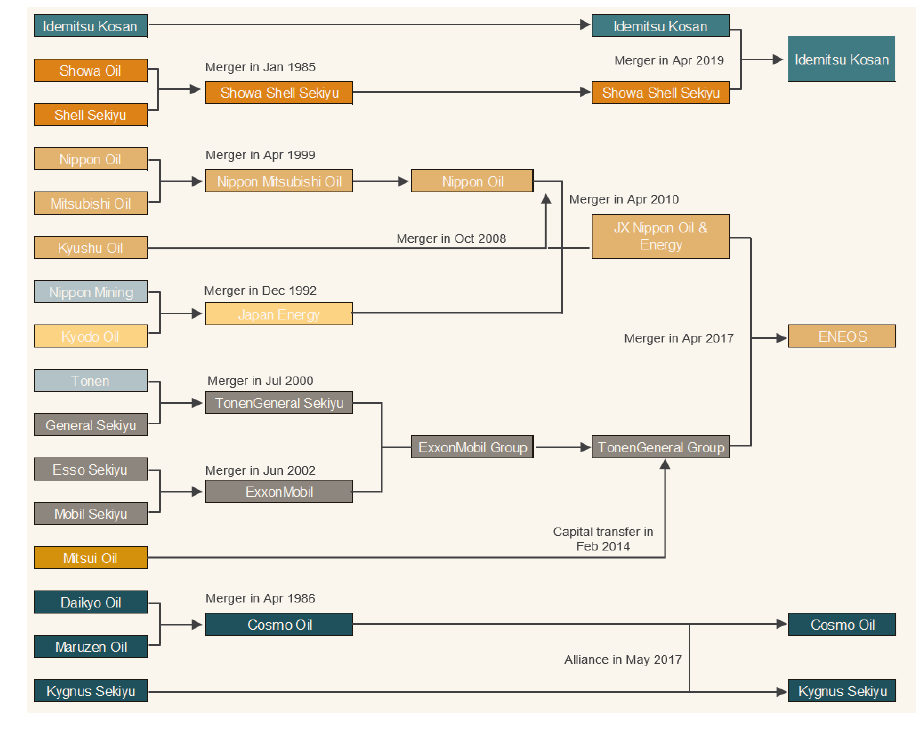
Japan's Ministry of Economy, Trade and Industry (MITI) has long led a consolidation policy of "closing simple refineries, retaining complex ones," significantly boosting industry concentration. In 2022, the industry's most complex refinery, Toa Oil's Keihin Refinery, was acquired by major player Idemitsu Kosan; previously in 2019, Idemitsu had merged with Showa Shell Sekiyu's complex refinery. The author notes that both Japanese and Western activist investors have driven consolidation with MITI's backing, stating, "One might say we are in the 11th innings" — meaning the game is nearing its end. The chart below shows that the current three major refining companies can be traced back to 16 original entities.
| Consolidation Event | Year | Key Parties |
|---|---|---|
| Toa Oil's Keihin Refinery acquired | 2022 | Idemitsu Kosan |
| Merger of Idemitsu and Showa Shell's complex refineries | 2019 | Idemitsu Kosan, Showa Shell Sekiyu |
Japan's Oil Demand Falls 2.5% Annually; Planned 8% Capacity Shutdown Still Hard to Balance
Oil consumption accounts for nearly 40% of Japan's total energy mix, and the country relies almost entirely on imported crude, but demand is declining at a steady rate of approximately 2.5% per year (contrary to the global trend). This stems from population shrinkage, making it even harder to maintain the industry's financial health. Idemitsu and ENEOS plan to shut down 8% of capacity over the next few years to balance supply and demand. The author argues: "Experience tells us this is a very hard balance to strike, and the probability of a squeeze is high, particularly for complex refineries that can produce low sulphur product for export as well as for the domestic market."
Cosmo Energy: Activist Shareholder Holds 20%, Commits to 60%+ Payout Ratio
Cosmo Energy's largest shareholder is veteran Japanese oil and gas activist investor Yoshiaki Murakami, holding a 20% stake; without the company's recent adoption of a poison pill, his stake could have been higher. Although Murakami has not publicly disclosed his investment rationale, he is pushing for board representation to oversee the spin-off of renewable energy assets. The author believes his views are likely reflected in the seventh medium-term plan announced in March 2023: a commitment to return ≥60% of cumulative profits to shareholders over the next three years. Notably, Cosmo was trading at 5.3x the Bloomberg estimate of FY2023 earnings at the time.
Tokyo Stock Exchange Pressures Below-Book Stocks; Japan's Buybacks Hit 16-Year High
Cosmo's shareholder return commitment is not an isolated case but part of a broader "paradigm shift" in Japan. Nikkei data shows that last year, Japanese buybacks reached a nearly 16-year high of approximately ¥10 trillion, and this year's figure is almost certainly higher. The Tokyo Stock Exchange (TSE) recently publicly urged attention to companies with price-to-book ratios below 1x and threatened to delist them from the prime market if reasonable measures to improve valuations are not taken. The author notes this is just one in a series of measures tracing back to former Prime Minister Abe's "three arrows" economic reforms. Japan is shifting from "providing full employment for a shrinking workforce" to "providing pensions for an expanding retired population," with the conversion of savings into investment and improved capital efficiency signaling this shift in national mission.
Investment Implications
After visiting Tokyo this month, Hosking Partners increased its Japan allocation to a record high of 9.5%, primarily driven by Cosmo Energy and other attractive investments. The author sees asymmetric opportunities in Japan's refining industry amid supply squeezes and improved shareholder returns. Institutional bias note: As an active fund manager, Hosking's narrative of "adding positions after a visit" carries an optimistic tilt from a holder's perspective; readers should note that the structural risk of long-term declining demand in Japan's refining sector has not disappeared.
Position Moves
| Ticker | Direction | Author's One-Sentence View | Key Data |
|---|---|---|---|
| Cosmo Energy | Add | Replacement cost is 2x enterprise value, plus activist shareholders driving return improvement — a core Japan allocation | Replacement cost ~$14B (2x EV); P/E 5.3x; committed to returning ≥60% of earnings to shareholders |
| Tüpraş | Hold & Watch | Replacement value of $19.5B is 11x book PP&E; the discount reflects investor sentiment toward refineries, not fundamentals | Four refineries' replacement value $19.5B (up from $12B pre-pandemic) |
| Idemitsu Kosan | Hold & Watch | Through the acquisition of Toa Oil's Keihin refinery (2022) and merger with Showa Shell (2019), post-integration supply squeeze probability is high | Plans to shut down 8% of capacity over the next few years |
| ENEOS | Hold & Watch | Jointly plans to shut down 8% of capacity with Idemitsu to maintain supply-demand balance | Plans to shut down 8% of capacity |
| Product Tanker (unnamed) | Hold & Watch | Refinery closures in developed regions will lead the US and Europe to import more refined products, benefiting product tankers | US has already lost 1.1M bpd of refining capacity (total capacity 19M bpd) |