Where’s a copper when you need one
Hosking Partners is a London boutique founded in 2013 by Jeremy Hosking, a portfolio manager at Marathon Asset Management for over 25 years. It runs a single global equity strategy built on the capital-cycle, supply-side approach — contrarian, long-term, and unusually diversified (350+ holdings) under a multi-counsellor model, managing around $5.5bn.
In plain words
This report says copper mining could be very profitable because new mines are hard to find and existing ones have less copper, while demand from EVs and renewable energy is rising. The fund manager is bullish on copper prices and thinks copper stocks are cheap now. They recommend buying a basket of copper miners rather than betting on just one. Key holdings mentioned: Codelco (production stalled, showing industry underinvestment) and Hudbay (predicts a big future copper shortage).
At a Glance
One-sentence summary: The author argues that the copper mining industry will benefit long-term from energy transition demand due to structural supply constraints (declining ore grades, underinvestment, geographic concentration), is bullish on copper price upside, and recommends investing in copper mining stocks via a diversified basket strategy. [Bullish]
- Global copper supply faces multiple pressures: ore grades have fallen below 1%, major miners' capital expenditure dropped from approximately $165 billion in 2012 to just $100 billion in 2021, and the average time from discovery to production for new mines has extended to nearly 14 years.
- The refined copper market deficit is expected to reach 20% (about 6–7 million tonnes) by 2035, whereas the largest historical deficit between 1994 and 2022 was only 2.5%, during which copper prices rose fivefold.
- Copper mining stocks currently trade at a discount relative to spot copper prices ($4 per pound) and long-term consensus copper prices. If the supply-demand imbalance persists, this discount may disappear, and copper prices could rise to $10 per pound before the end of this decade.
- Hosking Partners allocates approximately 6% of its portfolio to a basket of copper mining stocks. The core miners produced a combined 4.4 million tonnes of copper in 2021 (roughly 20% of global output), with annual EBITDA of about $24 billion.
Supply-Side Analysis Is More Reliable Than Demand Forecasting
The core of capital cycle analysis focuses on the supply side, as supply is easier to quantify than demand, and supply-driven industry investment cycles often span decades. The article notes that while demand forecasting is fraught with uncertainty, supply-side capacity expansion is typically traceable. The author states, "the supply of ‘stuff’ is demonstrably easier to quantify than future demand for it: most industrial and service capacity is entirely tangible, or measurable in some other way, thus the range of outcomes over a given time period is narrower for supply than demand." This means: "The supply of 'stuff' is clearly easier to quantify than future demand for it: most industrial and service capacity is entirely tangible or measurable in some other way, so the range of outcomes over a given time period is narrower for supply than for demand." The article emphasizes that the more capital flows into an industry, the lower the returns on residual capital, and vice versa. The supply cycle in the copper mining industry spans decades, requiring a truly long-term investment perspective.
Copper Supply Faces Structural Constraints: Declining Grades, Underinvestment, and Geographic Concentration
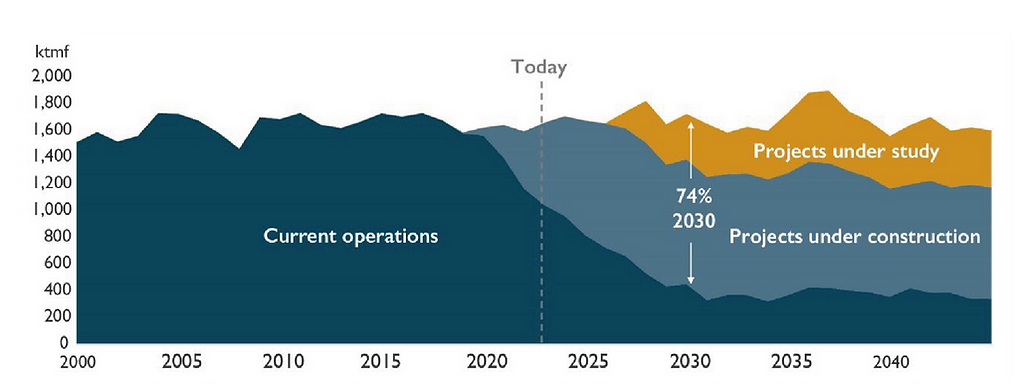
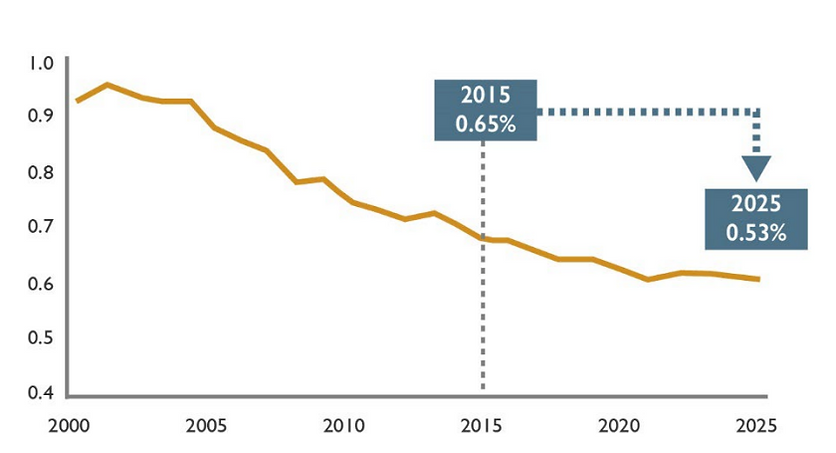
Global copper supply is under multiple structural pressures, including persistently declining ore grades, underinvestment in major producing countries, and a highly concentrated supply chain. The article provides a series of data points:
- Declining grades: The average purity (grade) of copper ore has now fallen below 1%, meaning less than 1 kg of copper per ton of ore. Grades at existing old mines continue to decline as ore bodies are extracted.
- Geographic concentration: The world's top two producers, Chile and Peru, together account for nearly 40% of the global 21 million tons of production. China holds nearly 50% of global smelting capacity and 40% of refining capacity, reflecting China's long-term planning for strategic industries, which Western supply chains have failed to replicate.
- Underinvestment: Major listed mining companies globally have consistently cut capital expenditures. Total mining capital spending fell from approximately $165 billion in 2012 to just $100 billion in 2021. Meanwhile, exploration returns have declined significantly: between 1990 and 2008, copper exploration budgets averaged around $1 billion, but after 2008, budgets doubled, yet only a few new copper mines were discovered (in geographically challenging regions such as Mongolia and the Democratic Republic of the Congo). According to Bloomberg Intelligence, the average time from first discovery to first production has extended from about 10 years in previous cycles to nearly 14 years in 2021.
Codelco's Stagnant Output Is a Microcosm of Supply Constraints
As the world's largest copper producer, Codelco's output has remained largely flat over the past two decades, reflecting persistent underinvestment and growing political headwinds. The article notes that Codelco's mine production has long hovered around 1.6 million tons per year. It operates the world's second-deepest open-pit mine (reaching a depth of 850 meters), and environmental issues arising from Chile's mining expansion have become highly politicized. The report argues that this supply constraint is not an isolated case but lays the groundwork for a supply-constrained industry for years to come. Canadian copper producer Hudbay forecasts that by the mid-2030s, the global copper market could face a deficit of up to 12 million tons annually.
Investment Implications
Through capital cycle analysis, the article clearly points to the copper mining industry as having investment value due to supply constraints. The author believes that against a backdrop of uncertainty on the demand side (e.g., variables such as global GDP growth, electric vehicle adoption rates, and the share of renewable energy in the grid), supply-side constraints (declining grades, underinvestment, and difficulty in discovering new mines) are more certain, which will drive up returns on existing capital. Readers should note that this is a perspective from a position holder, and the article itself carries a narrative component that defends mining investments.
At a Glance
The article emphasizes that while precise demand forecasting for copper is avoided, the directional judgment on copper demand is clear. The author notes that demand forecasts related to the energy transition have become "doubly unreliable" due to politicization. Roman Cassini, ESG Head at Hosking Partners, states bluntly: "If you draw a line in the sand and say 'for the world to reach net zero by a certain date, X, Y, and Z must happen,' and then forecast demand based on that, you turn the forecast into fatalism. The net-zero journey is not a single path but a maze. Accurately predicting long-term demand under such conditions is like trying to find the fastest exit from a maze blindfolded." Nevertheless, the article argues that copper's demand outlook is robust and relatively price-inelastic, driven by two main factors: baseline demand linked to GDP growth (projected at a compound annual growth rate of 2-3% through 2050) and additional demand from the energy transition.
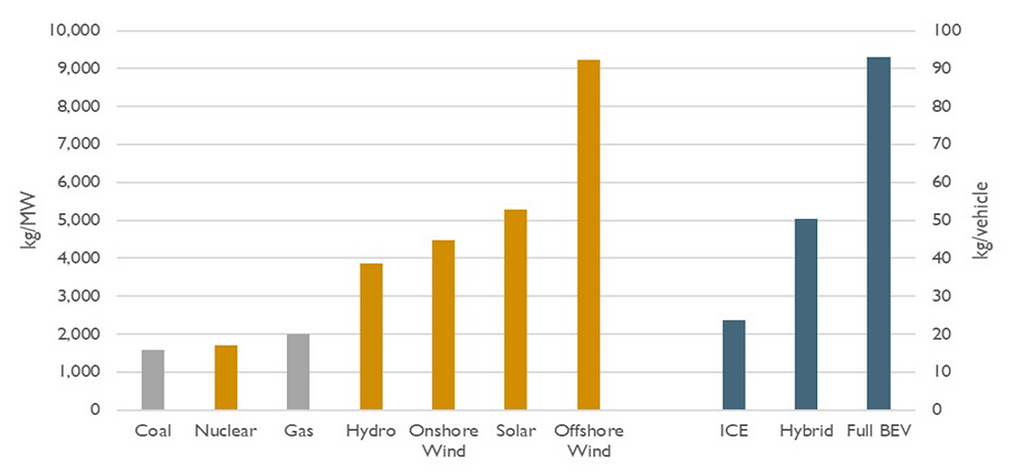
Three Major Energy Transition Trends Will Significantly Boost Copper Demand, Potentially More Extreme in the Medium Term
The article points out that electric vehicles (EVs), renewable energy, and grid expansion will substantially increase copper consumption. Specific data include:
- Electric vehicles: Require 2-3 times more copper than internal combustion engine vehicles.
- Renewable energy: Require 2-5 times more copper per megawatt of installed capacity than natural gas or coal.
- Grid transmission: Nearly one-third of global copper demand is related to wires.
Energy strategy firm Thunder Said Energy forecasts that by 2050, the annual growth rates for copper demand from these three trends will be 9%, 5.2%, and 5.6%, respectively. The article further notes that if governments genuinely fulfill their decarbonization targets, medium-term demand growth will be more "front-loaded." For example, if all countries with announced EV adoption targets achieve them, the compound annual growth rate for EV-related copper demand could reach 26% by 2035, with annual consumption surging from 300,000 tons in 2022 to 6 million tons.
Supply-Side Bottlenecks and Expectations of Historic Shortages, Significant Upside for Copper Prices
The article argues that long supply cycles and low capital expenditure will lead to severe copper market shortages. A recent expert research model shows that under a rapid electrification scenario, the refined copper market deficit is expected to reach 20% (approximately 6-7 million tons) by 2035. For comparison, the largest historical deficit between 1994 and 2022 was only 2.5%, during which copper prices rose fivefold from $0.70 per pound to $3.80 per pound. The article cites a portfolio company's view that supply tightness could push copper prices to $10 per pound before the end of this decade, compared to the current price of $4 per pound and the industry's median cost of approximately $2.30 per pound. The author believes that high copper prices will eventually stimulate supply (including recycling and substitution), but "this time, there is good reason to believe returns will remain elevated for longer," citing factors such as management's focus on balance sheets, extended permitting timelines for new mines due to ESG regulations, water regulations driven by climate change, and higher capital costs from operational carbon intensity.
Copper Mining Stocks Trade at a Discount, Supply-Demand Imbalance May Offer Upside
The article notes that copper mining stocks currently trade at a discount relative to spot copper prices and consensus long-term copper prices. The author believes that if copper scarcity, demand growth, and mining capital expenditure remain balanced, copper mining stocks could close this discount. If copper prices experience an unexpected "squeeze," it would represent a clear upside opportunity for mining stocks. The article emphasizes that the current low valuation multiples of mining companies "imply the market expects today's returns to reverse quickly," but the author judges the opposite may be true.
| Comparison Item | Current Level | Potential Scenario |
|---|---|---|
| Copper Price | $4 per pound | Could rise to $10 per pound before the end of this decade |
| Industry Cost (50th percentile) | $2.30 per pound | - |
| Largest Historical Deficit (1994-2022) | 2.5% | Deficit projected to reach 20% by 2035 |
| Copper Mining Stock Valuation | Discount relative to spot copper price and consensus long-term copper price | Discount may disappear if supply-demand imbalance persists |
Investment Implications
The article builds a bullish case for copper mining investments through the dual logic of supply constraints and demand growth. However, it should be noted that the author, as a position holder, presents optimistic forecasts (e.g., copper prices rising to $10 per pound) with a clear narrative bias, and extensively hedges on the "uncertainty" of demand forecasts. Readers should be cautious about risks such as weaker-than-expected demand or a stronger-than-expected supply response.
Invest in Copper Miners via a Basket, Not Single Stocks
Hosking Partners uses a basket of copper mining stocks (approximately 6% of the portfolio) to diversify single-stock risk while retaining exposure to a few companies capable of counter-cyclical production growth. The report notes that the core miners in this basket produced a combined 4.4 million tonnes of copper in 2021 (roughly 20% of global output), generating around $24 billion in EBITDA annually. By this estimate, the entire copper mining industry's EBITDA stands at approximately $125 billion, comparable to Apple's 2022 EBITDA. The author states: "This high-level comparison does not suggest to us an industry that is over-earning, particularly given the critical nature of copper to the climate transition process."
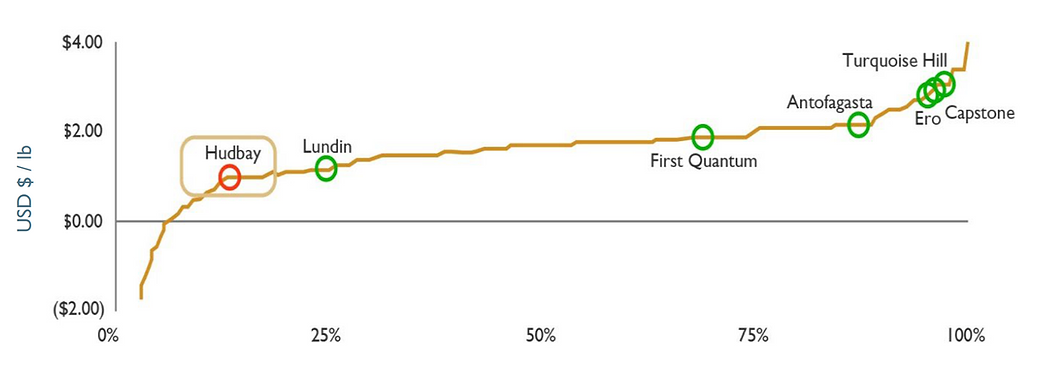
Concentrated Bets on a Single Mining Stock Ignore Political and Geological Risks
The report criticizes the market's enthusiasm for concentrated holdings, arguing that in cyclical industries, this exposes asset owners to risks. Copper mines are massive, immovable assets with sunk costs often running into billions of dollars, making them highly vulnerable to actions by governments and local communities. Expropriation, punitive taxes, shutdowns, and other forms of fiscal harassment are relatively common. The author emphasizes: "A concentrated, one-stock approach to the copper cycle – or indeed any commodity investment – ignores this reality." Therefore, a basket strategy is a rational choice to address such non-market risks.
Supply Constraints, Combined with ESG and Decarbonization, Will Double-Benefit Long-Term Copper Mining Returns
The report's core thesis is that constrained supply capacity, coupled with sustained demand growth, will jointly drive higher long-term returns for copper miners. Globally, local opposition to copper mining has intensified alongside the push for decarbonization. The author argues that long-term copper mining returns benefit from both ESG trends and the climate transition agenda. Adding to this, the core insight from capital cycle analysis—that the industry has long suffered from underinvestment, which should favor future returns—suggests that patient shareholders will see substantial returns over the next decade. The author concludes with a metaphor: "The net zero movie has only just begun…"
Investment Implications
The article clearly conveys Hosking Partners' bullish stance on the copper mining sector and recommends participation via a diversified basket. Readers should note that the firm itself holds relevant positions (the appendix lists 19 copper mining investment targets and their weights), so the analysis reflects a holder's perspective. However, the supply-side logic and supporting data are relatively robust.
Position Moves
| Instrument | Direction | Author's One-Sentence View | Key Data |
|---|---|---|---|
| Copper Mining Sector (Basket) | Add to position | Supply constraints + demand growth, attractive long-term returns, recommends a diversified basket strategy | Portfolio weight ~6%; core miners produce 4.4 million tonnes of copper annually, EBITDA ~$24 billion |
| Codelco | Hold and observe | Stagnant output (~1.6 million tonnes/year) epitomizes supply constraints, reflecting underinvestment and political headwinds | Operates the world's second deepest open-pit mine (depth 850 meters) |
| Hudbay | Hold and observe | Forecasts a global copper market annual deficit of 12 million tonnes by the mid-2030s | Cites its forecast data |