Quarterly letter 2Q2016
azvalor Asset Management is a Madrid deep-value boutique founded in 2015 by Álvaro Guzmán de Lázaro and Fernando Bernad, formerly the core of Bestinver's investment team in the Graham tradition. It is known for contrarian concentration in unloved cyclical assets — gold and silver miners, oil services, uranium — buying into panic and exiting once value is realized. Its flagship international fund is about 70% of firm AUM and has more than tripled since inception a decade ago; letters were quarterly from 2016-2022 and semiannual since 2023.
In plain words
This investment letter explains how Azvalor's funds beat the market in Q2 2016 by buying undervalued stocks. For example, Hyundai had more net cash than its market value, making it almost free, while Tesla was losing money but had a high price—they see it as overvalued. For regular investors, the message is to avoid trendy stocks and focus on profitable, cheap companies. They also warn that Brexit and quantitative easing (printing money) may not help the economy, and suggest emerging markets offer better long-term opportunities. It's worth reading because it uses clear examples to show why value investing works.
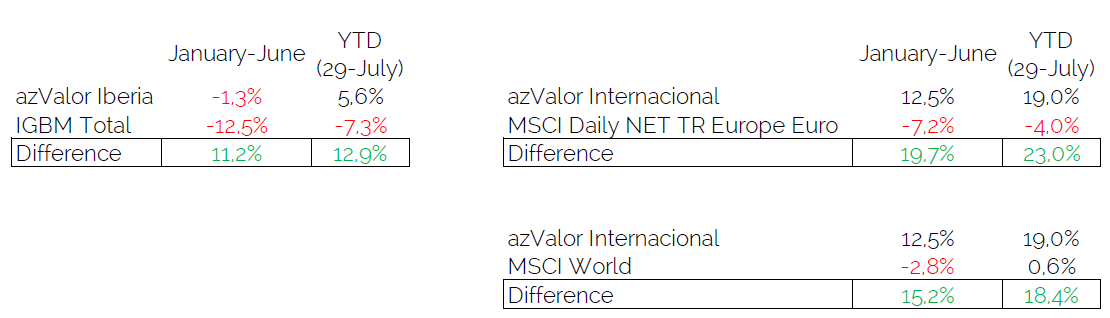
Azvalor's investment research article discusses the performance and investment strategy of its funds in the first half of 2016. The core view is that despite the uncertain market environment, the fund's performance significantly outperformed its benchmark. As of July 29, azValor Internacional achiev
Theme & Background
This chapter is the first part of Azvalor’s letter to investors for the second quarter of 2016. It primarily discusses fund performance, portfolio composition, and views on current market hot topics (such as Brexit and quantitative easing). The author emphasizes a long-term investment horizon (minimum holding period of 5 years) and explains why detailed holdings are no longer disclosed.
Core Views
- Fund performance significantly outperforms the benchmark: As of June 30, both azValor Iberia and azValor Internacional had expanded their excess returns over the benchmark; as of July 29, azValor Internacional’s excess return over the euro benchmark exceeded 22%.
- Portfolio valuations remain attractive: The international portfolio has a ROCE of 28% and trades at less than 7 times expected 2017 earnings; the Iberian portfolio has a ROCE of 16% and trades at 11 times earnings. Despite gains year-to-date, upside potential remains significant.
- Counterintuitive judgment: The author believes the current market valuation divergence is comparable to the dot-com bubble era, yet investment opportunities at reasonable prices still exist. For example, Tesla has a market cap of $30 billion and is loss-making, while Hyundai’s net cash exceeds its total market cap, effectively allowing investors to buy it for “free.”
Key Arguments & Data
- Portfolio Composition:
- International portfolio: 20% allocated to commodity-related companies; 20% allocated to “cyclical stocks + owner-operator” types (e.g., BMW); the remainder invested in companies with high ROCE, strong moats, and long-term upside.
- Cash levels: Approximately 16% for the international portfolio and 11% for the Iberian portfolio, expected to decline as target prices are reached.
- Valuation Comparison (Tesla vs. Hyundai):
| Metric | Tesla | Hyundai |
|---|---|---|
| Market Cap | $30 billion | Net cash exceeds market cap |
| 2015 Sales | 50,000 vehicles | Nearly 6 million vehicles |
| 2015 Net Profit | Loss of ~$900 million | Profit of $4 billion |
| Market Narrative | Will dominate the future battery market | Outdated, in persistent decline |
- Macro Judgments:
- Brexit will impact the European economy, as the UK exerts pressure on Europe in tax competition; EU negotiations without the UK may increase bureaucratic/socialist risks.
- Quantitative easing (QE) is ineffective, and alternatives (more QE, helicopter money) are equally ineffective, only delaying problems and worsening them.
- Emerging markets have better demographics, fewer welfare commitments, and greater potential for labor productivity growth; developed-market companies may benefit from this.
Companies/Assets Involved
- BMW: Represented as a “cyclical stock + owner-operator” type and included in the international portfolio.
- Tesla: Used as a negative example of valuation bubble; the author is bearish on its current valuation.
- Hyundai: Used as a positive example of undervaluation; the author is bullish on its current valuation.
- Commodity-related companies: Account for 20% of the international portfolio; the author does not name them specifically but emphasizes continued confidence despite market ridicule.
Investment Implications
- Adhere to value investing: With extreme valuation divergence in the current market, investors should avoid chasing high-valuation bubble stocks (e.g., Tesla) and instead focus on low-valuation, high-ROCE, cash-rich companies (e.g., Hyundai).
- Beware of macro risks: Brexit and the failure of QE may exacerbate political and economic turmoil in Europe. Investors should reduce excessive exposure to the euro and European assets and consider opportunities related to emerging markets.
- Hold for the long term: Portfolio cash levels will naturally decline as target prices are reached; investors need not trade frequently and should patiently wait for value to return.
Theme and Background
This chapter is a letter from Álvaro Guzmán de Lázaro Mateos, CEO and Chief Investment Officer of Azvalor Fund, to investors. It primarily discusses the working status of the company's internal team, the growth of the fund's scale, and the launch of new products. The author emphasizes that the fund's success depends not only on investment research but also on the investor relations team's ability to stabilize client sentiment during market panics.
Core Thesis
The author's central argument is: The success of value investing requires the enthusiasm and discipline of the entire organization, not just stock-picking ability. The counterintuitive judgment is that selling stocks during market panic is "absolutely wrong," and the task of the investor relations team is to prevent clients from exiting at the wrong time, thereby ensuring the execution of the long-term investment strategy.
Key Arguments and Data
- Research Team Size and Commitment: The author describes that the research department has 8 members (including China analyst Mingkun Chan), emphasizing that their "overworked" enthusiasm is key to value theory being "applied" rather than merely "preached."
- Role of the Investor Relations Team: This team (led by Beltrán Parages) has answered thousands of calls and met with hundreds of investors, with the core task of explaining that "stocks do not rise forever" and "market panic is never a time to sell." This has attracted "increasingly confident and patient clients."
- Fund Size and Client Count:
- "Investor family" size: 6,500 people
- Assets under management: Institutional mandates/SICAVs €850 million, investment funds €1.024 billion (total approximately €1.874 billion)
- New Products: With the efforts of the administrative/back-office team led by Sergio Fernández-Pacheco, two pension funds were successfully launched before summer:
- azValor Global Value: 100% global equities
- azValor Consolidación: Only 50% invested in equities (more conservative)
Companies/Assets Involved
| Asset/Product | Type | Key Data |
|---|---|---|
| azValor Internacional / azValor Series Funds | Global equity fund | Assets under management €1.024 billion (investment fund portion) |
| Institutional mandates/SICAVs | Institutional accounts | Assets under management €850 million |
| azValor Global Value | New pension fund | 100% global equities |
| azValor Consolidación | New pension fund | 50% equities, more conservative |
Investment Implications
- Implications for Fund Holders: The author's clear signal is that the fund's strategy relies on long-term holding, and investors should accept short-term volatility. The existence of the investor relations team is to prevent clients from redeeming during panic, so investors should remain patient and not exit due to market declines.
- Implications for Potential Investors: Azvalor is expanding its product line (pension funds), indicating a desire to attract a broader base of long-term capital. However, the author emphasizes that the fund's success depends on team enthusiasm and client trust, not short-term market timing. Investors should assess whether they can accept this long-term value investing style, which does not disclose holdings in real time or pursue short-term gains.