Shipping: A bigger splash?
Hosking Partners is a London boutique founded in 2013 by Jeremy Hosking, a portfolio manager at Marathon Asset Management for over 25 years. It runs a single global equity strategy built on the capital-cycle, supply-side approach — contrarian, long-term, and unusually diversified (350+ holdings) under a multi-counsellor model, managing around $5.5bn.
In plain words
This report says shipping is in a long-term upcycle because few new ships are being built, environmental rules are scrapping old ones, and longer trade routes boost demand. The author, Hosking Partners, is bullish, seeing overlooked opportunities. Key holdings: Pacific Basin Shipping Ltd (won't order new ships until zero-carbon ones are available), Hafnia (product tanker, trimmed position), and a shipping basket (6% of portfolio vs 0.1% benchmark, up 274% in four years).
At a Glance
One-sentence summary: The author believes the shipping industry is in a structurally upward cycle due to supply constraints (historically low newbuilding orders, accelerated phase-outs from environmental regulations) and structurally supported demand (deglobalization lengthening shipping routes, energy transition amplifying volatility), with a stance of [Bullish].
- The shipping portfolio has outperformed its benchmark by approximately 25% cumulatively since 2017, with a return of 274% (in USD) over the past four years.
- Shipping accounts for 6% of the portfolio versus just 0.1% in the benchmark, representing a significant active bet.
- Deglobalization (US-China tensions, shadow fleet) boosts ton-mile demand while effectively reducing available supply.
- The energy transition leads to heightened energy price volatility, constrained supply from aging fleets, and newbuilding orders falling to multi-decade lows.
- Simple ESG carbon intensity metrics (WACI) distort shipping efficiency, causing the sector to be shunned by long-term investors, creating a contrarian opportunity.
The "Unholdable" Label in Shipping Is Precisely the Gateway to Opportunity
The article opens by stating its core thesis: although shipping carries 80% of global trade, it is viewed by long-term investors as an "unholdable" sector, yet Hosking Partners' capital cycle perspective can uncover hidden upside within it. The author revisits a 2017 article that first focused on shipping and notes that over the subsequent seven years, the portfolio's shipping holdings have significantly outperformed the ACWI benchmark. The author states: "Seven years later – over which period the portfolio’s shipping holdings have outperformed our ACWI benchmark by a considerable margin – we return to the high seas once again to discuss this fascinating but often overlooked area of the equity market."
The article uses the shipping industry as a case study to tie together arguments repeatedly made in earlier reports such as "The Net Zero Maze," "A Multipolar World," and "Embracing Complexity": the energy transition will not unfold as most expect, and simplified ESG approaches may lead to capital misallocation. The author argues that shipping "brings this to life, and demonstrates how our capital cycle approach allows us to see the world from a differentiated perspective, unlocking opportunities others find difficult to access."
Deglobalization Is Not a Threat but a Driver of Ton-Mile Demand
The author argues that deglobalization trends (U.S.-China tensions, the "shadow fleet" spawned by Russian energy sanctions) will not suppress shipping; instead, they may boost ton-mile demand by lengthening routes and reducing efficiency, thereby benefiting an industry with constrained supply. The article notes that global trade as a share of GDP has hovered in the 20-25% range since 2010, ending decades of sustained growth. The author states: "Since 2010, it has stopped growing and been range-bound between 20-25%."
The author acknowledges that geopolitical instability could trigger a long-term contraction in trade but emphasizes a different conclusion from a supply perspective: "a supply-focused lens shows that it is not necessarily a wholly negative picture for investors." The key logic is that deglobalization (or more accurately, "re-localization") may reduce shipping route efficiency and fleet utilization, thereby effectively curtailing available supply; meanwhile, commodity price volatility driven by the energy transition will actually stimulate cross-regional arbitrage transport demand.
Energy Transition Amplifies Volatility, Aging Fleet Supply Constraints Support Freight Rates
The article judges that the energy transition will significantly increase energy price volatility, and shipping—as a vehicle for cross-regional arbitrage—will benefit; meanwhile, environmental regulations accelerate the scrapping of older vessels, new vessel orders are at historic lows, and supply constraints will support freight rates. The author points out that the annual output volatility of intermittent energy sources like wind and solar reaches ±3.5%, and when their share of useful energy rises from 5% to 30%, the standard error of the global energy balance could double. This means that a ±2% swing in the energy balance due to abnormal weather could become 250 times more likely by 2050 than today.
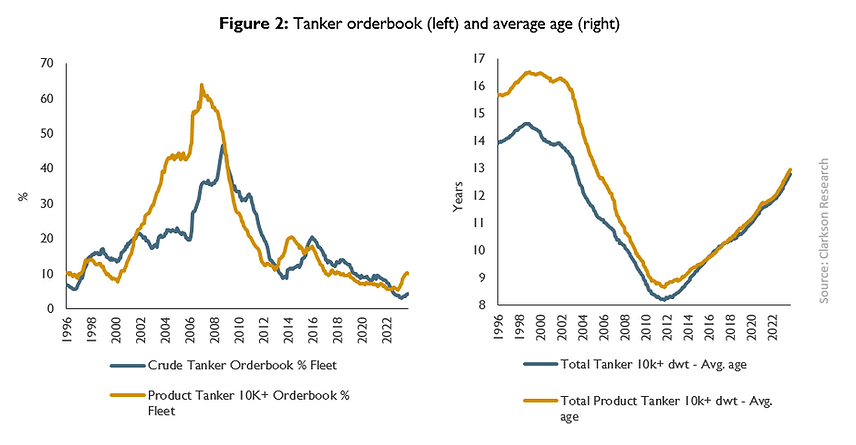
Against this backdrop of uncertainty, new vessel orders in shipping have fallen to multi-decade lows, and the average fleet age continues to rise (Figure 2 in the original text). The author concludes: "The dual trends of deglobalisation and the energy transition are likely to constrain future supply as uncertainty across several fronts suppresses new vessel orders into the 2030s." Supply constraints combined with rising demand volatility form the core logic behind the author's bullish view on shipping.
Investment Implications
The article offers investors a clear contrarian framework: when the market shuns shipping as "unholdable," the capital cycle perspective instead reveals structural opportunities from supply contraction. Readers should note that this is a position-holder's perspective—the author uses the portfolio's strong performance to support the thesis, but the cyclical risks of shipping (e.g., freight rate collapses, geopolitical black swans) are not fully explored. The article will later discuss specific holdings of Hosking Partners (tankers, dry bulk, LNG carriers, etc.) and how these sub-sectors have outperformed the benchmark in recent years.
The shipping industry's carbon emissions share is small, but its "hard-to-abate" nature makes it a target for ESG investors
Shipping contributes approximately 3% of global CO₂ emissions, ranking second in freight transport behind trucks (5%) and ahead of aviation (2.5%) and rail (0.5%). The report notes that shipping is a "hard-to-abate" industry: vessels are large and heavy, requiring high energy density fuels, with over 99% of energy demand currently met by petroleum-based fuels. Alternative solutions (biofuels, LNG, methanol, etc.) or carbon capture technologies are either immature or prohibitively expensive. Due to sustained global economic growth, total shipping emissions are rising rather than falling. Meanwhile, uncertainty over which technology will prevail in the future has led shipowners to delay new vessel investments—the author's original phrasing: "who wants to commit $250 million on a hard asset with a lifespan of 20+ years if it is unclear whether it will be able to operate in a few years’ time?"
Simple ESG carbon intensity metrics distort the true efficiency of shipping, making it "hard to hold"
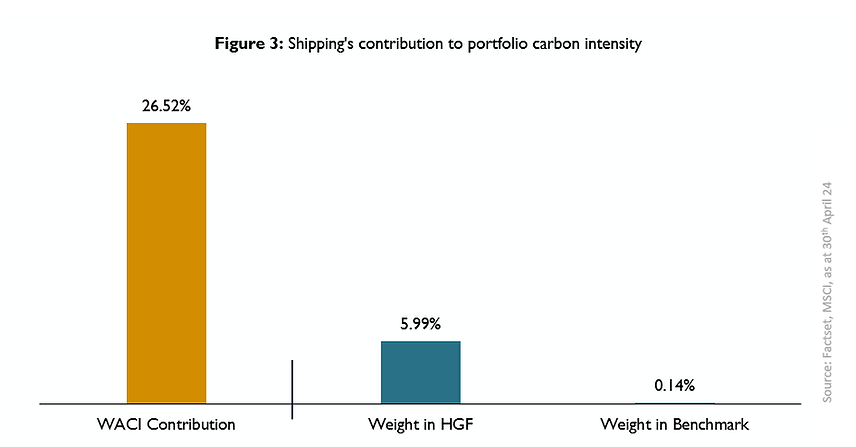
In Hosking Partners' unconstrained portfolio, shipping assets account for only 6% but contribute over 25% of the weighted average carbon intensity (WACI). The report argues that the commonly used WACI metric (emissions divided by revenue) structurally disadvantages shipping due to economies of scale (low revenue per tonne-kilometer). A more reasonable measure is emissions per tonne-kilometer: by this calculation, a ultra-large container ship is approximately 26 times more efficient than a truck and 145 times more efficient than an aircraft. Moreover, although total emissions have risen due to demand growth, emissions per tonne-kilometer have been steadily declining—thanks to proactive regulation by bodies such as the International Maritime Organization (IMO), including accelerated scrapping of older vessels and speed limits. Speed restrictions permanently reduce vessel speeds, thereby diminishing the global fleet's flexibility to respond to short-term demand spikes, effectively compressing effective supply capacity.
Low barriers to entry and high uncertainty jointly suppress new vessel supply, creating a "tighter for longer" supply landscape
Industry fragmentation and low entry barriers historically led to poor discipline among shipowners, but current fuel technology uncertainty and ESG-driven punitive capital costs are delaying supply responses. The report notes that many operators (such as Pacific Basin Shipping Ltd in the portfolio) have committed to not ordering new vessels until zero-carbon or near-zero-carbon ships are available and affordable. This limits "real" incremental capacity. Meanwhile, assessing management quality, shareholding levels, and incentive structures remains key to avoiding "pirate-style" shipowners. The report argues that technology uncertainty, low capital expenditure, simplistic ESG methodologies, imperfect emissions regulations, and the poor reputation of capital allocators collectively impose a natural constraint on short-term marginal supply. Over the past seven years, a basket of shipping stocks in Hosking Partners' portfolio has thus achieved higher returns on capital and share prices.
Investment Implications: Understanding cyclical differences across shipping sub-sectors is essential for dynamic position adjustments
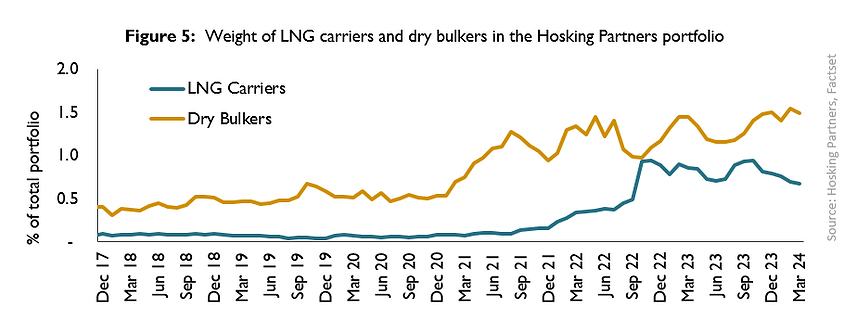
The report emphasizes that this is not a "one-size-fits-all" strategy; understanding the cycles of each shipping sub-sector and their interactions is crucial. For example, the LNG carrier orderbook has recently expanded in China, prompting the firm to reduce LNG carrier exposure over the past year and rotate into dry bulk (whose supply outlook is more attractive than in 2017). Meanwhile, signs of supply recovery in product tankers have led to a moderate reduction in Hafnia (which has delivered a 349% USD return since its initial position in 2019). Institutional perspective bias: As a position holder, the author tends to emphasize upside opportunities from supply constraints; readers should note that the criticism of ESG metrics may carry an element of self-justification.
Shipping Holdings Outperform Benchmark by 25%; Author Cites Supply Constraints and Long-Term Perspective as Core Advantages
Hosking Partners' shipping portfolio has outperformed its benchmark by approximately 25% cumulatively since 2017, with particularly strong performance over the past four years, achieving a cumulative return of 274% (in USD). As of the report's publication date, shipping companies account for about 6% of the portfolio, compared to just 0.1% in the benchmark—a significant active bet. The author states: "shipping companies make up about 6% of the Hosking Partners portfolio. This is a significant active bet – the weight in the benchmark is just 0.1%."
| Metric | Data |
|---|---|
| Cumulative excess return since 2017 | Approximately 25% |
| Cumulative return over the past four years (USD) | 274% |
| Shipping weight in the portfolio | 6% |
| Shipping weight in the benchmark | 0.1% |
|---|
The author attributes this success to a long-term perspective, unconstrained investment mandate, and a combination of bottom-up analysis with judgment on global trends. The author emphasizes that evaluating management behavior helps avoid principal-agent conflicts, while focusing on the supply side aids in identifying signals amid noise. The author concludes with a nautical metaphor: "our approach thus far has caught favourable winds, and with due caution and an eye on the horizon, we sense some life remains in this old sea dog yet."
Companies/positions involved: The text does not name specific shipping companies, but the overall portfolio direction targets shipping sub-sectors (tankers, dry bulk, LNG carriers, etc.). The author's stance is consistently bullish, citing reasons including supply constraints (low newbuilding orders, environmental regulations accelerating the scrapping of older vessels) and structural demand support (deglobalization boosting ton-mile demand, energy transition driving incremental LNG transport).
Investment Implications
The institution believes the shipping sector still has upside, but investors should note its long-position perspective. The author acknowledges that investing in shipping is "never likely to be plain sailing," but supply-side constraints (historically low newbuilding orders, environmental regulations accelerating fleet attrition) and long-term trends (deglobalization, energy transition) provide structural support. Institutional bias note: Hosking Partners holds a 6% overweight position, and its optimistic assessment is partly driven by its long-position stance. Readers should independently evaluate the downside risk of the freight rate cycle.
Position Moves
| Ticker | Direction | Author's One-Sentence View | Key Data |
|---|---|---|---|
| Pacific Basin Shipping Ltd | Hold & Observe | Has committed to not ordering new vessels until zero-carbon ships are available, demonstrating strong supply discipline | Specific holding percentage not disclosed |
| Hafnia | Reduce Position | Signs of recovery in product tanker supply, moderately reducing holdings | Dollar return of 349% since position initiation in 2019 |
| Shipping Portfolio (Tankers/Dry Bulk/LNG Carriers, etc.) | Add Position | Overall bullish outlook remains, supported by supply constraints and structural demand | Portfolio weight 6%, benchmark 0.1%; cumulative excess return of approximately 25% since 2017 |
| LNG Carriers | Reduce Position | Orderbook expanding in China, exposure has been cut over the past year | Specific reduction percentage not disclosed |