Search Engine to Steam Engine
Hosking Partners is a London boutique founded in 2013 by Jeremy Hosking, a portfolio manager at Marathon Asset Management for over 25 years. It runs a single global equity strategy built on the capital-cycle, supply-side approach — contrarian, long-term, and unusually diversified (350+ holdings) under a multi-counsellor model, managing around $5.5bn.
In plain words
This report says the AI investment boom is showing cracks, with US tech giants forced into a spending war while Chinese firms show better capital discipline. The author is cautious, noting early signs of doubt in US AI infrastructure. Key holdings: Alphabet (reduced) because its capital spending jumped from 10% to nearly 50% of sales, dragged into an AI compute arms race; Tencent (increased) because it uses low-cost AI to make money, with marketing revenue up over 20% and operating margins above 40%. The author advises waiting for the cycle to play out and looking for small, disciplined opportunities.
At a Glance
One-sentence summary of the author’s current market view: The AI capital cycle is shifting from frenzy to cracks, with US tech giants caught in a war of attrition, while Chinese companies demonstrate superior capital discipline. [Cautious]
- The author continues to reduce Alphabet (position 1.6%), as its capital expenditure as a percentage of sales has surged from 10% to nearly 50%, dragging it into the AI computing capital torrent led by OpenAI and Anthropic.
- The author increased Tencent (position 0.3%), as it profits from AI at low cost—marketing revenue grew over 20%, operating margin rose above 40%, and DeepSeek can be directly integrated into WeChat.
- Early signs of wavering confidence in US AI infrastructure: Nvidia seeks GPU residual value guarantees to shift risk, Amazon explores $8 billion GPU sale-leaseback, Oracle invokes force majeure on a 2.5GW data center.
- The author advocates “investing by avoidance, not prediction,” patiently waiting for a cyclical reckoning and seeking small opportunities that exhibit “deliberate behavior.”
1. Value Chain Fragmentation and Capital Allocation Specialization: A Recurring Cross-Industry Pattern
The article opens by identifying a recurring cross-industry pattern: value chain fragmentation, where the capital allocation process becomes more specialized. The author quotes David Bowie's lyrics "Turn and face the strange" as an introduction, noting that this pattern is typically driven by the strongest players in an industry, which divest or actively encourage competition in parts of the business model where value creation is lower. The author argues that this pattern is closely linked to the latest developments in AI and hyperscale cloud providers.
2. Strategic Divergence of US and Chinese Tech Giants: US Focuses on Monopoly, China Engages in Cross-Sector Chaos
The article compares the "comfortable" positions occupied by Alphabet (1.6% position, held since 2013) and Tencent (0.3% position, held since 2018) in the old tech value chain over the past two decades, as well as the divergence in performance between US and Chinese tech giants over the last decade. Both hold the "front-door keys" to the internet in their respective home markets—Alphabet through Search, YouTube, Gmail, and Android; Tencent through WeChat and its 1.44 billion monthly active users. Over the past decade, US tech giants (Alphabet in search, Meta in social media, Microsoft in enterprise software, Apple in consumer hardware, Amazon in e-commerce) each focused on their own niche, achieving monopolistic market share and returns. In contrast, China's major players—Tencent, Alibaba, Baidu, JD.com, Meituan—competed with each other across various domains, ultimately eroding profits. However, as the AI value chain evolves, this landscape appears to be reversing: US tech giants are increasingly encroaching on each other's territory, while Chinese companies are demonstrating stronger pricing discipline.
3. Stark Contrast in AI Investment Strategies: Alphabet Forced into a Capital Deluge, Tencent Chooses to "Let It Pass"
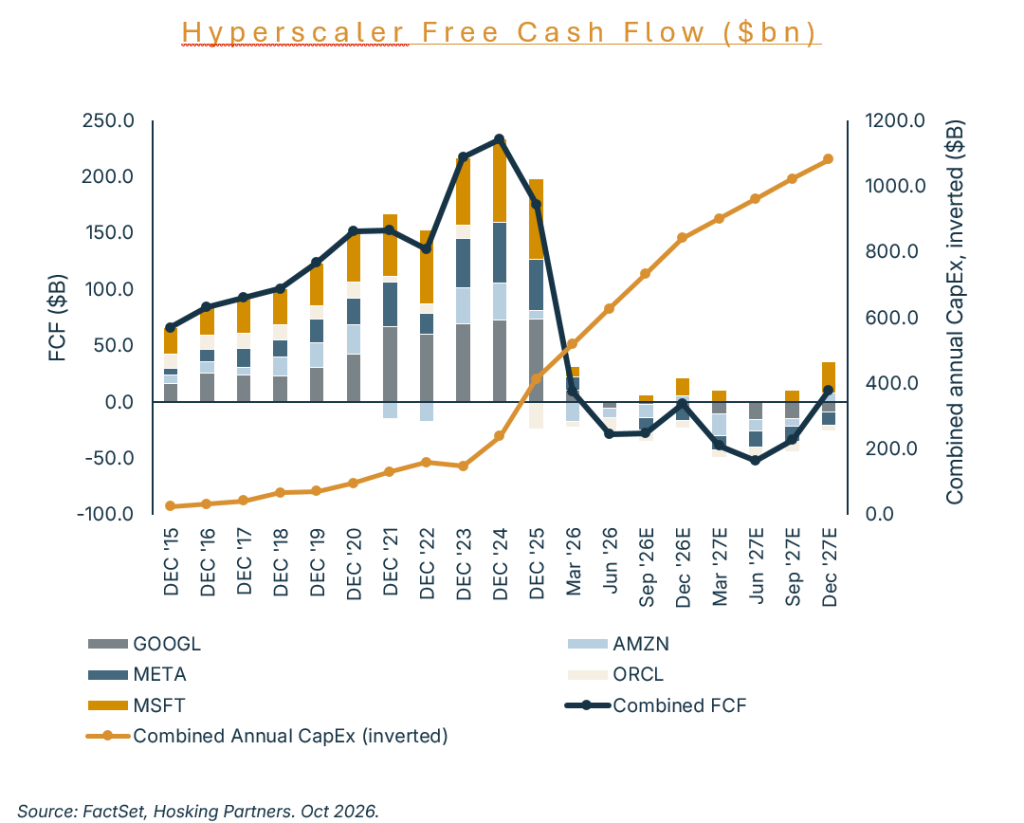
Faced with the threat of AI, Alphabet and Tencent have reacted in starkly different ways, reflected in the vast disparity in capital expenditure (Capex). The author argues that Alphabet is significantly increasing capital expenditure to meet the market's growing appetite for AI computing, effectively "dancing to the beat of its competitors' frontier model companies." Data shows that Alphabet's capital expenditure has surged from $90 billion in 2025 to an estimated ~$200 billion in 2026, with 2027 expected to see "significant growth" as well. Capex as a percentage of sales has risen from about 10% to nearly 50% in just a few years. In contrast, Tencent appears to be letting the entire AI revolution "pass by its door"—its 2025 capital expenditure was RMB 79 billion, roughly 10% of sales, which is approximately the level Alphabet was at before this cycle began. Although Tencent has plans to increase spending, the proposed amounts are only a fraction of its US counterparts.
4. The Structural Crisis in Search is the Root Cause of Alphabet's "Rearmament"
The primary reason for Alphabet's "rearmament" along the value chain is the structural crisis in search caused by competition from Large Language Models (LLMs). The author points out that when AI answers are provided to search users, their propensity to click on links (the core of the revenue model) is halved. As click-through rates decline, Google has significantly increased the number and price of sponsored links to maintain high monetization rates. While successful so far, the risk to user experience is evident. Capital intensity is increasing, while network effects are being weakened. Search runs on relatively modest distributed computing power, with network effects continuously improving algorithms; AI, however, is more "brutalist": LLMs require massive centralized computing. Alphabet is being dragged into an AI-compute capital deluge dominated by OpenAI and Anthropic, which continuously dangle unfettered demand growth in front of an increasingly frenetic market. The author's original words: "The journey looks painful and expensive as Alphabet gets dragged into an AI-compute capital deluge, puppeteered by OpenAI and Anthropic, who continue to dangle unfettered demand growth in front of an increasingly frenetic market." The author cautions that this incentive structure should make investors across the value chain think twice.
5. US AI Compute Investment Faces "Prisoner's Dilemma" and "War of Attrition" Risks, While China Demonstrates Cost Discipline
The article contrasts the different logics behind AI compute investment in the US and China, pointing out the risks of the US model and the greater cost discipline of the Chinese model. In the US, cloud data center computing was once an oligopolistic industry, but AI computing has made inference tokens largely a fungible commodity, making customers more price-sensitive. Frontier labs incentivize massive capacity buildout by signing multi-year compute contracts far exceeding their current revenue. For example, Oracle's capex-to-sales ratio surged from 13% in 2023 to 82% in 2024, backed by a $664 billion revenue backlog (nearly 10 times its current annual revenue), about half of which is believed to be related to OpenAI, which has an annual revenue of $50 billion. The author expresses skepticism, arguing that "the value of a backlog is only as good as the counterparty's ability to pay." In contrast, in China, due to export restrictions, Nvidia's market share has dropped from 95% to zero, limiting capex capacity, forcing Chinese companies to find alternatives and build LLMs with comparable performance on extremely low capital budgets. This reinforces the author's view that computing power is more like a commodity than US rhetoric and activity suggest.
6. Alphabet's Expensive Gamble: Providing "Ammunition" to Competitors and Betting on a Cost Curve Advantage
The article analyzes the complex game-theoretic logic behind Alphabet's massive investments, arguing it is an expensive but potentially rational asymmetric gamble. The author believes Alphabet's investment stems partly from a "prisoner's dilemma" (the CEO explicitly stated in 2024 that "the risk of under-investing is far greater than the risk of over-investing") and partly from a "war of attrition." While Alphabet's spending plan appears massive, it remains restrained compared to the over $1.5 trillion in compute contracts signed by OpenAI and Anthropic. Alphabet's goal is to "stay close enough to the frontier to be relevant, but not necessarily to lead it." Its key advantage is: if the frontier labs default, Oracle loses a customer (and could go bankrupt), while Google loses a competitor. Every dollar a lab pays to Google Cloud is a dollar less for its own funding. The author's original words: "Alphabet is in the enviable position of being able to monetise their competitors burn rate, extracting rent to the point of exhaustion." Furthermore, Alphabet is building data centers at what may be the industry's lowest cost. By keeping its unit token cost below that of competitors reliant on Nvidia, Google can remain profitable even if inference pricing is compressed to marginal cost.
7. Chinese Tech Companies Are Using AI to Make Money, Not Turning It into a "Religion"
The article points out that China's tech value chain is evolving into a more familiar pattern, where capital intensity does not overwhelm the business model. Treating AI computing and open-weight models as commodities allows existing platforms like Tencent and ByteDance to maintain their position in the value chain and find new profitable revenue streams. For instance, when Tencent's own model performance lagged in early 2025, it directly integrated DeepSeek into WeChat—something Alphabet could never do with ChatGPT, as it would leak significant value to OpenAI. Subsequently, Tencent rebuilt its own model behind WeChat. Meanwhile, Tencent's marketing revenue has grown over 20% in the past year, and its operating margin excluding new AI products has risen above 40%. The author concludes: "China, it seems, is using AI to make money. In the US it has become something of a religion."
Investment Implications
The core investment implication of this article lies in identifying the structural opportunities and risks arising from the restructuring of the AI value chain. The author argues that US tech giants (especially Alphabet) are being drawn into an expensive capital war of attrition, driven by competitors (OpenAI, Anthropic) and suppliers (Nvidia), with their traditional search business model facing a fundamental threat. In contrast, Chinese tech companies (like Tencent) demonstrate greater capital discipline and flexibility, enabling them to leverage AI at low cost to enhance existing businesses and create new revenue. This points to a potential investment theme: focus on companies that can use AI to enhance existing businesses at low cost, rather than those forced into massive capital expenditure, and remain wary of companies whose business models are being disrupted by AI and are being dragged into a capital deluge. (Institutional Perspective Bias: Hosking Partners holds positions in both Alphabet and Tencent. Its analysis may contain elements that justify its holdings; readers should be aware of this position-holder perspective.)
1. Cracks Appear in Capital Frenzy, AI Infrastructure Risks Are Emerging
The article points out that early signs of wavering confidence have emerged in the AI infrastructure investment boom, with several key participants beginning to adopt risk-averse behavior. The author lists a series of specific events: Nvidia is looking to offload its GPU residual-value guarantees onto insurance companies; Amazon is exploring selling $8 billion worth of GPUs into a special purpose vehicle (SPV) and leasing them back; Oracle has invoked force majeure on a 2.5GW data center project in New Mexico; and landlords are demanding stricter guarantees, such as Nvidia providing guarantees for OpenAI's data center lease worth up to $105 billion. The author's original words state: "Nvidia is looking to foist its GPU residual-value guarantees onto insurance companies; Amazon is exploring selling $8bn worth of GPUs into an SPV and leasing them back." These signals indicate that even amid the AI capital flood, market participants are beginning to recognize potential risks and seek hedges.
2. Tencent and Alphabet: Same Rationality, Radically Opposite Strategic Choices
The author argues that both Tencent and Alphabet have made economically rational decisions, but in diametrically opposite directions, representing the two extremes of the capital cycle. The author's core judgment is that the combination of rising capital expenditure, intensifying competition, and pressure on marginal returns typically signals mediocre returns on incremental capital. Alphabet (position direction: reduced, but still held) will inevitably bear the pressure of this dynamic—this is also one reason the author has been steadily reducing its long-term position. However, the author retains a position, citing its ability to "counter-position" against frontier AI labs and to consolidate its dominant position when the cycle reverses. Tencent (position direction: increased) is held for the opposite reason: its business model is stable, and it can generate substantial value without an extreme change in capital intensity. The author's original words state: "We own (and have added to) Tencent for the opposite reason: business-model consistency and the ability to generate substantial value without an extreme change in capital intensity."
3. Investment Strategy: "Avoidance" Over "Prediction," Patiently Awaiting the Cycle's Reckoning
The article advocates that in the current highly uncertain and chaotic AI investment environment, investing through avoidance is a more prudent strategy than investing through prediction. The author notes that every capital cycle has fervent believers who fund infrastructure buildouts, while skeptics benefit from the subsequent bust. Although AI appears flush with capital, capital is no longer free—poor capital allocation will have consequences, and creative destruction will eventually arrive. The author emphasizes that rather than completely avoiding the entire sector like most contrarian investors, they prefer to seek out small investment opportunities that exhibit "deliberate behavior" and then patiently wait for the cycle to play out. The author's original words state: "With such flux and opacity, investment by avoidance seems like a more prudent strategy than investment by prediction."
Investment Implications
The core investment implication of the article is: During the frenzied phase of the AI capital cycle, be wary of the erosion of traditional business models (such as Alphabet's search advertising) by surging capital intensity, while focusing on companies that maintain capital discipline and stable business models (such as Tencent). The author explicitly states having reduced Alphabet and increased Tencent, and prefers to seek out "small-scale rational behavior" rather than betting on the entire sector. Note that this is from a position-holder's perspective—the author's retained position in Alphabet and the "counter-positioning" argument may carry an element of justifying their own holdings.
Position Moves
| Ticker | Direction | Author's One-Sentence View | Key Data |
|---|---|---|---|
| Alphabet | Reduce | Capital expenditure is surging, and the search model is threatened by LLMs, but retains a position betting on its "contrarian bet" ability | Capital expenditure rises from $90 billion in 2025 to an estimated $200 billion in 2026; as a percentage of sales, it increases from 10% to nearly 50% |
| Tencent | Add | Business model is stable, capable of creating value without extreme changes in capital intensity | Marketing revenue growth exceeds 20%; operating margin exceeds 40% excluding AI products; 2025 capital expenditure is RMB 79 billion (approximately 10% of sales) |
| NVIDIA | Hold & Observe | Attempting to transfer GPU residual value guarantees to insurers, revealing risk-averse behavior | Provides guarantees for OpenAI's data center leases worth up to $105 billion |
| Amazon | Hold & Observe | Exploring the sale of $8 billion in GPUs to an SPV and leasing them back, indicating capital pressure | Exploring an $8 billion GPU sale-leaseback transaction |
| Oracle | Hold & Observe | Capital expenditure as a percentage of sales surges from 13% to 82%, but the solvency of the revenue backlog ($664 billion) is questionable | Capital expenditure as a percentage of sales rises from 13% to 82%; revenue backlog is approximately $664 billion (10 times recent annual revenue) |
| OpenAI | Not Disclosed | As a competitor to Alphabet, its demand growth is viewed by the author as a tool manipulated by the "frenzied market" | Signs computing contracts worth over $1.5 trillion with Oracle and others |
| Anthropic | Not Disclosed | Together with OpenAI, dominates the AI computing capital flood, seen by the author as a driver forcing Alphabet's involvement | Signs computing contracts worth over $1.5 trillion with Oracle and others |
| ByteDance | Hold & Observe | As a Chinese platform, treats AI as a commodity, maintaining its value chain position and finding new revenue sources | Similar to Tencent, leverages low-cost AI to enhance existing businesses |
| DeepSeek | Not Disclosed | Directly integrated into WeChat by Tencent, reflecting Chinese companies' ability to flexibly utilize external AI models | Tencent integrated it into WeChat in early 2025 |