A focus on Canadian oil sands
Hosking Partners is a London boutique founded in 2013 by Jeremy Hosking, a portfolio manager at Marathon Asset Management for over 25 years. It runs a single global equity strategy built on the capital-cycle, supply-side approach — contrarian, long-term, and unusually diversified (350+ holdings) under a multi-counsellor model, managing around $5.5bn.
In plain words
This report argues that Canadian oil sands, despite high carbon emissions, could be a surprise winner as global oil demand stays high and new projects struggle for funding. The author is cautiously optimistic, noting oil sands have long asset lives and low maintenance costs ($4-8 per barrel) with no exploration risk. Key holdings include Suncor, Canadian Natural, and Cenovus—three of six major operators building the world's largest carbon capture network at $25 per ton, far cheaper than alternatives. The author sees these firms as stable investments where ESG and financial goals align.
At a Glance
One-sentence summary: The author argues that Canadian oil sands, with low sustaining costs, extremely long asset lives, and no need for new exploration, could become a "counterintuitive winner" in a net-zero scenario, taking a 【cautiously optimistic】 stance.
- Global oil demand hit a record high of 102 million barrels per day in 2023, accounting for roughly 30% of global energy consumption, while the IEA's net-zero pathway requires a reduction to 72 million barrels per day by 2030.
- Canadian oil sands have an annual decline rate of only 5-10%, far lower than the 40% for U.S. shale oil, with sustaining costs of just $4-8 per barrel, more than 50% lower than shale oil.
- The Pathways Alliance plans to build the world's largest carbon capture pipeline network, with carbon reduction costs of approximately $25 per ton, far below the $400 per ton for direct air capture.
- The Canadian government has committed a 50% investment tax credit for carbon capture projects, and the federal minimum carbon tax will rise from C$50 to C$170 by 2030.
- Of the world's proven oil reserves, 80% are controlled by non-democratic governments, and of the 3.2 billion barrels of reserves available for private investment, 52% are located in the Canadian oil sands.
At a Glance
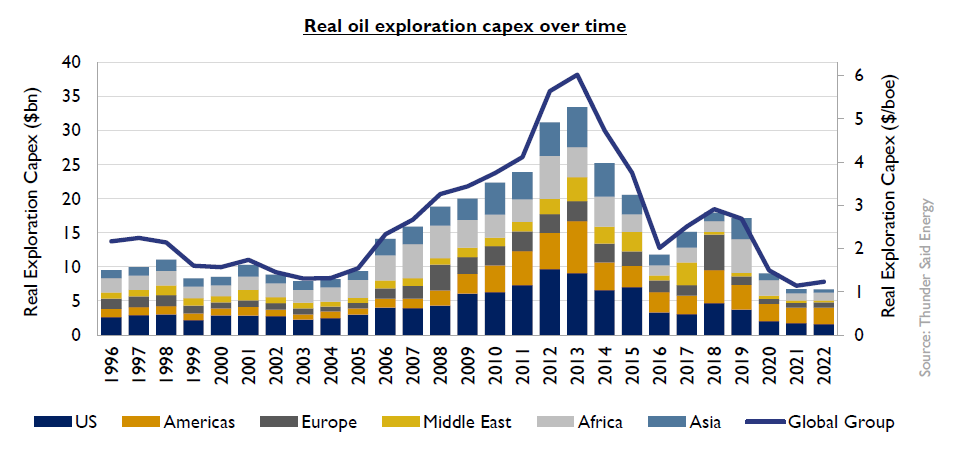
The report argues that despite Canadian oil sands' poor reputation due to high carbon intensity in production, their vast reserves and low sustaining capital costs have become unexpected advantages in an environment where financing for new fossil fuel projects globally is increasingly difficult. The author notes that global oil demand hit a record high in 2023 at 102 million barrels per day, accounting for roughly 30% of global energy consumption. According to the IEA's Net Zero pathway, oil demand would need to fall to 72 million barrels per day by 2030 and 24 million barrels per day by 2050. The author states: "Whilst we believe the transition will take longer than the IEA expects, the direction of travel is clear and ultimately for the good of the planet." This outlook has been deterring oil companies from making large-scale capital investments—a trend that has persisted since 2016. The five supermajors (accounting for 11% of global oil and gas production) spend only $10 per barrel on capital expenditure, compared to an average of $18 per barrel over the 2004-2014 decade (when production declined by 1.5% annually). Current exploration capital expenditure stands at just $1 per barrel, the lowest real value in history.
Low Decline Rates and Extremely Long Asset Life Form the Core Advantage
The report emphasizes that the unique cost structure of Canadian oil sands makes them a highly attractive resource. Oil sands projects require substantial upfront capital investment, but once built, the assets can sustain or even modestly increase production for decades at low marginal costs. This stems from geological characteristics and extraction methods, with annual decline rates of only 5-10%, far below the 40% annual decline rate per well for U.S. shale oil. The author notes: "The outcome an extremely long asset life and zero exploration risk." In contrast, U.S. shale oil has lower startup costs but shorter asset lives and relies more heavily on a "treadmill" of exploration activity to maintain production.
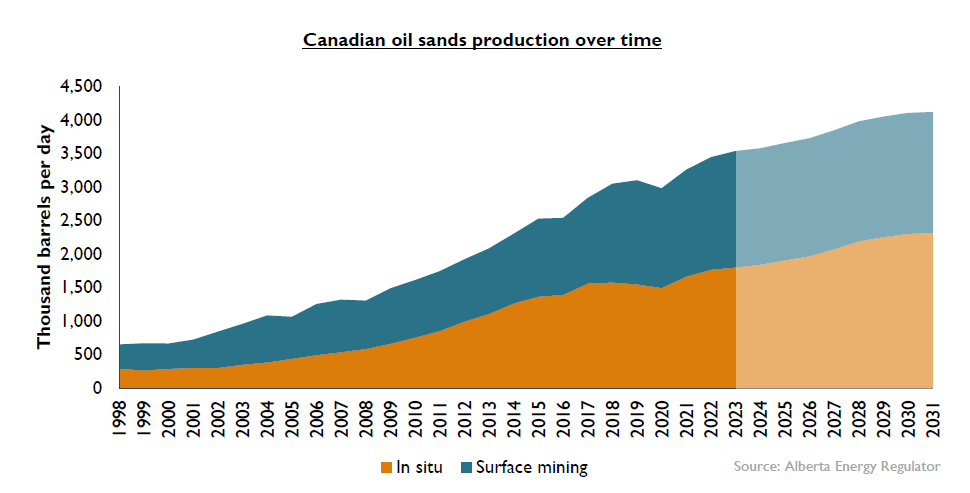
The report further compares sustaining costs: the two largest Canadian operators need only $4-8 per barrel annually to maintain current production, more than 50% lower than U.S. shale operators (which require $10-15 per barrel). Most Canadian oil sands producers have reduced their cash breakeven point to around $35 per barrel, comparable to the most efficient U.S. shale producers. Notably, this already includes capital expenditure for maintaining current production and dividend coverage. Due to the low marginal costs of expansion projects at existing sites, Canadian oil sands production is expected to increase by approximately 600,000 barrels per day by 2030, with over 80% of this growth coming from the commissioning, optimization, and completion of projects where capital has already been deployed.
Counter-Intuitive Opportunity Amid the Carbon Emissions Dilemma: A Potential Winner in a Net Zero Scenario
The report argues that although oil sands have higher carbon intensity than conventional oil, they could emerge as a counter-intuitive winner in a net zero scenario. The author acknowledges that the energy-intensive nature of oil sands production results in higher carbon emissions than the global average—carbon intensity has fallen by 21% since 2009 but remains above the global mean. As the world moves toward net zero, the most carbon-intensive barrels of oil face the risk of production cuts, especially as carbon pricing becomes more widespread. However, the author offers several reasons why reality may be more complex:
1. Long asset life and high upfront capital expenditure make Canadian oil sands one of the few oil resources globally that can sustain current production without further development. The author states: "Several major organisations – most significantly the IEA – have stated that no new oil and gas development can be supported in a Net Zero scenario. Perhaps counter-intuitively, in that scenario Canadian oil sands may emerge as a potential winner."
2. Less vulnerable to tightening bank financing—while other regions require continuous financing to maintain production, oil sands producers can quietly continue supplying the oil market, even as oil's share of global energy gradually shrinks.
3. Unique emissions reduction potential: The six leading oil sands producers have jointly formed the "Pathways Alliance," the world's first cooperative basin-wide decarbonization initiative, targeting net zero Scope 1 and Scope 2 emissions (i.e., emissions from production processes and power demand) by 2050. The author believes that despite current high carbon intensity, Canadian oil sands have the capacity to achieve meaningful emissions reductions in the coming years.
Investment Implications
The report suggests that Canadian oil sands operators possess structural advantages in the current environment: low sustaining capital costs, extremely long asset lives, and the ability to sustain production without new exploration. However, it should be noted that this is a position-holder's perspective—Hosking Partners' portfolio holds three of the six major operators (by market capitalization and reserve depth). The author uses the "counter-intuitive winner" argument to justify the portfolio's holdings. Readers should be aware that the carbon emissions risk and policy uncertainty surrounding oil sands have not disappeared; they have merely been repackaged by the author under the logic of "no new development needed in a net zero scenario."
3. Carbon Capture Cost at Only $25/Tonne, Far Below $400/Tonne for Direct Air Capture
Pathways Alliance reduces emissions in three phases, with the first phase building the world's largest carbon capture pipeline network, offering extremely high cost efficiency. Phase 1: Construct the world's largest carbon capture and storage network, capturing CO₂ from over 20 oil sands facilities and transporting it via a 400-kilometer pipeline to an underground storage hub. The author states, "It will reduce CO₂ emissions by a third by 2030 and is expected to cost C$16.5 billion" — meaning: "It will cut CO₂ emissions by one-third by 2030, with an estimated cost of C$16.5 billion," accounting for the majority of the alliance's C$24.1 billion commitment before 2030. Assuming annual reductions of approximately 20 million tonnes and a 30-year asset life, the carbon reduction cost is about $25 per tonne, compared to the current cost of around $400 per tonne for direct air capture projects. Phases 2 and 3 further reduce emissions and operating costs through efficiency improvements, carbon offsets, and new solvent and steam reduction technologies.
4. Concentration Among Six Operators + Low Decline Rates Make Carbon Capture Economically Viable
Canadian oil sands production is concentrated among six operators (accounting for ~95% of output), with CEOs meeting weekly to coordinate project progress. All major assets are concentrated in Alberta, with total deposits covering only 140,000 square kilometers, and key processing facilities are even more compact. In contrast, the U.S. Permian Basin spans over 220,000 square kilometers. The low decline rate (5-10%) of oil sands assets supports the economics of large-scale carbon capture facilities, with a single pipeline capable of serving all six operators. This contrasts sharply with traditional oil companies (operating thousands of wells spread across different basins, requiring continuous drilling of new wells) — the latter must constantly redeploy emission control equipment, incurring higher operating costs.
5. Canadian Government Offers 50% Investment Tax Credit, Clear Policy Support
The Canadian government has committed to supporting the project to achieve its own emission reduction targets. In March 2022, the Canadian government unveiled a new climate plan: reduce greenhouse gas emissions by 40% below 2005 levels by 2030 and achieve net-zero emissions by 2050. This requires the oil and gas sector (accounting for 27% of national emissions) to cut emissions by 42%. The government has announced a 50% investment tax credit for carbon capture project costs (lasting at least until 2030) to accelerate investment, with companies expecting further support down the line.
6. Geopolitical Stability + Accountable Governance, Rare Alignment of ESG and Financial Interests
Canadian oil sands offer critical geopolitical stability, achieving the most stable global oil production growth over the past 20 years. Major alternative supplies come from politically volatile countries like Russia and Venezuela. Canadian oil sands producers are transparent and well-regulated, allowing investors to track decarbonization progress and hold management accountable through active ownership. Of the world's proven oil reserves, 80% are owned or controlled by non-democratic governments; of the 3.2 billion barrels of remaining reserves available for private investment, 52% are located in Canadian oil sands.
The author states, "Canadian oil sands therefore represent a relatively unusual example of an industry where financial and ESG considerations are clearly and relatively unambiguously aligned" — meaning: "Canadian oil sands thus represent a relatively rare industry case where financial and ESG considerations are clearly and relatively unambiguously aligned." Because the upfront investment required for emission reductions is more attractive over a 30-50 year asset life, the decarbonization goals of oil sands align with their long operating cycles, whereas shale wells deplete after a few years, leading operators to prioritize maximizing short-term cash flow. With the federal minimum carbon tax rising from the current C$50 to C$170 by 2030, successful decarbonization is critical for future profit margins. The author argues that even the most cautious ESG investors should reconsider Canadian oil sands.
Investment Implications
The report explicitly recommends focusing on the six major Canadian oil sands operators (Suncor, Canadian Natural, Cenovus, Imperial Oil, MEG Energy, ConocoPhillips Canada), arguing that their carbon capture cost advantages, policy support, geopolitical stability, and accountable governance align ESG with financial returns. Institutional bias note: Hosking Partners holds positions in three of these operators, and its argument carries a self-defensive bias from its holdings — the $25/tonne carbon capture cost is based on a 30-year asset life assumption, and actual execution risks (technology, cost overruns, carbon price volatility) are not fully explored.
Position Moves
| Ticker | Direction | Author's One-Sentence View | Key Data |
|---|---|---|---|
| Suncor | Hold & Watch | As one of the six major operators, it benefits from the structural advantages of oil sands and the economics of carbon capture. | The six major operators account for approximately 95% of Canada's oil sands production. |
| Canadian Natural | Hold & Watch | Same as above, with low sustaining costs and extremely long asset life forming core advantages. | Sustaining cost of $4–8/barrel, cash breakeven point of approximately $35/barrel. |
| Cenovus | Hold & Watch | Same as above, a member of the Pathways Alliance with leading cost efficiency in carbon capture. | Carbon reduction cost of approximately $25/ton. |
| Imperial Oil | Hold & Watch | Same as above, with assets concentrated in Alberta, benefiting from policy support. | The Canadian government provides a 50% investment tax credit. |
| MEG Energy | Hold & Watch | Same as above, low decline rate supports the economics of large-scale carbon capture facilities. | Annual decline rate of 5–10%. |
| ConocoPhillips Canada | Hold & Watch | Same as above, advantages of geopolitical stability and accountable governance. | Achieved the most stable global oil production growth over the past 20 years. |