A diverse world
Hosking Partners is a London boutique founded in 2013 by Jeremy Hosking, a portfolio manager at Marathon Asset Management for over 25 years. It runs a single global equity strategy built on the capital-cycle, supply-side approach — contrarian, long-term, and unusually diversified (350+ holdings) under a multi-counsellor model, managing around $5.5bn.
In plain words
This report says the global energy transition affects countries differently. The author is cautiously optimistic about North America, which benefits from cheap shale gas and could see a manufacturing revival. Europe looks uncertain due to past policy mistakes. China and India, consuming 35% of global energy, will decide the transition's success. Key holdings mentioned: Permian Basin Trust (a US oil and gas royalty company, increased position), Flex LNG (a LNG shipping firm, favored), and PrairieSky Royalty (a Canadian oil and gas royalty company, increased position).
At a Glance
One-sentence summary: The energy transition is reshaping global geopolitical and industrial landscapes. The author is [cautiously optimistic], viewing North America as the biggest winner, Europe's outlook as uncertain, and the paths of China and India as decisive for success. The portfolio has increased holdings in North American oil & gas equities and LNG shipping.
- China and India together consume 35% of the world's useful energy and emit 40% of CO2; their growth models will determine the success or failure of global decarbonization.
- North America, with cheap shale gas (long-term prices below $3/MMBtu), is well-positioned to drive reindustrialization and supply chain reshoring.
- Europe, due to an early over-reliance on renewables and premature decommissioning of nuclear power, saw its energy import dependency rise from 56% in 2010 to over 60% in 2022, placing it at a short-term disadvantage.
- The portfolio has increased holdings in North American oil & gas equities (e.g., Permian Basin Trust, PrairieSky Royalty) and LNG shipping (Flex LNG, Golar LNG), while underweighting European materials stocks.
- The energy transition is accompanied by heightened geopolitical conflicts, with Middle Eastern oil producers under pressure and US-China competition intensifying due to supply chain reshoring.
Energy Transition: Both Opportunity and Threat for Different Economies
The article opens by highlighting the core contradiction: the energy transition impacts different regions in vastly different ways, and competition among transition models will determine the long-term outcomes for both the planet and its population. The author points out that the global energy transition is systemic, and the molecular composition of the atmosphere does not respect national borders. Therefore, "it is no use for Europe to decarbonise if China and India’s emissions are rising." As the energy supply structure diversifies, the advantages of historically oil- and gas-endowed countries may diminish, while countries with new geological endowments of critical materials will gain strategic importance. At the same time, regulatory measures such as carbon pricing and sustainable finance require international coordination to avoid cross-border arbitrage, and the uneven distribution of physical climate risks further complicates the situation—developing countries are both the most vulnerable to long-term climate impacts and the least able to bear the high transition costs of decarbonisation.
China and India: The Interaction Between Growth and Energy Intensity Will Shape the Global Transition Path
The author argues that China and India together consume 35% of the world's useful energy and emit 40% of global CO2, making the interaction between their growth models and energy intensity a key factor in shaping the global transition path. China consumes approximately 20,000 TWh of useful energy annually and emits 12 Gt of CO2; India consumes 5,000 TWh and emits nearly 3 Gt. The article notes that the interaction between growth and energy intensity in these countries will determine the global transition trajectory. The author describes China as "front-footed China offers both promise and peril"—offering hope (e.g., leadership in renewable energy) while also posing risks (e.g., massive emission volumes). India is viewed as a growth opportunity but also faces the challenge of high transition costs.
North America: Cheap Decarbonised Natural Gas Drives Reindustrialisation
The article believes that North America, with its cheap decarbonised natural gas, has the potential to revitalise its manufacturing sector and emerge as one of the winners of the energy transition. The author writes: "In North America we see the potential for a revitalised manufacturing sector fueled by cheap, decarbonised natural gas." This assessment is based on North America's strong energy independence, low natural gas costs, and significantly lower carbon emissions compared to coal. The author directly links North America with "re-industrialising and largely energy independent," suggesting that the trend of manufacturing reshoring will benefit from its energy advantages.
Europe: Policy Missteps Leave the Outlook Fraught with Uncertainty
The author takes a pessimistic view of Europe's prospects, arguing that years of mismanagement in energy policy have left the region's outlook "fraught with uncertainty." The article criticises Europe's policy failures over the past two decades, which may undermine its potential to become a global leader in renewables: "we fear the continuation of two decades of poor policy could dent the region’s potential to become a world-leader in renewables." The author also notes that if Europe's net-zero policies become disconnected from the rest of the world, they could exacerbate inflation in the short term, especially if implementation is uneven.
Investment Implications
The article's implied investment direction is to focus on the themes of North American reindustrialisation and energy independence (benefiting from cheap natural gas), India's growth theme (benefiting from demographic dividends and rising energy demand), and the double-edged sword effect of China's renewable energy supply chain (leading but facing emission pressures). At the same time, investors should be wary of policy risks in Europe's renewable energy sector and the potentially challenging future for major 20th-century oil-producing countries (e.g., Middle Eastern nations). The author emphasises that the energy transition has already had a significant impact on global capital allocation, but readers should note that this is a position-holder's perspective—Hosking Partners may already have corresponding allocations in these regions.
At a Glance
China and India together define the success or failure of the global energy transition.
The report opens by stating that China and India together consume 35% of the world's useful energy and emit 40% of global CO2, making their growth trajectory decisive for global decarbonization goals. The world consumes roughly 70,000 TWh of useful energy annually (actual consumption after accounting for efficiency losses), with an average efficiency of about 45%, meaning more than double that amount must be supplied, while releasing 35 billion tonnes of CO2. China alone consumes 20,000 TWh of useful energy and emits 12 Gt of CO2, roughly one-third of the global total; India, as the third-largest energy consumer, uses 5,000 TWh and emits nearly 3 Gt of CO2. The author emphasizes that advanced economies (the EU and North America) have effectively "outsourced" a large share of their energy use and emissions to China and India via industrial supply chains, but the growth rate, rather than static comparisons, is the more critical factor.
If China and India continue to catch up to Western levels of per capita GDP, energy demand will surge in tandem. The energy intensity of high-income post-industrial countries has already approached zero or even negative growth, but the "decoupling" in China and India has only just begun—for every additional $1,000 in per capita GDP, China requires roughly an extra 0.7 MWh per person per year, and India about 0.6 MWh. Currently, China's per capita energy consumption is 2–3 times lower than that of the West, while India's is roughly 12 times lower. The author uses an extreme scenario to illustrate India's potential demand: if India's per capita energy demand were to reach the level of high-income countries, it would require 35,000 TWh of useful energy annually—equivalent to half of the global total. In 2021, China's incremental electricity demand alone was comparable to the entire grid size of the African continent. The author states: "Depending on the energy mix employed to feed this growth, emissions will rise somewhere between 25% to 300%." The combined net-zero efforts of the US and Europe would need to be achieved twice over just to offset the annual emissions increase from moderate (100%) growth in China and India. The author concludes that Western net-zero efforts are essentially a "supporting role," and the success of the energy transition hinges on the interplay of population, economic growth, and emissions intensity in the emerging world, especially China and India.
The Strategic Value of Coal and the Dilemma of Transition
China and India are heavily dependent on coal, the dirtiest fossil fuel, but its low cost and domestic reserve advantages make it difficult to replace quickly. In 2022, coal met 58% of China's and 45% of India's energy consumption, compared to just 11% in the US and 10% in the EU. Coal costs roughly 1–3 cents per kWh, and 94% of China's and 80% of India's coal consumption is domestically produced, providing a significant strategic advantage—a stark contrast to the two countries' reliance on imported oil and natural gas. The author notes that China views dependence on imported energy as a major strategic weakness, as the vast majority of these imports must pass through the Strait of Hormuz and the Strait of Malacca, two narrow and relatively vulnerable maritime chokepoints; India, meanwhile, has seen its diplomatic stance on the Ukraine war influenced by its reliance on Russian oil and gas supplies.
The cost of coal is severe air pollution and climate risk. Millions of people die each year from the toxicity of particulate matter generated by coal combustion, while urban smog depresses tourism; high population densities make both countries more vulnerable to physical climate risks such as floods, crop yield volatility, and drought. Renewable energy thus becomes an attractive option, offering clean, domestically produced power. However, the author stresses that the enormous energy volumes required for economic growth mean fossil fuels will remain important well into the second half of the 21st century. Coal-to-gas switching is one of the main pathways, as both countries have substantial untapped domestic natural gas reserves, and efforts to exploit these strategic assets are likely to intensify in the coming years.
China's Slowing Growth and Structural Transition Uncertainty
China's rapid growth since the early 2000s is decelerating, and its core driver—industrial exports—faces multiple pressures. China derives 60% of its energy demand from industry, three times the share in the US and 30% higher than the global average, and decarbonizing industrial energy use is far more difficult than in residential, commercial, or transport sectors. Industry accounts for 40% of China's economy, and combined with its reliance on coal, this makes China the country with the highest emissions intensity per unit of GDP globally. However, the COVID-19 pandemic and the Russia-Ukraine war have catalyzed a rupture in economic relations between the West and China: export growth rates have fallen from an average of about 25% annually in the 2000s to 7% in 2021–22. The West is beginning to "reshore" critical supply chains, partly due to the realization of China's monopoly over key energy transition commodities such as photovoltaic silicon, copper, lithium, aluminum, and steel. At the same time, China's aging population is pushing up wages, and environmental pressures are eroding the appeal of cheap supply chains.
The author argues that China's future path depends on whether the economy can shift from export-driven to domestic consumption-driven growth. In the near term, slowing growth, systemic risks in the real estate sector, compounded by Xi Jinping's regressive political stance, intensified authoritarian rule, and a concerning military posture, will further complicate the outlook. The author concludes: "For investors, the outlook is highly uncertain."
India: Demographic Dividend and Poverty-Driven Energy Transition
India's growth story may still lie ahead, and its energy transition is primarily aimed at poverty alleviation, not decarbonization. In the latter half of this decade, India will surpass China as the world's most populous country, with a median age of just 28 (a full 10 years younger than China), and over one-third of the population under 20. The UN projects the population will peak at 1.6 billion around 2060–70 before beginning to decline. Despite being the fifth-largest economy, its per capita GDP is only $2,500, lower than that of the Democratic Republic of the Congo or Papua New Guinea; more than 300 million Indians live on less than $1.25 per day. This widespread poverty means India's energy mix still resembles that of the poorest countries—20% of demand is met by biomass. The author quotes the Indian government's statement: "energy is the mainstay of the development process of any economy," and notes that India has formulated a strategy to "advance its transition in its own way."
India explicitly prioritizes poverty alleviation over decarbonization, with cost and supply security determining the energy mix. The shift from biomass to natural gas is central to the transition, known as the "blue flame revolution." Demand for pipeline and LNG in India is expected to increase in the coming years, and the country may return to long-term contracts to ensure supply security. Key obstacles include dismantling the multi-layered bureaucratic "license raj," simplifying the overly complex subsidy system (which encourages the production of low-quality, high-pollution coal), and reducing government intervention to allow market forces to shape energy supply. India is also leveraging its increasingly educated workforce to drive technological innovation: literacy rates are rising steadily, and higher education enrollment is expected to accelerate by 2030. The author judges that, unlike China's industrial export revolution, the driving force of India's 21st-century growth may be a highly educated services sector—which is favorable for global emissions, as the carbon intensity of services is far lower than that of industry. Currently, India's renewable energy penetration is only 2%, and the transition is still in its early stages. However, as the West reshuffles industrial supply chains while outsourcing higher-complexity white-collar jobs to India, the country's young, entrepreneurial, increasingly educated, and gradually deregulating economy presents an attractive prospect.
Investment Implications
The investment themes highlighted in the report include: demand growth for India's natural gas infrastructure and services (pipelines, long-term LNG contracts), technologies related to China's industrial decarbonization (though policy and geopolitical risks warrant caution), and beneficiaries of North American reindustrialization (as an alternative supply chain to slowing growth in China and India). Institutional perspective note: Hosking Partners, as a multi-asset value-oriented fund, tends to emphasize structural opportunities in emerging markets and the long-term role of fossil fuels; readers should be aware that its holdings may include energy and resource companies.
The Second Rise of American Industry?
The US Shale Gas Revolution Will Reshape Global Energy Dynamics and Geopolitics
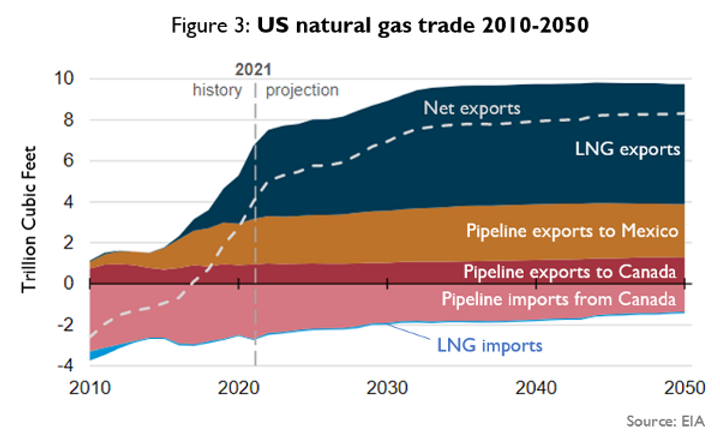
US shale oil and gas, thanks to its abundant reserves and short drilling cycles, not only holds the promise of energy independence but also positions the country as a price setter for marginal global supply. The author's original statement is: "Shale oil and gas, thanks to its abundance and short-run drilling cycle not only grants the US the prospect of energy independence but also the critical role of price setter for marginal global supply." In a market where oil's share of total energy supply is shrinking from 25% to approximately 17%, the core production base of roughly 80-85 million barrels per day that will still exist by 2050 is primarily determined by operating costs, followed by reserve depth. This favors low-cost producers such as Saudi Arabia and Qatar, as well as US shale oil, which can rapidly adjust output to meet marginal demand. US shale gas is particularly advantaged, as the growing intermittency from expanding global renewable energy capacity may increase volatility in natural gas demand. Moreover, shale wells are quick to build, quick to ramp up, quick to decline, and quick to recover capital, making their cost base especially resilient to rising interest rates. With pragmatic regulatory support, the US LNG export sector could see significant growth in the coming years as other regions attempt to phase out coal. Existing projects have already doubled capacity from 11 billion cubic feet per day to over 20 billion cubic feet per day by 2030. The EIA assumes this capacity growth plateaus after 2030, but this assumption is based on a forecast of 200 trillion cubic feet of global natural gas consumption by 2050, which is conservative. If the higher forecast of over 300 trillion cubic feet becomes reality (driven mainly by China and India), the US is likely to be a major beneficiary of this transition path.
Cheap Shale Gas Will Drive Supply Chain Reshoring and Industrial Boom
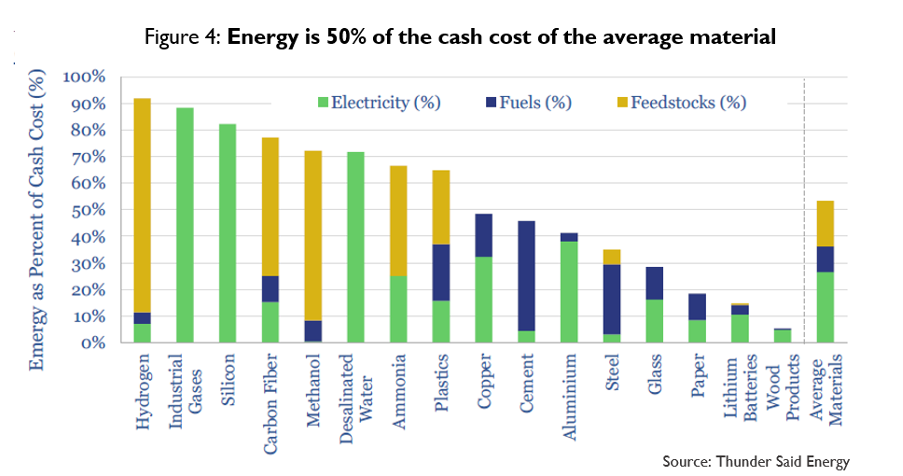
The ready availability of cheap US shale gas could trigger an industrial boom, driving supply chain reshoring from China. Through the Inflation Reduction Act, reshoring industries related to the production of the most critical materials for the energy transition has become a headline policy in the US. Currently, approximately 90% of the market for the most critical energy transition commodities is located in China. China produces 50% of the world's metals, 60% of wind turbines, 70% of solar panels, and 80% of lithium-ion batteries. Over-reliance on a potentially unreliable strategic rival has raised alarms in Washington, an effect amplified by Russia's invasion of Ukraine. The rationale for this concentration lies in extremely cheap energy prices, as energy accounts for roughly 50% of the average cash cost of commodity production (see Figure 4). Chinese commodities are supported by subsidies, ensuring managed coal prices at 1 cent per kWh. The only region in the world that can compete on energy costs while offering stable geopolitical and regulatory conditions is likely the US South—assuming long-term domestic natural gas prices below $3 per thousand cubic feet, where gas can also support energy prices as low as 1 cent per kWh. The widening spread between US and European natural gas prices reinforces the US's appeal, as Europe's energy-intensive industrial sectors are under pressure from high gas prices. Even under a moderate geopolitical scenario, Russian natural gas is priced at $8 per thousand cubic feet long-term, and imported US LNG at $7-10 per thousand cubic feet, two to three times the price expected for US domestic consumers. If the world is moving toward increasingly bipolar or multipolar regional spheres of influence, the US stands to regain industrial market share in the critical materials and technologies needed for the energy transition. However, policymakers need to accept the key role of US natural gas in driving the broader transition, as it is the only cost-competitive alternative to Chinese coal. Due to how labor, energy, and future carbon costs transmit through the value chain, the energy transition and the east-to-west reshoring trend remain broadly inflationary in the medium term. Maximizing the opportunity of US shale gas can mitigate this inflationary impact and spark a 21st-century US industrial boom.
Canada and Mexico Will Benefit from the US Industrial Renaissance
The US's North American neighbors can also benefit significantly from US growth and industrial revival. Both Canada and Mexico find themselves in interesting positions as they enter the mid-to-late 2020s. The Canadian oil sands industry, long criticized as carbon-intensive and environmentally damaging, is undergoing a kind of sustainability renaissance. Alberta's oil sands supply approximately 3.5 million barrels per day (3% of global supply) with very low operating costs. Massive reserves and a mature, low-maintenance asset base have reduced the breakeven cost of Canadian oil from around $75 per barrel to roughly $45. Meanwhile, the Canadian government is carefully regulating the industry to ensure decarbonization is prioritized, primarily through a gradually increasing carbon price—from the current $50 per ton to $170 per ton by 2030. The Canadian oil sands industry does not see this as a threat but is embracing the challenge. The six largest companies, representing 95% of production, have formed the "Oil Sands Net Zero Pathway" organization, committed to achieving industry-wide net-zero emissions by 2050. The CO2 intensity per barrel of Canadian oil sands has already fallen to near the global average and continues to improve. The combination of low operating costs, high cash flow, capital discipline, and well-regulated sustainability targets creates an attractive investment proposition.
Meanwhile, south of the US border, Mexico could benefit from the US reshoring trend. With labor costs significantly lower than in the US and proximity to the Texas shale basin, some manufacturers may choose to cross into Mexico. Protectionist interpretations of this phenomenon have fueled Trump's aggressive foreign policy toward Mexico, but a more pragmatic approach may reveal more upside than downside risk. Closer trade ties, exchanging cheap natural gas southward for cheap manufactured goods northward, would benefit both economies and partially offset the cost impact of reducing exposure to Chinese labor. Is it not preferable to work with US neighbors and political allies rather than continue relying on a long-term strategic rival? Regulatory uncertainty and the lingering effects of the war on drugs have depressed Mexico's valuations, but the author sees upside potential in the medium to long term.
European Energy Transition: Early Overcommitment Backfires
The report argues that Europe’s early over-reliance on inefficient renewables and premature phase-out of nuclear power have increased its energy import dependency from 56% in 2010 to over 60% in 2022, placing it at a significant short-term disadvantage. The author states: "Europe’s enthusiasm for renewables in the early 2000s was driven by a belief that ‘peak oil’ would lead to ever-higher fossil fuel prices, and that early investment would pay-off down the line in cheaper energy prices and reduced import dependency." In other words, Europe’s early 21st-century enthusiasm for renewables was rooted in the belief that the "peak oil" theory would drive fossil fuel prices ever higher, and that early investment would eventually pay off through lower energy costs and reduced import reliance. However, the rise of U.S. shale gas upended this logic, exposing Europe as "woefully ahead of the curve."
| Key Data Comparison | 2010 | 2022 |
|---|---|---|
| European Upstream Oil & Gas Investment | >$50 billion | <$20 billion |
| Energy Import Dependency | 56% | >60% |
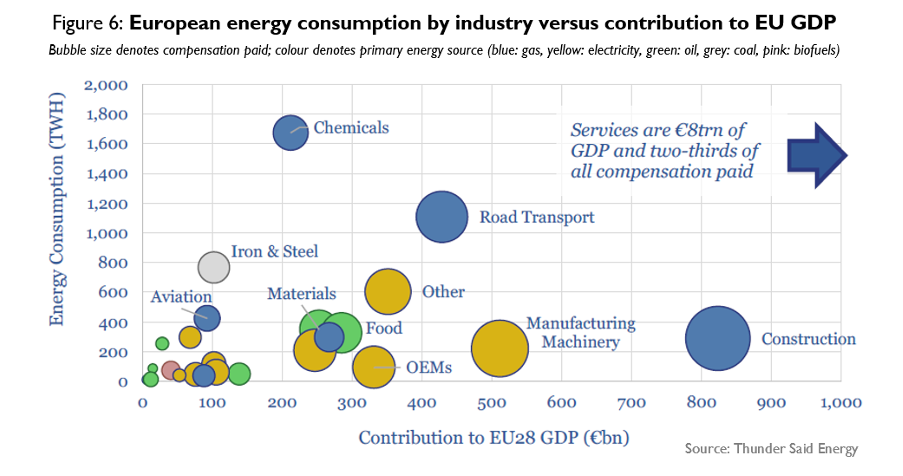
European upstream oil and gas investment plummeted from over $50 billion in 2014 to less than $20 billion in 2022, while the growth rate of renewable energy investment was far from sufficient to fill the gap—the author reiterates that "for every $1 divested from upstream traditional energy, $25 must be invested in renewables to obtain an equivalent amount of energy." The result has been a heightened reliance on imported fossil fuels, particularly Russian pipeline gas, while LNG import infrastructure lagged behind. This left Europe with few fallback options during the 2021-22 price shock, forcing a return to coal-fired power. If high energy prices persist for several years, they will severely impact energy-intensive industries (sectors with high energy consumption per unit of GDP, see Figure 6), making Europe far less able to benefit from the reindustrialization trend compared to the U.S.
Russia-Ukraine War Catalyzes a Pragmatic Policy Shift, but Outlook Remains Uncertain
The report argues that while the Russia-Ukraine war has temporarily slowed the energy transition, it is catalyzing a long-term strategic rethink in Europe, potentially steering it toward a more pragmatic path. Specific positive signals include: the EU including natural gas and nuclear energy in its green taxonomy, accelerating the phase-out of coal power; accelerated construction of LNG import infrastructure, with signs of a recovery in long-term contracts—this not only ensures energy security but also de-risks financing for production and export projects in places like the U.S. The author judges: "Assuming consumers are willing (and able) to accept higher bills in the near term, Europe could build out a world-leading integrated renewables network." In other words, if consumers are willing and able to accept higher bills in the short term, Europe could develop a world-leading integrated renewable energy network.
Rising interest rates should prompt the market to focus more on cost-effectiveness, curbing excessive investment in speculative clean energy technologies and shifting toward pragmatic decarbonization solutions such as efficiency improvements, alternative options, and cross-regional renewable power generation and transmission. However, highly leveraged, long-cycle renewable energy projects face valuation revaluation risks—those priced based on low capital costs may come under pressure. If Europe can learn from its mistakes and adjust its direction, it could still be the first to offer consumers low-cost marginal renewable energy.
Europe Leads in Sustainable Technologies, but Oil Majors' Transition Is a High-Stakes Gamble
The report notes that Europe remains a global leader in natural carbon capture, sustainable fuels, next-generation nuclear power, and renewable energy. At the same time, European oil majors are pioneering the "pivot model," redirecting an increasing share of capital from upstream oil and gas production to technologies and services for a post-transition world. The author comments: "This is a gamble that deserves detailed evaluation to parse the probability of success." In other words, this is a gamble that warrants careful assessment to determine the likelihood of success. Overall, early mismanagement of the energy transition has left Europe at a significant short-term disadvantage. Citing economist Dieter Helm’s 2018 assessment: "Europe has failed on all three of its [energy] objectives. Its energy is expensive, insecure, and it no longer leads on climate change." While the Russia-Ukraine war has prompted serious reflection and may create future upside, political infighting and economic uncertainty remain concerning.
Investment Implications
The report takes a cautious stance on Europe overall: short-term high energy costs will weigh on industrial competitiveness (especially in energy-intensive sectors), but policy shifts (including natural gas and nuclear in the green taxonomy, accelerated LNG infrastructure) may create structural opportunities. Key areas to watch: the success or failure of European oil majors' (e.g., Shell, TotalEnergies) transition strategies, the leadership of European sustainable technology leaders (in natural carbon capture and sustainable fuels), and the valuation pressure on long-cycle renewable projects from rising interest rates. Institutional bias note: As a global long-short equity fund, Hosking Partners’ narrative of Europe "being ahead of its time and suffering for it" may reflect a consistently critical stance on European policy. Readers should be mindful of its tendency to emphasize "pragmatism" (i.e., greater reliance on transitional energy sources like natural gas).
Energy Transition Will Intensify Geopolitical Conflicts, Benefiting North America While Pressuring the Middle East
The report argues that the energy transition will be accompanied by price shocks, geopolitical turmoil, and conflicts, with the Ukraine situation already serving as a precursor, and future frictions between nations will intensify. The author quotes Pulitzer Prize winner Dan Yergin: "the clash among nations will become sharper, international collaboration more difficult, and borders higher." The report points out that as crude oil demand peaks and declines between the late 2030s and 2040s, some oil-producing countries will decline, with the Middle East being particularly vulnerable; internal cohesion within OPEC may collapse, while the long-gestating "NOPEC" bill (No Oil Producing and Exporting Cartels Act) in the U.S. will benefit as a result. Meanwhile, U.S.-China competition is intensifying due to supply chain reshoring and protectionism, and the report views conflict in the South China Sea as "when, not if."
The Portfolio Has Increased Positions in North American Oil & Gas Royalties and LNG Shipping, Awaiting a Shakeout Opportunity in European Materials
Hosking Partners, based on a bottom-up capital cycle analysis, has adjusted its holdings to capture structural opportunities in the energy transition. Specific actions include:
- North American Oil & Gas Royalty Companies: Increased positions in oil and gas royalty companies in the Permian Basin and Canada, such as Permian Basin Trust and PrairieSky Royalty. The report notes that these companies "have very low overheads and so are minimally impacted by cost inflation," allowing them to fully benefit from the leverage effect of rising commodity prices and production expansion.
- LNG Shipping and Processing: Surging global natural gas prices, structural supply shortages in shipping, and disruptions to pipeline networks have positioned companies like Flex LNG and Golar LNG favorably—the report states they are "well placed to exploit the bottleneck in supply of this essential clean fuel."
- European Materials: The firm has underweighted European materials stocks but believes the competitive landscape will become more benign after the shakeout. It favors companies reliant on efficient energy sources like hydropower (e.g., Alcoa) and nuclear-related companies (e.g., Cameco).
- China: Maintains a cautious stance but believes China's renewable energy buildout will continue, benefiting the largest and most technologically efficient solar companies.
Capital Misallocation Leads to Structural Energy Shortages, Market Inefficiencies Create Investment Opportunities
The report's core thesis: In the early stages of the energy transition, capital has exited traditional energy too quickly and flooded into renewables, but the latter's higher capital intensity has led to a decline in total energy output, creating structural supply shortages and price increases. The report notes: "overall energy output has fallen as the capital intensity of renewables is higher than that of hydrocarbons." This misallocation, combined with differences in national regulations, monetary policies, geopolitical factors, and corporate risk management strategies, creates widespread market inefficiencies. The report argues that the two-decade era of low interest rates and cheap capital is facing mean reversion pressure, providing fertile ground for capital cycle analysis.
Investment Implications
The report clearly presents a long-position perspective: the author uses the cases of increased holdings in North American oil & gas royalties and LNG shipping to support their thesis, but readers should note that these positions themselves benefit from high energy prices and supply bottlenecks, carrying the risk of price declines. The report does not provide specific buy or sell recommendations but points to themes such as North American energy independence, LNG infrastructure, efficient European industry, and leading Chinese solar companies.
Position Moves
| Instrument | Direction | Author's One-Sentence View | Key Data |
|---|---|---|---|
| Permian Basin Trust | Add | Extremely low management fees, minimal impact from cost inflation, fully leveraged to commodity price increases | Permian Basin oil and gas royalty trust |
| PrairieSky Royalty | Add | Same as above; Canadian oil and gas royalty company benefiting from North American energy independence | Breakeven cost for Canadian oil sands has fallen from approximately $75/barrel to around $45/barrel |
| Flex LNG | Add | Well-positioned to capitalize on LNG supply bottlenecks, benefiting from surging global natural gas prices and structural undersupply in shipping | Global LNG capacity is expected to double from 11 billion cubic feet per day to over 20 billion cubic feet per day by 2030 |
| Golar LNG | Add | Same as above; LNG shipping and processing company in a favorable position | Same as above |
| Alcoa | Hold & Watch | Favor companies reliant on efficient energy sources like hydropower; waiting for a more benign competitive landscape after European materials sector reshuffling | High energy prices in Europe are impacting energy-intensive industries |
| Cameco | Hold & Watch | Favor nuclear-related companies, benefiting from Europe's inclusion of nuclear energy in its green taxonomy | European policy shift toward pragmatism, accelerating the phase-out of coal power |
| Chinese solar leader (unnamed) | Hold & Watch | China's renewable energy buildout will continue, benefiting the largest and most technologically efficient solar companies | China produces 70% of the world's solar panels and 80% of its lithium-ion batteries |