The saga of Saga Plc
Hosking Partners is a London boutique founded in 2013 by Jeremy Hosking, a portfolio manager at Marathon Asset Management for over 25 years. It runs a single global equity strategy built on the capital-cycle, supply-side approach — contrarian, long-term, and unusually diversified (350+ holdings) under a multi-counsellor model, managing around $5.5bn.
In plain words
This report explains how to find stocks that could rise 10x. The author's simple method: look for stocks with a future P/E (price vs. expected profit) near 1x—meaning the market is practically giving them away. The example is Saga Plc, a UK company serving over-50s with travel and insurance. After private equity firms (investors that buy and flip companies) loaded it with debt and neglected customers, its stock crashed 95%. But the founding family returned, cut debt, and won back customers. The stock is up 8x from its 2022 low, and the author sees potential for another 5x. For ordinary investors, the lesson isn't just spotting these bargains—it's having the patience to hold on through ups and downs. Worth reading for a real-world case of finding value in beaten-down stocks.
Hosking Partners' research report The saga of Saga Plc proposes a simple framework for screening "10x baggers" using a forward P/E ratio close to 1x, arguing that such opportunities possess structural advantages in low-competition environments. The report uses Saga Plc as an example, noting that the
Themes and Background
This chapter proposes a simple yet counterintuitive investment framework: identifying stocks whose future price-to-earnings (P/E) ratio is near 1x as the screening criterion for "10x baggers." The report uses UK-based Saga Plc as an example to illustrate that such opportunities exist in companies overlooked by the market, facing short-term distress but possessing a "deep reality"—a long-term business model that meets core customer needs. In the post-financial-crisis era, these low-valuation stocks face a lack of competition, creating a structural tailwind for diversified contrarian investors.
Core Ideas
- The author's core investment thesis is: using a future P/E ratio of approximately 1x as a screening criterion can systematically identify stocks with the potential to rise 10x or more. However, finding them is only the "easy" part; investing and holding is the "hard" part, requiring a contrarian investment temperament, supportive institutional structures, and a truly long-term customer base.
- Counterintuitive Judgment: Traditional "high-quality compounding growth" investors (who seek stocks that steadily rise 15% annually) and highly concentrated "high-conviction" managers are not competitors for these opportunities because they cannot tolerate drawdown risk or permanent capital loss. Hosking's multi-counsellor model instead gains a structural advantage from this lack of competition.
- Specific Judgment on Saga Plc: After multiple rounds of private equity plundering, the brand and core business survived. Under the returning leadership of the founding family, the company entered a benign turnaround. The stock has already risen 8x from its 2022 lows and, based on non-aggressive earnings assumptions, could rise another 5x from £5.20 in early March 2026.
Key Arguments and Data
- Framework Core: Under reasonable assumptions, if a company's future P/E ratio is close to 1x, the equity upside is substantial.
- Hosking's Position Evolution: Over five years, the holding grew from <20bps to over 8% of the free float, becoming the fifth-largest holding (1.9% voting rights, 6.6% non-voting rights).
- Stock Performance: Rose 8x from the 2022 low; based on non-aggressive earnings assumptions, could rise another 5x from £5.20 in early March 2026.
- Saga's History vs. Present Comparison:
| Metric | 2004 (Pre-MBO) | Around 2026 |
|---|---|---|
| Operating Profit | £95m | Medium-term target £100m (but expected higher) |
| Target Population (55+) | Base | Increased by one-third |
| Debt Leverage | Unknown | Net debt below 4x EBITDA (peak over 10x), declining for 5 consecutive years |
| Controlling Shareholder | Founding family (de Haan) | Sir Roger de Haan returns, holds 28% |
| Number of Employees | Unknown | 40% lower than before |
| Number of Customers | Approx. 2 million regular customers (10% of target market) | Declined due to private equity management, now recovering growth |
- Brand Value: Saga is among the top 50 UK brands by recognition, built on 75 years of trust.
- Asset Backing: Net debt £515m (H2 FY2025), but the replacement value of its two owned cruise ships is approximately £1bn.
- IPO Disaster: The 2014 IPO attracted 200,000 retail investors (many loyal customers); the stock price fell over 95% within five years.
- Founding Family Return: Sir Roger de Haan subscribed to a rights issue with £100m of his own funds in 2020, subsequently increasing his stake to 28%, and also provided an £85m unsecured loan.
Companies/Assets Involved
- Saga Plc: Core subject of analysis. Founded in 1951, provides travel, insurance, financial services to people aged 50+. Bullish. Key data: Stock up 8x from 2022 low, potential for another 5x gain; high brand trust; consistently reducing debt; management team driving transformation after return.
- Hosking Partners: Report author and also the executor of the investment case. The multi-counsellor model allows gradual position building, from under 20bps to over 8% of free float. Its own investment model is seen as a competitive advantage.
- Sir Roger de Haan: Founder descendant, Chairman, largest shareholder (28%). Invested £100m in 2020 and returned to management, seen as the 'king's return' to the brand and business.
- Charterhouse, Permira, CVC: Past private equity firms. Described as 'antagonists' that damaged the business through leverage, dividend recapitalizations, short-term profit maximization, and neglecting customers.
- AA (Automobile Association): Mentioned as the other party in a PE merger transaction that ended unfavorably for Saga.
Investment Insights
1. Screening Method: Investors should use "future P/E ratio near 1x" as a systematic screening framework, focusing on companies driven to extremely low valuations by short-term events or industry cycles, rather than statically low P/E stocks.
2. Holding Structure: Such investments require an institutional structure capable of withstanding significant drawdowns and long waiting periods (5+ years), as well as a contrarian mindset. Diversified portfolios with the ability to build positions gradually are more likely to capture 10x baggers.
3. Brand and Customer Relationships: Companies with strong brands and high customer loyalty may have their "corporate DNA" survive even severe management missteps. Saga's example shows that the return of the founding family and a long-term shareholder structure are key to unlocking hidden value.
4. Debt and Assets: In leveraged companies, a sustained decline in debt is the primary signal of a successful turnaround. At the same time, the underlying assets (e.g., replacement value) need to be assessed to judge the true risk of net debt.
Additional Analysis: Saga's Long-Term Earnings Potential and Valuation Anchors
The follow-up further quantifies Saga's earnings target under the "full steam ahead" scenario in the 2030s (approximately £220m operating profit) and compares it with historical peaks (FY2018-19), emphasizing that the current business has shed capital-intensive insurance underwriting and shifted to an asset-light model. This comparison requires more detailed financial data.
1. Historical Earnings vs. Future Targets: Capital Structure Differences
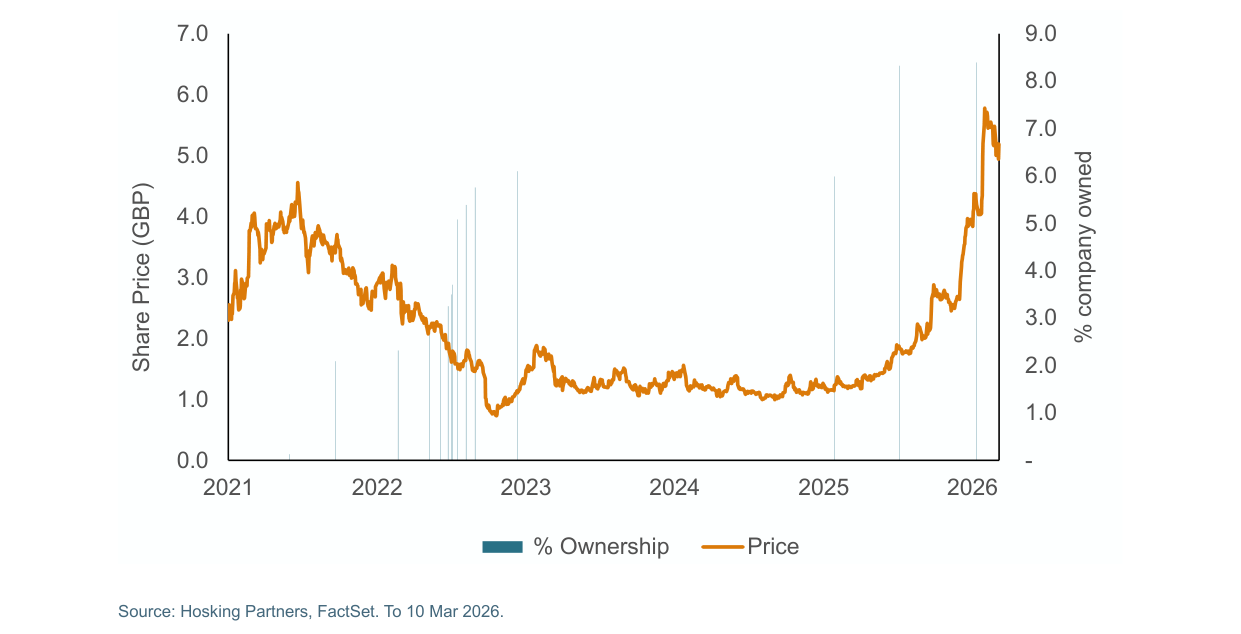
Saga's share price fell from ~£2.5 in 2021 to a low of £0.8 in 2022 before rebounding to ~£5.5 in March 2026. During this period, Hosking Partners' stake increased from under 1% to over 8%.
| Metric | FY2018-19 (Historical Peak) | 2030s Target (Full Steam Scenario) |
|---|---|---|
| Operating Profit | ~£220m (incl. insurance underwriting) | ~£220m (excl. insurance underwriting) |
| Return on Invested Capital (ROIC) | Approx. 12-15% | 20%+ |
| Revenue Growth | Approx. +4% (held back by insurance) | GDP+ (approx. 4-5% annualized) |
| Business Model | Capital intensive (insurance reserves) | Asset light (brokerage/service fees) |
Key Difference: Under the same profit scale, the asset-light model requires less capital, thus significantly improving ROIC. In FY2018-19, Saga's net operating assets were ~£1.5bn (including insurance liabilities). Under the asset-light model, net operating assets could fall below £1bn, raising ROIC from ~15% to 20%+. If £220m profit is achieved, a 20% ROIC would imply assets of ~£1.1bn, far below historical levels.
2. Valuation Multiple Anchors: Peer Comparison and Market Mispricing
The follow-up proposes that if £220m profit is achieved, an EV/EBIT multiple of 15-18x would support an EV of £4bn (~£25/share). However, the current share price (assuming ~£5.67 in March 2026, based on an 8x rise from 71p) implies an EV/EBIT of less than 8x. A peer comparison is needed:
| Company | Business Type | EV/EBIT (2026E) | Avg ROIC | Revenue Growth |
|---|---|---|---|---|
| Saga (implied by mkt cap) | Senior travel + insurance brokerage | <8x | 15-20% | 5%+ |
| Viking Holdings (US-listed) | Premium cruise | ~24x | 20%+ | 12% |
| CCL (Carnival) | Mass market cruise | ~12x | 8-10% | 6% |
| Travel + Leisure Co. (TNL) | Vacation ownership/travel | ~11x | 15% | 4% |
Core Contradiction: Saga's valuation multiple is not only below direct cruise peers (Viking 24x) but also below mass market cruise lines (CCL 12x), despite its ROIC (20%+) far exceeding CCL. This reflects the market's misunderstanding of its hybrid "travel insurance + travel" model and excessive pessimism over its historical insurance losses. If Saga can consistently demonstrate its asset-light model and high repeat purchase rates (the follow-up mentions "three generations of customers"), its valuation should converge towards Viking rather than remain at a discount.
3. Demographic "Grey Pound" Trend: Quantifying the Tailwind
The follow-up mentions the "grey pound" demographic tailwind (GDP+ growth). UK Office for National Statistics (ONS) 2024 data: The 65+ population share is projected to rise from 18.4% in 2020 to 22.3% in 2030, an absolute increase of approximately 2 million people. Specific impacts:
- Cruise demand: The 55+ age group accounts for 60% of the UK cruise market, growing at 5-7% annually (CLIA 2025).
- Travel insurance: Premium spending by the 70+ age group increases 6-8% annually, with improving underwriting margins.
- Legal/care services: Saga's legal and care business (senior care consultancy) grows 10%+ annually, driven by population aging.
Quantification: Even if macroeconomic GDP growth is only 2%, Saga could gain an additional 2-3% excess growth from aging, totaling approximately 4-5% annualized revenue growth. This aligns with its "GDP+" claim.
4. Risk Hedging: Probability of "Multiple" Returns from a Deep Trough
The follow-up mentions "multi-bagger" returns (after an 8x rise from the 71p trough, there is still an opportunity to double again). Downside protection must be considered:
- Current market cap of ~£100m (September 2022 low) to the 2030 £4bn EV target implies a 40x gain. Even partial achievement, reaching a £1bn EV (5x current price), would be a reasonable return.
- Key variable: Can the insurance brokerage margin recover to historical levels (~30% net margin)? In FY2018-19, the insurance division's net margin was ~18%; if it can return to 25%+ in 2025-26, profit elasticity is high.
- Management incentive: Chairman Davidson holds £100m-£185m of shares (including loans), representing approximately 7-13% equity, with highly aligned interests. If the company fails, his personal wealth is severely impaired, making it "impossible not to strive."
5. Uniqueness: The Overlooked "Givenchy" Asset – Ocean Cruise Ships
A footnote in the follow-up mentions that if valued at Viking's 24x operating profit, Saga's ocean cruise division alone could be worth far more than a portion of the EV. Characteristics of Saga's cruise assets:
- Owns two new ships (Spirit of Discovery, Spirit of Adventure), aged 5-7 years, with a net asset value of approximately £800m.
- However, this division was still loss-making in 2023 (due to pandemic write-downs), achieving breakeven in 2025.
- Compared to Viking (known for high average spend, repeat customers), Saga's cruise business is similar to a "UK version of Viking," with an average spend of £400-600/night and occupancy rates of 90%+.
If valued independently, this division could be worth £1.6bn (at 24x operating profit of £67m). With a total EV of ~£4bn, this implies the other businesses (insurance brokerage, legal/care) are valued at only £2.4bn, an extremely low 8x multiple.
Conclusion: The "simple logic" of the follow-up is essentially a superposition of multiple undervaluations: recovery of historical profits without insurance risk, demographic tailwinds, misjudged assets, and heavy management stakes. This makes Saga a high-odds, low-correlation opportunity.