'Normal' Service Resumes
Hosking Partners is a London boutique founded in 2013 by Jeremy Hosking, a portfolio manager at Marathon Asset Management for over 25 years. It runs a single global equity strategy built on the capital-cycle, supply-side approach — contrarian, long-term, and unusually diversified (350+ holdings) under a multi-counsellor model, managing around $5.5bn.
In plain words
This report argues that today's market volatility and rising bankruptcies aren't signs of trouble—they show the market is returning to normal after a decade of unusually low interest rates and low volatility. For everyday investors, this means you can't rely on the old 'everything goes up' approach. Instead, focus on companies with real profits and competitive advantages. Hot sectors like AI will likely see many failures before a few winners emerge, while beaten-down stocks may offer hidden opportunities. Worth reading because it explains why the rules have changed and how to adapt your investing strategy.
A report from Hosking Partners argues that, although current equity markets have ample liquidity, IPOs at the trillion-dollar level, and indices near historical highs, the market has returned to "normal" from the abnormal state of the 2010s. The capital cycle is at work, with funds flowing into them
Theme and Background
This chapter addresses the following question: While global stock markets appear superficially prosperous — ample liquidity, IPOs reaching the trillion-dollar level, and indices near historic highs — the underlying reality is that markets are returning from the anomalous conditions of the 2010s to a historical norm. The author argues that this "normalization" is not a malfunction but rather a sign that the capital cycle's functions are reasserting themselves.
Core Thesis
The report's core investment thesis is that markets have transitioned from the apparent "low volatility, high growth" anomaly of the 2010s back to a "normal" state characterized by divergence, volatility, and creative destruction. The author judges that even the currently seemingly low cost of capital is sufficient to drive the capital cycle's self-correcting mechanism. The report specifically highlights a major contrarian view: the surge in AI investment and the rising wave of corporate bankruptcies are not precursors to a market crash but an integral part of a healthy capital cycle. The zero-interest-rate era was the true "anomaly," not a "destination."
Key Arguments and Data
- Capital Flow Characteristics: Capital is concentrating in themes such as AI infrastructure, the energy transition, critical minerals, defense, and industrial reshoring. The author argues this is the typical start of the capital cycle's "boom-overcapacity-cleanout" pattern.
- Increasing Market Dispersion: The implied dispersion of the S&P 500 is at historically high levels, indicating capital flowing away from uncompetitive companies ("left behinds") and a clear process of market selection favoring the strong over the weak.
- Corporate Bankruptcy Rate: As of 2026, the corporate bankruptcy rate has hit its highest level in over a decade. This stands in stark contrast to the continuously declining trend in bankruptcy rates during the decade prior to 2021, which was driven by artificially low interest rates.
- Restoration of the Cost of Capital Mechanism: The report emphasizes that even a "meager" cost of capital is sufficient to "lubricate" the capital cycle, ensuring outcomes are no longer as distorted as they were in the past.
- Core Historical Variable: The Collapse of the US-China Imbalance: The report attributes the abnormally low interest rates of the 2010s to China's post-financial crisis stimulus policies, which suppressed global rates by exporting deflation and purchasing foreign assets. Today, the West is no longer willing to absorb China's excess capacity, and China has reduced its purchases of Western debt. This "interest rate suppression system" is disintegrating.
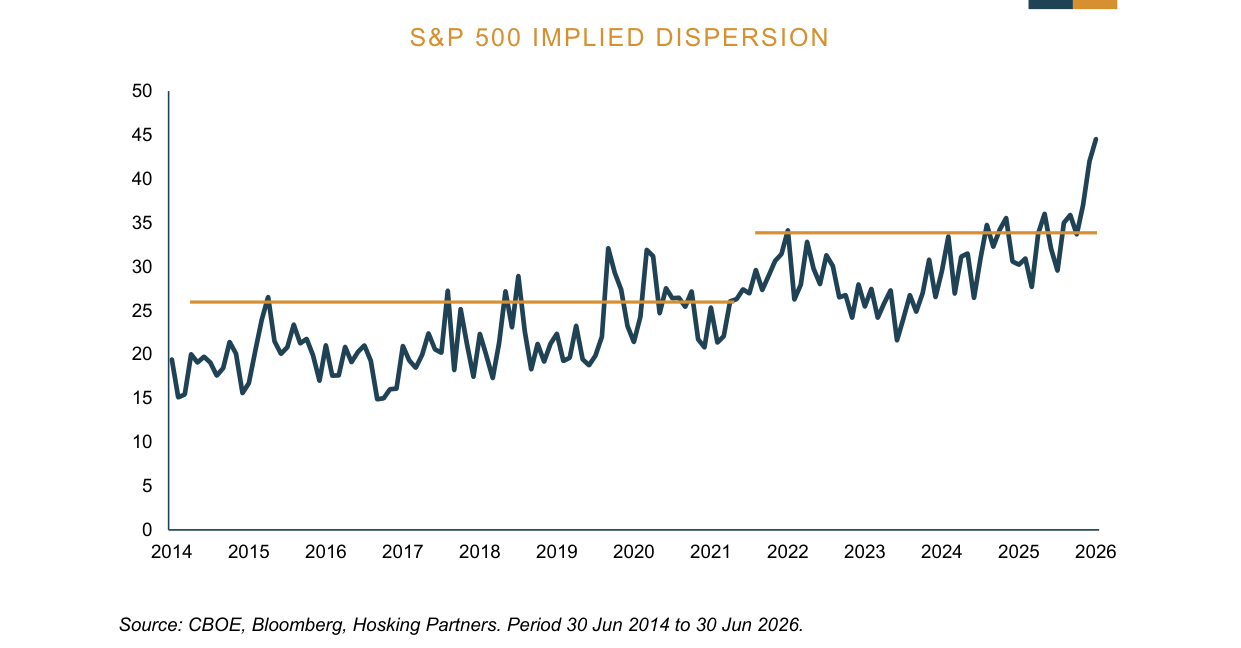
S&P 500 implied dispersion rose from approximately 15-20 in 2014 to around 45 by 2026, significantly breaking out of the 25-35 range seen between 2014-2021, indicating that stock-level dispersion has reached its highest level in over a decade
| Market Current State (2026) | 2010s Anomalous State |
|---|---|
| Capital concentrated in a few themes like AI | Broad-based low volatility, widespread capital flows |
| Corporate bankruptcy rate at decade high | Bankruptcy rate continuously declining |
| Market implied dispersion extremely high | Dispersion at historically low levels |
| Risk pricing partially restored | Systemic low interest rates suppressed risk pricing |
Companies/Assets Covered
The report does not name specific companies but analyzes the following categories of assets/sectors:
- Hot Theme Assets (many bulls, but caution warranted): AI infrastructure, energy transition, critical minerals, defense, and industrial reshoring. The report argues these sectors will inevitably experience overcapacity, bankruptcies, and consolidation. In the long run, only companies with clear business models will achieve final returns.
- "Left Behind" Companies (bearish): Those firms unable to attract capital in the hot themes and possessing weak competitive advantages. The report views them as victims of capital cycle "creative destruction," and their bankruptcy pressures will persist.
Investment Implications
1. Embrace Rather Than Avoid Volatility and Bankruptcy Waves: The report suggests investors should not view the current increase in bankruptcies as systemic risk but rather as a positive signal that the capital cycle is returning to "normal." This indicates the market is clearing inefficient companies, clearing the path for future recovery.
2. Beware of 2010s Investment Thinking Inertia: Investors should no longer rely on the valuation paradigm of the low-rate environment ("raise terminal value, lower WACC") but should refocus on fundamental business quality, business models, and management's capital allocation capabilities.
3. Maintain a Cyclical Perspective on Hot Themes: For sectors like AI currently flooded with capital, the report implies that today's high valuations and capital abundance will erode expected returns over the long term. True investment opportunities may arise only after industry consolidation and capacity cleanup.
4. Look for Revival Seeds in "Forgotten" Corners: When capital outflows from weaker companies compress their valuations to extremely low levels, it creates buying opportunities for patient capital cycle investors. The report believes that the opportunities generated by this current divergence are at their highest in years.