← 返回列表
Hosking Partners15 Aug 2025

UK Stewardship Code

作者:
UK Stewardship Code

AI 中文摘要

本期内容并非传统投资播客,而是一家资产管理公司对其投资哲学与尽责管理实践的详细阐述。核心论点是:Hosking Partners LLP是一家奉行资本周期理论的精品投资管理公司,其投资流程深度整合了积极的尽责管理与ESG分析。公司管理规模达54亿美元,采用独特的“多顾问”架构,由四位自主决策的全球全行业基金经理管理单一全球股票策略。其商业模式的关键在于通过低基础管理费+基于5年滚动业绩的绩效费与客户利益深度绑定,并强调长期投资,平均持股周期约为10年。公司认为,其全行业、跨地域的比较视角,以及对资本周期(即供给侧动态)的专注,是其获取超额收益(Alpha)的潜在来源。

研究报告原文

Foreword

Report chart

We are proud to comply with the UK Stewardship Code, which provides an invaluable handrail for asset managers and owners alike.

If you have any questions, please do not hesitate to be in touch.

James Batting

April 2025

Compliance with the UK Stewardship Code Stewardship is the responsible allocation, management and oversight of capital to create long-term value for clients and beneficiaries leading to sustainable benefits for the economy, the environment and society. This document describes Hosking Partners approach to stewardship and details its compliance with the UK Stewardship Code (as updated 1st Jan 2020). Principle 1 Signatories’ purpose, investment beliefs, strategy, and culture enable stewardship that creates long-term value for clients and beneficiaries leading to sustainable benefits for the economy, the environment and society. CONTEXT Hosking Partners LLP (the “Firm”) is a Full-Scope Alternative Investment Fund Manager (“AIFM”) authorised and regulated by the Financial Conduct Authority (FCA) in the United Kingdom and registered as an Investment Adviser with the Securities and Exchange Commission (SEC) in the United States. The Firm is also registered with the Financial Sector Conduct Authority (FSCA) of South Africa as a (Category 1 Intermediary Services) Financial Services Provider. Hosking Partners was established in the United Kingdom on 7th February 2013 under the name Seculum Asset Management LLP. The Firm’s name was changed to Hosking Partners LLP in August 2014. The assets under management as at 25th April 2025 were USD $5.4 billion. Hosking Partners is a limited liability partnership (LLP) which is wholly owned by its partners with no one partner owning more than 25% of the business. The Firm believes this ownership structure helps to ensure that the business remains focused on generating investment returns for clients rather than for external shareholders. Hosking Partners’ strategy focuses on investing predominantly in equities, such as but not limited to common stocks, preferred stocks, convertible bonds, warrants, depositary receipts, exchange-traded funds and other securities which are convertible or exercisable into shares or which, in the opinion of the Firm, have equity characteristics (such as income trusts). The Firm provides its investment management services to institutional and professional investors such as government entities, pension, and superannuation funds, foundations, and endowments, as well as pooled investment vehicles. Hosking Partners’ investment team is held together by its strong commitment to a shared investment philosophy. Faced with the challenge of distilling a large universe of opportunities into a portfolio with attributes that are associated with value creation, Hosking Partners focuses on the concept of the capital cycle. The ‘Capital Cycle’ investment approach was first developed by Jeremy Hosking (and colleagues) in the 1980s. It recognises the gradual changes that the supply of capital has on the competitive landscape of an industry and the inverse relationship that exists between supply-side dynamics and returns. Under the capital cycle approach, consolidation is regarded as bullish and the opposite, a proliferation of competing firms, is regarded as bearish. This approach leads the team to shun areas of the market where profitability is high, and investors are enthusiastic and to target areas where profitability is low, and investors are apathetic. This leads to investments that are contrarian and often give the portfolio a value bias. The investment approach transcends sectors and countries. Each of the four autonomous portfolio managers has a remit to invest globally. Global generalists benefit from the neuroscientific finding that cognition is improved as contrast levels increase. For example, a Japanese pharmaceutical company is dramatically different to a Mexican cement company and, in most fund management architectures, the two are never compared directly due to silo-based investment teams. At Hosking Partners, we believe our generalist approach – which encourages contrasting areas of the market to be compared directly – should be a source

of latent alpha. Additionally, in circumstances where two or more portfolio managers hold the same shares, often bought at different times, the probability success rate of such overlapping stocks benefits from what is an independent second opinion. Accordingly, the success rate of the investment in question is probably improved. A range of valuation tools are employed, and the use of elaborate forecasting models is avoided. The portfolio managers prefer inference over forecasting and tend to invest if their beliefs are more optimistic than those inferred by the current market price. The investment team also make use of valuation metrics based on replacement costs, takeover values, and revenues, which suit the long-term investment horizon. Valuation metrics are applied flexibly, adapting the approach depending on market conditions and sectors. ACTIVITY Generally Hosking Partners charges a low base fee plus a performance fee. There is also a tiering mechanism which means the base fee lowers as firm-wide AUM increases. The Firm intentionally aligns its business interests with those of its clients and places emphasis on performance rather than asset gathering. The Firm’s qualitative investment strategy naturally encourages frequent and sustained engagement with investee companies. The Firm does not rely on quantitative modelling to screen the portfolio or investment universe. As such, active ownership, engagement, and stewardship is an integral part of the investment process because it allows the portfolio managers to better understand how investee or prospective companies are positioning themselves with respect to the Firm’s investment philosophy. Consideration of ESG issues forms a key part of the Firm’s investment analysis. Hosking Partners approaches ESG using an integrated approach, as the Firm does not think it appropriate to isolate any single aspect of a company’s activities from the rest. Hosking Partners consults third-party ESG research, ratings, and screens, but it does not exclude any geographies, sectors or stocks from its analysis based on ESG profile alone. Our generalist remit and independent stance affords us the perspective to think more broadly about long-term factors such as changes to regulatory conditions, liabilities not reflected in financial statements and reputational issues which are captured more completely by a qualitative approach. OUTCOME Hosking Partners is dedicated to serving the best interests of our clients and their beneficiaries and this is viewed as the ultimate purpose of the Firm. Having both a clear purpose and a consistent and well considered investment strategy drives a cohesive culture within the Firm. Having the whole Firm bought into this ethos means that there is a common goal for effective stewardship. In order to actually achieve effective stewardship, Hosking Partners employs the below actions: The Firm maintains a constant dialogue with clients to ensure they are fully cognizant of current thinking, investment objectives, past performance, past and upcoming engagements. Furthermore, the Firm collaborates with each client to ensure geographically varying definitions of fiduciary duty are individually met and managed. Over the past 12 months, Hosking Partners has continued to work with several clients to ensure their accounts are individually tailored to guarantee certain climate-related standards and have incorporated client specific enhanced modern slavery and climate-related reporting. Engagement and proxy voting are fundamental parts of active ownership, and our procedures are designed to ensure Hosking Partners both actively engages and instructs the voting of proxies in line with our long- term investment perspective and client investment objectives. Voting is undertaken on all shareholder meetings and reported to clients. Engagement is discussed in more detail under Principles 9-11, and voting under Principle 12, with associated data provided. Furthermore, to underline the Firm’s commitment to the ESG issues on which clients and beneficiaries are increasingly focused, Hosking Partners has in the past year renewed its commitment as a listed signatory of the United Nations Principles for Responsible Investment (UNPRI) and Supporter of the Taskforce on

Climate-Related Financial Disclosures (TCFD). The Firm continues to be a supporter of the charity GAIN (Girls Are INvestors), which seeks to increase female representation in the asset management industry. Hosking Partners will welcome its third GAIN intern in Summer 2025. More broadly, in the last 12 months the Firm has continued its enhanced ESG-related communications to clients (and publicly), via its ESG & Active Ownership Report. This quarterly publication not only includes voting and engagement data, but also detailed qualitative discussion on a range of ESG and stewardship-related issues. Public versions of this document (which are shorter than the client versions) are available on the Firm’s website. Notably, in Summer 2024 the Firm published its first enhanced climate-related disclosure report under the Financial Conduct Authority’s Enhanced Climate-related Disclosure (ECR) regulations. This report is available at entity level here and product level here.

Principle 2 Signatories’ governance, resources and incentives support stewardship. ACTIVITY Hosking Partners’ belief is that active ownership – in the form of long-term analysis of investments, active exercise of voting rights, and constructive engagement – improves management accountability, and long-term returns. The average holding period of investments at Hosking Partners is around 10 years and engagement with governance and related issues is therefore seen as a cornerstone by the portfolio management team to the oversight of their holdings. Shareholder engagement is therefore integral to Hosking Partners’ investment process. The Firm’s governing body is the Management Committee which is responsible for the strategic direction and the running of the business. Matters reserved to it for decision include approval of the following:

• Strategy and Management (including approval of business plans, oversight of the Firm’s operations, adequacy of internal systems and controls, changes to Firm’s management and structure, new appointments, review of performance, new products, contingency and succession planning, oversight of research and service provision);

• Structure and Capital (including approval of Annual Audited Financials, ICARA, oversight of regulatory capital, bank facilities);

• Internal Controls (including approval of policies governing Firm’s operations, compliance reports, approval of any significant outsourcing arrangements); and

• Other matters (including escalated engagement, legal matters, public relations).

Overall responsibility for Hosking Partners’ stewardship and engagement strategy rests with the Management Committee. Day-to-day responsibility sits with the Head of Responsible Investment and the Investment team. Compliance provides a control function and assurance. The overall governance structure of the Firm is displayed below:

Report chart

Whilst an informal dialogue regarding stewardship, engagement, and ESG integration is encouraged and achievable due to the small size of the Firm, it has also been recognized that formal processes are required to ensure decisions are recorded, communicated, and appropriately scrutinised. A continual dialogue is maintained between the four portfolio managers, Head of Responsible Investment, and business development teams. This dialogue is formalised in monthly ESG-focused meetings between the Head of Responsible Investment and each member of the investment team, but in practice stewardship and ESG are integrated on a day-to-day basis. The Firm follows a process that identifies and takes opportunities for engagement, and then communicates that engagement. Hosking Partners believe this approach to governance to be appropriate for the size of the Firm as it enables the team to work closely but cross-functionally, while the formalised meetings add rigour and document the rationale for decisions. A graphical depiction of this process, and the internal inputs to it, is provided below:

Report chart

Hosking Partners currently engages a range of research and service providers, from big banks to small independent boutiques. Because stewardship and engagement are integrated into the investment process from the bottom-up, each of these providers helps inform the Firm’s approach despite the fact that few focus on stewardship solely or specifically. Research and service provision is discussed in more detail under Principle 8. Remuneration for the investment team is not linked specifically to ESG or stewardship outcomes, but both are integral to the extent they contribute to overall Firm success in terms of client retention and long-term investment performance. Furthermore, the calculation of the Firm’s performance fee over rolling 5-year periods across the majority of our AUM reduces short-term thinking and is aligned with the elements of stakeholder theory that suggest a constructive approach to ESG and stewardship increases value over time. As long-term investors, Hosking Partners are therefore incentivised to consider stewardship and material ESG issues as part of their core investment activity. Hosking Partners is an equal opportunity Firm, and candidates for employment are judged on their merits and suitability for the role. Any recruitment firms used source candidates from a broad pool (encompassing several diversity metrics) and share our commitment to equal opportunity. The Firm operates with a small team (circa thirty persons) and hires only experienced professionals for key roles in the investment team and other areas of the business. The team are experienced professionals, and many are members of relevant professional bodies and institutes.

All employees of the Firm are subject to continual professional development and the culture encourages individuals to participate in learning and development opportunities. The Firm is aware of key person risk in a small firm and succession planning is an ongoing priority. Diversity and Inclusivity are a key part of the culture, and the Firm maintains a strict Anti-Discrimination and Anti-Harassment Policy.

OUTCOME Hosking Partners continually seeks ways to further improve its structures and processes, both in support of stewardship and wider goals. At the end of 2019, Hosking Partners became a signatory to the UNPRI. This was promptly followed in 2020 by the publication of a formal ESG Statement, a document which sets out the Firm’s philosophy and approach to incorporating ESG into the investment decision making process, and the strategy for voting and engaging with investee companies. Active ownership was a main area of focus through 2020-2021 and the approach was formalised with the publication of a Shareholder Engagement policy. Throughout 2021 internal monitoring procedures were further developed to enable the documentation of engagement and voting efforts in the form of a quarterly Active Ownership report. This report was designed to support client oversight obligations and give additional transparency on voting and engagement activities on various ESG matters. Following the hiring of a Head of Responsible Investment in December 2021, the following calendar year (2022/3) saw the Active Ownership report upgraded once more to include a quarterly ESG report and more granular detail and data regarding stewardship and shareholder engagement. The last twenty-four months have seen the Firm continue to expand its ESG and stewardship communications, both through the Active Ownership Report and related multi-media content including podcasts and media articles. Additionally, procedures and governance structures have been further strengthened, particularly with a view to ensuring there is a formal system for flagging emerging risks (including geopolitical, reputational etc) to the Management Committee and, if necessary, the Supervisory Board. While this function has not been exercised to date, the Firm has spent much of the past 12 months thinking carefully about how to better incorporate geopolitical and country risk into investment decisions, a topic which we have written about here, here and here. In response to an increasing level of interest from clients and the broader investment community, there has recently been an increased focus on the carbon intensity of the portfolio and understanding the transition risks arising from the move to Net Zero by 2050. This is a major area of analysis at the Firm, and consideration of physical and transition risk is factored into all investment decisions. The Firm has also written extensively on the topic (e.g. see here, here, here and here). As an active member of the AlMA, IIMI, and UNPRI, the Firm frequently engages with other industry actors to discuss the complexities of investing for Net Zero.

Within the past 12 months, in Summer 2024, the firm published its first Taskforce for Climate-Related Financial Disclosures (TCFD) Report. The reports are available here (entity-level) and here (product-level).

Principle 3 Signatories manage conflicts of interest to put the best interests of clients and beneficiaries first. CONTEXT Hosking Partners has an organisational structure that works in concert with our investment goals. This structure also serves to minimise the likelihood of conflicts of interest from the outset. To recap, the relevant fundamental principles on which our business has been modelled are:

• Single strategy;

• Low base fee plus long-term performance fee; and

• Perpetual partnership that discourages the sale of the business, assists succession planning and maintains the boutique structure of the Firm.

Several of these principles directly contribute to reducing conflicts of interest, particularly in relation to our duty as stewards. Hosking Partners manage one strategy only, that being global equities. This product provides the sole source of income for the Firm. The Firm therefore generally avoids the sorts of conflicts of interest inherent in multi-strategy firms. Similarly, the Firm’s performance fee structure keeps the team focused on investment performance. In particular, the fact that the Firm measures its performance fee using a long-term approach (typically 5-year rolling) inherently reduces the likelihood of short-term conflicts of interest and principal-agent problems. It also significantly reduces the likelihood of conflicts of interest between portfolio managers, who are equally incentivised to deliver the best long-term performance for clients rather than themselves. Augmenting these fundamental principles is a robust Conflicts of Interest policy designed to ensure all decisions are taken wholly in the interest of its clients, and that any potential and actual conflicts are identified, evaluated, managed, monitored and recorded. The Conflicts of Interest Policy is available to read on our website (here) and defines activities that have potential to present conflicts of interest, and sets out the procedures to manage those conflicts. Of particular note with regards to stewardship, the Firm’s Conflict of Interest Policy specifies appropriate steps to identify and avoid conflicts between the Firm and its clients. ACTIVITY Examples of procedures that help identify and manage conflicts of interest are listed below. Our Conflict of Interest Policy can be found on our website. These examples highlight areas of particular relevance to ensuring good stewardship.

• The Firm typically executes client orders on an aggregated basis so that each client included in the block transaction obtains the same average price, with transaction costs shared pro rata between clients based on their proportionate share of the aggregated transaction. Where the Firm aggregates client orders, the Firm must be satisfied that it is unlikely such aggregation will work overall to the disadvantage of any client included in the aggregation.

• The Firm has strict controls in place to manage conflicts between the Firm and its clients. These controls are set out in policies covering Best Execution, Order Handling, Aggregation & Allocation, and Inducements. All these policies are fully available to clients upon request. The Firm does not have any soft dollar / use of dealing commission arrangements with its brokers.

• The Firm has developed detailed and effective strategies for determining when and how any voting rights are to be exercised, to the exclusive benefit of its clients. Should a conflict of interest arise, the Firm’s Management Committee will take such steps as it considers appropriate to achieve fair

treatment. Should any conflict arise which the Firm’s arrangements do not enable it to manage, as required by the FCA rules, the clients would be notified.

• The Firm maintains a register of Outside Interests for all personnel including the Firm’s partners. There is a requirement on all partners and personnel to inform the Compliance Department of any outside interests and these are reviewed on no less than an annual basis to confirm that they do not give rise to any conflicts that cannot be managed by the Firm’s internal procedures and that such conflicts do not negatively impact clients’ interests.

• The Firm has in place a Personal Account Dealing Policy which requires staff to obtain prior approval for personal transactions. The procedures include black-out periods prior to and after dealing in securities for clients.

• The Firm has in place a Gifts & Entertainment Policy which requires all gifts and entertainment to be notified to Compliance. Prior approval is required before accepting gifts or corporate hospitality from brokers as well as for any gifts or corporate hospitality with a value greater than £50 per contact in any twelve-month period.

OUTCOME Given the size of the Firm and its strategy and business model, the frequency of conflicts arising is low to minimal. As such, during the past 12 months, no material conflicts of interests have been identified at Hosking Partners. Despite this, the below outlines some examples of how what may be considered potential conflicts have been managed in practice to ensure the best interest of clients.

Trailing 12-Month Examples (to 30th April 2025) Example Topic Example Narrative

Difference between the stewardship policies of managers and their clients

As outlined throughout this report Hosking Partners takes an active approach to stewardship including via proxy voting. For some clients, Hosking Partners does not retain the voting rights for the shares of their client’s account. There are instances however where Hosking Partners will communicate with a client to express the Firm’s view on a particular vote and provide the rationale for this. As stated in response to Principle 1, Hosking Partners does not generally isolate any single aspect of a company’s activities from the rest, including those related to ESG. However, the Firm recognises that in today’s market there exists considerable diversity of opinion on certain ESG matters. As such in the scenarios where we express our voting preference there is the potential that minor conflicts may arise between those preferences and the stewardship policies and ESG priorities of the clients and their beneficiaries. One such example in the last 12 months is where Hosking Partners wished to vote AGAINST ISS and FOR Management at Champion Iron’s AGM. The company is incorporated and listed in Australia but does not employ anyone there, instead operating out of Canada. ISS judges the company’s policies against Australian policy standards rather than prevailing North American standards. Hosking Partners expressed this to clients and outlined this rationale but cannot ultimately make the voting decision for the clients who retain these rights.

Stock specific exclusions and variation by clients

The Firm accommodates a range of stock-specific exclusions, sector exclusions and geographical exclusions. For some clients, they provide exclusions against specific names which will be updated and amended by the client at their request. The Firm will provide for these restrictions by coding these in the order management system and ensuring these clients account’s do not hold the prescribed names. These client specific restrictions can be accounted for even when they differ between accounts. For example, some clients will exclude tobacco stocks or have carbon intensity threshold requirements. However, Hosking Partners is able to retain compliance with these restrictions, while still allowing for the portfolio managers to invest in these names across those accounts that permit the particular stock and thus can continue to apply their investment strategy.

Principle 4 Signatories identify and respond to market-wide and systemic risks to promote a well- functioning financial system. ACTIVITY As a long-term investor Hosking Partners considers a diverse array of financial and non-financial factors when making investments. The Firm believes that the generalist remit of its investment team allows it the perspective to think broadly about the interaction of investee companies and both the market-wide and systemic environment in which they operate. Perturbations at the macro level are directly relevant to the valuation Hosking Partners apply to these companies, and indeed the Firm’s capital cycle approach is at least partly reliant on an assessment of which sectors (and constituent companies) are best positioned to navigate market-wide and systemic risks. For example, the Firm consistently seeks to understand issues such as exposure to future regulatory changes, financial liabilities carried off balance sheet, legislative risks, and reputational issues before making an investment decision. Hosking Partners’ approach to identifying and responding to systemic risks avoids setting formalised criteria and considers each situation on its own merits. The investment team are all generalists, and do not have defined areas of focus, which brings a unique perspective to discussions of global trends. The team strives to avoid groupthink and challenge assumptions, using a wide-ranging and carefully selected range of third-party research providers to assist in this effort. Hosking Partners also routinely participate in wider industry initiatives and forums, including UNPRI, AIMA and IIMI. OUTCOME Hosking Partners actively consider the ever-changing risks associated with the market as outlined in the examples provided below. Over the past year, the Firm has tightened its processes and procedures in response to growing market and wider geopolitical instability. This tightening includes the introduction of climate-related scenario analysis and continued use of the red cord system noted above, but also a wider range of minor alterations to operational procedures to better safeguard clients’ assets. This culture of continual improvement is a key facet of Hosking Partners’ working practice and is driven by our Senior Partner supported closely by the Managing Director. The Management Committee routinely monitor the effectiveness of these procedures both internally and as part of a two-way dialogue with our clients and is currently assessed as strong but with further room for incremental improvement. Examples of systemic risks identified over the past 12 months are provided below.

Trailing 12-Month Examples (to 30th April 2025) Example Topic Example Narrative

Global recession

While we have not seen a global recession in over a decade, we believe there is a material risk of this today. All global markets would be impacted. Although our portfolio has a high level of cyclical exposure, including commodities, and would likely be negatively impacted in the immediate short term, we believe our companies are materially better positioned today – both in terms of disciplined supply contraction and balance sheet strength – today than they were ahead of the GFC or the 2015-16 energy crisis, In those prior periods, companies and whole industries were massively oversupplied, but today we would expect the supply/demand imbalance to correct quickly, We would expect near-term price pain but believe we could see a quick recovery within our portfolio companies, rather than an extended structural decline.

UK Political and Fiscal Risk

If we saw a sudden shift in UK government policy, there may be risk of a mini crisis, similar to the UK gilt crisis under Liz Truss. While we do have an overweight to the UK in the portfolio, approximately 45% is comprised of multi- national businesses that would be less likely to be impacted. We would expect the impact to be relatively isolated and could provide a near-term buying opportunity.

US Tariff War A tariff war could potentially lead to a spike in inflation and US interest rates, which could drive a much more meaningful correction in US markets. This feels as though it might already be unfolding. While we expect US markets, and particularly US growth stocks, would be post impacted, it could have some spillover impact into global markets.

Structurally lower oil price

A structurally lower oil price may have negative impact on our portfolio in the near term, given the overweight exposure to Energy. However, as noted in the Global Recession comment above, we believe our businesses are well positioned on balance with strong balance sheets and disciplined supply contraction, which will help to navigate any near-term declines.

Principle 5 Signatories review their policies, assure their processes and assess the effectiveness of their activities. ACTIVITY Hosking Partners’ belief is that active ownership – in the form of long-term analysis of investments, active exercise of voting rights, and constructive engagement – improves management accountability, and long-term returns. Shareholder engagement and stewardship is therefore integral to our investment process. Hosking Partners has a robust framework in place to support the investment team’s approach to stewardship. The Management Committee provide overall oversight of processes and compliance (discussed below) and will also contribute to active ownership issues that go beyond routine engagement. The Operations team collates data on engagement and voting for reporting, client communications, and internal trend analysis. Examples of this data can be found under responses to principles 9-12. The Business Development team works with the Management Committee, portfolio managers, and Operations team to ensure stewardship and engagement policies, actions, and data (respectively) are clearly communicated to clients. The Head of Responsible Investment sits outside these teams and works across all staff functions to lead development and evolution of the underlying policies and processes, facilitate open and constructive interaction between teams, and ensure ESG and stewardship reporting is fair, accurate, and balanced. OUTCOME Ashland Partners International LLC complete an annual internal controls audit in accordance with ISAE 3402. With regards to stewardship specifically, we are proud signatories of UNPRI and the UK Stewardship Code and intend to continue to remain signatories and produce updated reports as and when required. UNPRI provides external assurance of our policies and processes. The implementation and assurance of these policies and procedures is reviewed annually and signed off by the Management Committee. Examples of continuous improvement in our approach to stewardship from the previous 12-months are:

Trailing 12-Month Examples (to 30th April 2025) Example Topic Example Narrative

Publication of the firm’s first TCFD report

In Summer 2024 the firm published its first TCFD Report. Although technically the firm’s AUM falls just below the FCA’s mandated £5bn limit, the firm felt – as a long-term supporter of TCFD – that it was the right time to publish our first reports, as these offer critical transparency for clients and prospects, which is aligned with our commitment to effective stewardship. The reports are available here (entity-level) and here (product-level).

Ongoing client- specific work

The firm continued to engage with a range of clients to ensure their specific requirements are catered to. In 2024, this included the further incorporation of client-specific reporting relating to environmental and social issues.

Modern Slavery Statement

The firm introduced a new Modern Slavery Policy, and published a related Modern Slavery Statement, which is available on our website here.

Principle 6 Signatories take account of client and beneficiary needs and communicate the activities and outcomes of their stewardship and investment to them. CONTEXT As described under Principle 1, Hosking Partners is a single-strategy firm. The entire team is dedicated to managing global equities for institutional investors. Hosking Partners charge a low base fee plus a performance fee. There is also a tiering mechanism which means the base fee lowers as firm-wide AUM increases. The Firm intentionally aligns its business interests with those of its clients and place emphasis on performance rather than asset growth. The investment strategy is best described as all-cap core, with a very long-term approach and eclectic style. Over the team’s long history of working together, the portfolio has tended to have a value bias (which has recently been increasing). That said, the investment team is not precluded from investing outside of this space and indeed make use of a variety of approaches as part of our analysis that may tend to favour different market sectors, industries, styles and strategies over time. In general, Hosking Partners have observed markets becoming increasingly short-term, with many asset managers mirroring this outlook. In contrast, the Firm’s patient investment approach results in an average holding period of around ten years and leads to opportunities not available to short-term players. In other words, the Firm “fishes where the fish are, not where the fishermen are”. The Firm believes its patience, rather than its concentration, displays the conviction in its portfolio and also allows tolerance during periods of underperformance, which typically sets the stage for periods of significant outperformance.

Report chart
Report chart

In addition to regular meetings, Hosking Partners produces monthly and quarterly investment reports. The monthly report includes performance returns and a full portfolio holdings list. Quarterly reports include investment commentary, portfolio and performance analysis – attribution, security, regional and sector exposures vs. the benchmark. The Firm also produces a quarterly ESG and Active Ownership Report for clients. This covers ESG and stewardship, voting, and engagement in detail. Complimenting this drumbeat of reporting, the Firm also produces investment thought pieces, the Hosking Post, several times a year. Further, bespoke information is made available to clients upon request.

Principle 7 Signatories systematically integrate stewardship and investment, including material environmental, social and governance issues, and climate change, to fulfil their responsibilities. CONTEXT As long-term investors Hosking Partners consider many non-financial factors when making investments, including the presence of a significant inside owner, management incentives and other behavioural factors. While the Firm actively considers ESG factors and acts in accordance with the principles set out in the UK Stewardship Code and UNPRI, it does not incorporate formal ESG ‘screens’ in the same way that it avoids creating and relying on financial models (although Hosking Partners may take notice of models and screens created by others in order to help stimulate discussion and prompt investment ideas). Hosking Partners believe that the generalist remit of the investment team allows it the perspective to see the wood for the trees. In so doing, the Firm focuses on less obvious risks such as exposure to future regulatory changes, financial liabilities carried off balance sheet, legislative risks, reputational issues, and capital misallocation. These may materialise in any industry, and are relevant across the spectrum of the E, S, and G areas. The hiring of a dedicated Head of Responsible Investment in December 2021 enhanced this expanded coverage, and over the course of 2022 and 2023 this resource became further embedded within the investment team, helping to coordinate and lead engagements and adding capacity to the portfolio managers. Engagement remains a key part of the Firm’s approach; if an issue which the investment team believes could negatively affect the value of the company is identified, and it is determined that engagement may rectify matters, Hosking Partners will actively engage with the company management/board as appropriate. This is discussed in more detail under Principle 9. As well as engaging in specific situations and in response to (or ahead of potential) controversies, Hosking Partners focuses on company management and how they are rewarded, considering whether they are exposed to more corrupting incentives which elevate short-term rewards above longer-term success, or more thoughtfully designed schemes promoting better thinking. All investment managers, even the most activist, are essentially subcontracting the majority of capital allocation decisions to underlying managers of the underlying portfolio companies. Part of getting capital allocation right is to think and act on the (often) intangible risks and opportunities captured by the E and the S in ESG, along with other factors that might affect long-term valuations. We discuss this topic at length in our quarterly Active Ownership Report. Careful consideration is therefore undertaken by the portfolio managers assessing whether management teams’ time horizons and incentive frameworks come close to aligning them with the company’s shareholders. Given the Firm’s contrarian investment approach, it remains alert to the opportunity to exploit the ESG rating process where it is inevitable that there will be certain companies that are rejected by negative screens for reasons which may not be valid (e.g. historic behaviour which is being addressed by concrete governance changes, or quirks in certain climate assessment metrics which unfairly disadvantage certain revenue models). In contrast to relying purely on a simplistic rating system, a contrarian instinct leads Hosking Partners to look below the surface and understand the underlying issues at a fundamental rather than descriptive level. Hosking Partners consider proxy voting to be a fiduciary duty and an integral component of the investment process. The Firm employs Institutional Shareholder Services (ISS) to assist with proxy voting and provide recommendations prior to implementing the votes on the Firm’s behalf. All recommendations are reviewed by a member of the investment team before being accepted. This is discussed in more detail under Principle 12. ACTIVITY The relevance and weighting given to ESG, and these other issues depends on the circumstances relevant to the particular investee company and will vary from one investee company to another. This includes the

consideration of socio-cultural factors that may be more or less relevant in one geography (or indeed sector) than another. For example, while a mining company operating in South Africa will likely consider broadly the same set of ESG-related risks as a similar company operating in Canada, it may prioritise them very differently. Indeed, the materiality of those issues are likely to vary considerably across geographies. The increasing standardisation of ESG across the financial system can serve to smooth these important differences. This is a key area in which Hosking Partners believes active managers continue to play a critical role in pricing the cross-sectoral and cross-border nuances of ESG issues. As such, the Firm plays close attention to local influences when assessing the materiality of an ESG topic and will also adjust its engagement strategy appropriately to take into consideration cultural norms. Whilst Hosking Partners may use third-party ESG research, ratings or screens, the investment team does not exclude any geographies, sectors or stocks from its analysis based on ESG profile alone. The Firm’s multi- counsellor approach, which is deliberately structured to give each autonomous portfolio manager the widest possible opportunity set and minimal constraints on making investment decisions, means that ESG and other issues relevant to the investment process are evaluated by each portfolio manager separately rather than on a firm-wide basis. On a broader firm level, all members of staff continue to learn more about emissions reporting, led by the Head of Responsible Investment. Key areas of focus include the work conducted by the Task Force on Climate-related Financial Disclosures (TCFD), the Transition Pathway Initiative (TPI), and issues and challenges relating to achieving Net Zero by 2050. In the last year, the firm released its first TCFD report (available here). Hosking Partners undertakes to completely offset its own Scope 1, 2 and 3 emissions (less investments) via an agreement with carbon offset providers C-Level. Furthermore, Modern slavery has always been a risk factor in our investment decision making process. In the last year, Hosking Partners released a formalised policy on Modern Slavery, a statement relating to which is available here. OUTCOME Examples of notable engagements over the last year are provided under Principles 9-11. They are also published in our quarterly Active Ownership Reports, which also include in-depth qualitative discussion of a wide range of ESG-related issues. These reports are available on our website and linked below for ease:

Document Link

Active Ownership Report Q1 24 Available here

Active Ownership Report Q2 24 Available here

Active Ownership Report Q3 24 Available here

Active Ownership Report Q4 24 Available here

Principle 8 Signatories monitor and hold to account managers and/or service providers. ACTIVITY Hosking Partners engages a range of research and service providers, from big banks to small independent boutiques. Because stewardship and engagement are integrated into the investment process from the bottom-up, each of these providers helps inform the Firm’s approach despite the fact that few focus on stewardship solely or specifically. The high-quality online resources available through the UNPRI, MSCI and ISS are utilised throughout the Firm, and the portfolio managers draw ESG information from numerous sources including independent third-party research, annual reports, financial statements, broker research, road shows, company meetings and proxy voting research from ISS. The list of engaged research and service providers is reviewed regularly by the portfolio managers and Management Committee. This review process includes a qualitative discussion of the research and services already provided, and the extent to which they are meeting expectations and providing value for money. The Firm also considers additions to the list, especially where gaps in coverage are identified as new investment ideas increase in prominence. The portfolio managers drive proposals for inclusion, but any member of staff may suggest a new provider for consideration by the Management Committee. Furthermore, the Head of Responsible Investment has the responsibility to review the use of ESG products and services specifically. OUTCOME Hosking Partners continuously monitor the market of ESG research providers for alignment with our investment philosophy and are currently engaging with ISS, MSCI, Integrum, Clarity (and others), to see if their product offerings would support our portfolio managers’ and Head of Responsible Investment’s analysis, and our related reporting process. The Head of Responsible Investment leads this process, with a particular focus on service/data providers. Hosking Partners feel that the current market for ESG data is still in the process of maturing, with many offerings remaining overly simplistic or deterministic is their coverage. That said, the market is evolving rapidly, and the Firm will continue to assess new offerings as they arise throughout 2024. For example, in the past 12 months, the firm partnered with Canbury, following a rigorous selection process, to assist in the production of its first TCFD report, with a particular focus on the scenario analysis section. As has been previously mentioned, Hosking Partners employ ISS to assist with proxy voting. ISS provide recommendations and implement the votes on the Firm’s behalf. All recommendations, whether on ESG or other matters, are reviewed by a member of the investment team before being accepted. Where deemed appropriate, an ISS recommendation may be overruled. In each case this decision is justified and recorded, with relevant data and examples communicated to clients quarterly as part of the ESG & Active Ownership Report. In some specific cases clients may express a view on a specific vote issue, which the Firm will consider and action as appropriate. It should be noted that this is not generally encouraged as it may dilute the strength of the Firm’s overall vote. More detail on voting, including data from the past 12 months, can be found under Principle 12. During the last 12 months, the Firm has continued to engage with one provider of carbon emissions data to improve the quality and timeliness of the data provided. This is an ongoing project which has continued from the prior period. This in an area that continues to require further improvement, as many data providers deliver incomplete or out-of-date information which the Firm has to manually review. The Firm is supportive of the FCA’s upcoming regulation of ESG ratings providers, and over the past year has continued to contribute to the ongoing industry consultation on the topic, as well as attended several collaborative sessions (including several organised by the IIMI) which have focused on the area. The firm also took an active role in the FRC’s review of the Stewardship Code.

Principles 9-11 Signatories engage with issuers to maintain or enhance the value of assets. Signatories, where necessary, participate in collaborative engagement to influence issuers. Signatories, where necessary, escalate stewardship activities to influence issuers. ACTIVITY Each of Principles 9-11 focus on engagement, so the Firm has elected to collate its responses into a single section to avoid repetition. Hosking Partners’ Engagement Policy can be found here. Engagement is an important part of our process and our willingness to take on large stakes in companies allows us more effectively to put to use the potential value of our engagement. As well as engaging in specific situations, Hosking Partners focus on company management, and careful consideration is undertaken to assess whether the management teams’ time horizons and incentive frameworks are aligned with the long- term interests of our clients. The Firm also seeks to confirm management’s understanding of capital allocation and believe part of getting capital allocation right is to consider environmental and social risks, along with other factors that might affect a company’s long-term valuation. Hosking Partners are open to engagement in any portfolio company, regardless of the size of holding or topic of engagement, if the Firm deems that there is a material shareholder (or wider stakeholder) benefit to such action. Areas the Firm pays close attention to include (but are not limited to): minority interests; capital allocation strategies; forced labour in the supply chain; energy transition planning; and conflicts of interest. Hosking Partners look to engage with companies generally, and in particular where there is a benefit in communicating its views in order to influence the behaviour or decision-making of management. Engagement will normally be conducted through periodic meetings and calls with company management. Our approach to engagement is consistent across Clients in that the investment strategy is consistent. However, how Hosking Partners looks to engage may differ across geographies or sectors. This takes many forms depending on the circumstance and location of a specific engagement. For example, the Firm will be particularly sensitive to avoiding unnecessary publicity when engaging with a Japanese or South Korean company, as these business cultures do not respond in the same way to pressure via publicity as their Western equivalents, for whom this is a recognised engagement tactic. Another example is that engagements with Chinese companies generally take place over a longer time period than elsewhere due to local nuances around transparency, government regulation, and shareholder primacy. Understanding and working within the strictures of local or sectoral nuances such as these is vital for a global investor like Hosking Partners, and the Firm routinely tailors engagement objectives and timelines accordingly. Where necessary, Hosking Partners will escalate engagement, with each escalation assessed on a case-by- case basis to determine the appropriate next steps. The decision to escalate considers myriad factors, including: size of holding; geography and sector; cultural differences; time-sensitivity; the aim to be achieved; and outcomes of comparable previous engagements. This may include further contact with executives, meeting or otherwise communicating with non-executive directors, voting, communicating via the company's advisers, submitting resolutions at general meetings, or requisitioning extraordinary general meetings. The Firm may conduct these additional engagements in connection with specific issues or as part of the general, regular contact with companies. Hosking Partners recognises that there are occasions when it is better to work with other shareholders to effect change. Where Hosking Partners considers that it is likely to enhance its ability to engage with a company, and it is permitted by law and regulation, it will work with other investment firms. This may involve sharing views and ideas with such other institutions. It may also involve meeting companies jointly with other

shareholders or using the services of third-party membership organisations or other collaborative or informal groups. The below diagram depicts the firm’s escalation process for engagements:

Report chart

OUTCOME A graphical depiction of ESG-related engagements conducted over calendar year 2024 is included below.

2024 ESG-related Engagements by Category

Environment Social Governance Multiple

13 12

Q124 Q224 Q324 Q424

Detailed examples of specific engagements from the previous period are included over the following pages.

Trailing 12-Month Examples (to 30th April 2025) Example Topic Example Narrative

Incentive schemes (Governance, collaborative, escalated)

In a recent letter to the company (an escalation following meetings/calls), we expressed concerns regarding the incentive compensation schemes for Anglo American executives, particularly the $21 million paid to former CEO Mark Cutifani for FY2021 & FY2022. We questioned the short-term focus of such compensation, highlighting the deterioration in Anglo American's financial health following Cutifani's departure. The letter advocated for a long-term, owner-oriented remuneration policy that aligns with the cyclical nature of the mining industry. Key suggestions included rewarding contrarian capital allocation over decades, focusing on per- share metrics like reserves and production, and maintaining balance sheet flexibility. The letter further questions the effectiveness of current compensation structures, suggesting they contributed to suboptimal capital decisions, such as the missed opportunity to internally fund the Woodside project and potentially retire equity at more favourable prices, thus enhancing long-term shareholder value. In response to our letter, Anglo American acknowledged the need for remuneration outcomes that are sensitive to both the cyclical nature of the mining industry and shareholder interests. They argued that the current remuneration policy consists of various elements designed to reward management through the business cycle. For instance, the annual bonus is heavily influenced by underlying performance rather than market prices alone, ensuring that high compensation is contingent on sustained performance. The company further argued that the Long-Term Incentive Plan (LTIP) is structured to focus on long-term performance, including a mandatory two-year holding period post the three-year performance period, which ties executives like former CEO Cutifani to the long-term outcomes of their decisions. Anglo American's Remuneration Committee has also adjusted the compensation package for incoming executives to increase the emphasis on long-term performance, moving from 300% to 350% of LTIP awards. That said, Anglo American’s definition of ‘long term’ seems plainly inadequate in the context of asset lives with minimum 20-year durations. Furthermore, they did not respond to our request for a per share focus. Nevertheless, this dialogue opens a pathway for further discussions regarding recalibrating executive compensation to better align with the principles of "owner-oriented long termism" as advocated in our letter. Since our engagement, BHP announced a well-publicised approach for Anglo American – and in particular their world-class copper assets – which was rejected swiftly due to the extremely low valuation premium applied. Despite this, that BHP are proposing the largest mining M&A deal of the century suggests the capital cycle in copper is alive and well, a boon for our exposure to the sector. This engagement was conducted in informal collaboration with a small group of fellow investors.

Forced labour (Social, collaborative)

We engaged with Kroger several times to discuss concerns related to various allegations regarding forced labour that circulated through 2024.

The main allegations against Kroger are historic and often not specific to the company. Many involve broader industry issues and suppliers who are no longer associated with Kroger. The historic nature of these allegations suggests that Kroger's actions since then, including improvements in supply chain due diligence, are more relevant for current assessments. The historical nature of the allegations is significant, as it allows us to evaluate Kroger's efforts to improve its practices. While the Business & Human Rights Resource Centre (BHHRC) – an advocacy group that reported the allegations - suggested a continuous chain of misbehaviour leading up to the present, implying an inadequate commitment to supply chain due diligence and human rights protection, we question this conclusion. The allegations primarily relate to incidents that occurred before 2021, with some dating back nearly a decade. Since then, Kroger has made strides in developing their supply chain due diligence and reporting, as evidenced in their recent ESG reporting, and as described in our meetings with management. We recognise that industries like food retailing, with highly diversified supply chains, are at inherent risk of forced labour cases, even with thorough auditing processes. The key is to assess the frequency and severity of these cases, along with the company’s long-term management of such risks. In Kroger's case, we believe the frequency and severity are relatively low, and that their risk management and due diligence efforts are adequate. We continue to believe that while joining the Fair Food Program (FFP) could be beneficial, it is not a solution that would necessarily have prevented the incidents in question, as evidenced by similar issues faced by FFP signatories. Kroger were also keen to impress upon us that while they are not a member of the FFP, they are signatories of other, similar programs. At the 2023 and 2024 AGMs, no shareholder resolutions related to forced labour were raised, which we believe reflects Kroger's efforts to address historic issues over the past two years (a resolution was raised in 2022). Notably, Kroger implemented their Human Rights Due Diligence Framework in the second half of 2022 and have continued to improve their processes since. In our meetings with management, the company acknowledged that it had initially overfocused on international supply chains, on the assumption the human rights risk was greater, which led to some gaps domestically. They have subsequently added resource to better cover this latter area, as well as introduced enhanced research audits (Human Rights Impact Assessments). While we were encouraged by the progress Kroger has made, we stressed upon the company that it could still do more to improve its reporting. At present, Kroger reports on the total number of audits conducted and provides some limited details on the outcomes. We stressed upon the company the importance of providing additional detail, including actions taken to escalate failed or suboptimal outcomes, as well as tracking progress from one stage of progress to another. The company acknowledged our request and ensured us it would work on this area in the future. We fully acknowledge the challenges in establishing the 'ground truth' in cases like this. Without clear evidence, judgment is required to determine whether a company is taking reasonable steps to address issues and holding itself to high standards. We remain open to reviewing any new evidence that might contradict our current conclusions and will incorporate it into our ongoing risk assessment. Furthermore, we look forward to continuing to engage with

Kroger and track their progress in this important area. We will particularly look for further improvements in reporting and transparency across their supply chain due diligence and human rights audit process, as we discussed during our engagement. This engagement was conducted in informal collaboration with a client.

Energy transition (Environment, independent)

In Q3 2024, we held several meetings with Mexican multinational cement producer Cemex, as part of an ongoing series of engagements which aims to better understand how portfolio holdings operating in ‘hard-to-abate’ industries are tackling the risks and opportunities posed by the energy transition. Cemex has been committed to decarbonisation since the mid-1990s, with a renewed focus starting in 2020, prompted by shareholder pressure. Notably, this pressure did not come from a small group of activists, but rather reflected a ‘shared message’ from across the company’s investor base. This is useful (albeit anecdotal) evidence than generalised, directional engagement can prompt real-world action by management teams in public markets, providing it is sustained and sensibly aligned with financial materiality. Since 2020, Cemex has achieved a 14% reduction in gross carbon emissions and a 12% reduction in intensity (emissions per unit of product) — an impressive acceleration that, according to company reports, would have taken around 15 years on the prior, long-run decarbonisation glidepath. Since 2020, Cemex’s progress has also accelerated ahead of the industry average. Cemex’s short-term (to 2030) decarbonisation strategy involves reducing its reliance on clinker, a carbon-intensive component in cement, increasing the efficiency of its operations, and where possible switching to renewable sources of electricity. Beyond 2030, Cemex is investigating carbon capture technology and researching emerging technology, such as micronisation (reducing the size of clinker particles) and mineralisation (injecting captured CO2 back into the cement mix). The introduction of the company’s lower-carbon product line, Virtua, has also made a noticeable impact. Approximately 50% of Cemex’s product offerings are now lower-carbon alternatives, which is positive for the planet but also for the company’s bottom line. Due to associated cost reductions, the company assesses that they earn incremental EBITDA of $16 million per 1% reduction in the clinker factor. A key element of these engagements is understanding how management teams think about capital allocation against decarbonisation goals and how return on that capital is measured. Focusing on this issue allows us to ensure that efforts are aligned with long-term shareholder returns, while also addressing broader externalities and managing associated risks. Cemex categorises sustainability investments within its broader growth capital expenditure. Approximately $150m per year is allocated for sustainability initiatives until 2030. These investments are expected to yield marginal financial benefits, including a targeted reduction in financing costs of about 5 bps, although the company notes that the cost of implementing green financing structures does not yet justify widespread adoption. To date, Cemex has been cautious about dedicating significant capex to experimental carbon capture and storage (CCS) solutions until they can get

Report chart

Human rights and labour standards (Social, independent)

In Q4 2024 we conducted an in-depth engagement with Petra Diamonds, ahead of a potential investment, to investigate whether historic allegations of human rights abuses at the firm’s Williamson Mine in Tanzania were material to the forward-looking investment case. In such cases, we look at issues like management incentives and culture, the company’s self-assessment of the chain- of-events that led to the abuses, and the quality of remediation activity subsequently undertaken. This analysis provides an insight into the likelihood of reoccurrence, as well as read-across into how other areas of the business are managed, both of which may be material to the investment case. To support the engagement, we conducted open-source research and engaged in discussions with Petra Diamonds’ senior leadership. We concluded that despite ongoing challenges, particularly around maintaining constructive community relations, reforms implemented since the allegations came to light have already had a considerable positive impact, and as such we initiated a small position in the company. We urged Petra to maintain independent, third-party oversight to reinforce accountability and risk management, and we will continue tracking this issue. Williamson is one of the world’s oldest continuously operating diamond mines, having begun operations in 1940. Petra acquired a 75% stake in 2009, with the Tanzanian government retaining the remaining interest. In 2020, anonymous complainants represented by the law firm Leigh Day raised allegations implicating a local security contractor (Zenith Security) in multiple human rights violations. The allegations concerned illegal artisanal miners experiencing unlawful detention, physical abuse, and even fatalities at the hands of contracted security personnel. The alleged abuses spanned more than a

decade, partially overlapping with Petra’s ownership. In 2021, Petra reached a settlement with 96 claimants, paying approximately £4m without admitting liability. Although many of the claims lacked consistent details, Petra’s board responded by commissioning Control Risks to investigate and cross-reference each alleged incident with company records. The findings were shared locally for transparency. Petra acknowledged security lapses and a lack of effective oversight, replaced Zenith Security, and engaged NGOs such as RAID and IPIS to help develop and embed best-practice safeguards. To further address the shortcomings, Petra has enhanced its human rights policies, notably introducing an Independent Grievance Mechanism (IGM). This provides a structured channel for community members to lodge complaints and seek redress, including potential legal recourse. The first internal report on the IGM’s performance, published in 2023, is publicly available. Petra also initiated community-focused programmes, including restorative justice projects targeting gender-based violence and alternative livelihood initiatives to discourage illegal mining. Worker welfare has improved through on-site psychotherapy and physiotherapy services. These measures demonstrate a marked shift toward prioritising the social aspects of Petra’s license-to-operate at Williamson. At Williamson, GardaWorld has replaced the former security contractor, while Petra continues to manage security at lower-risk South African mines in-house. Enhanced security infrastructure includes high-resolution cameras, fencing around open-pit areas, and body cameras for security personnel. While Petra has not contracted an ongoing independent monitor, Control Risks carried out a follow-up audit in 2023, concluding that the new measures were largely effective. IPIS similarly reported a significant decrease in abuse allegations since 2022 and noted the IGM’s positive reception, despite early implementation challenges. Independent monitoring of the IGM now occurs biannually, backed by stronger record-keeping and more frequent risk reviews. Petra’s risk management system is updated on both biweekly and quarterly cycles to bolster oversight. Although human rights risks at its South African sites are inherently lower, Williamson remains the focus for sustained monitoring, given the historical and ongoing pressures related to illegal artisanal mining. On 22nd January 2025, Petra announced the sale of its stake in Williamson to Pink Diamonds Investments Ltd for a headline consideration of USD $16m, a decision deemed in the interests of Petra, the Williamson mine, and the wider community. Pink Diamonds is a wholly Tanzanian-owned company, and its Chairman, Rostam Azizi, grew up in the area surrounding Williamson. During our engagement, we advocated for periodic, independent third-party audits to complement Petra’s internal processes, ensuring continued accountability. As shareholders in Petra, we will continue this dialogue to ensure management of their other assets is robust, transparent, and in line with best-practice human rights standards, particularly as community relations evolve and operational needs change.

Principle 12 Signatories actively exercise their rights and responsibilities. CONTEXT Hosking Partners believe that active ownership – in the form of long-term analysis of investments, active exercise of voting rights, and constructive engagement – improves management accountability, and long-term returns. The Firm votes proxies in accordance with the procedures set forth below. The procedures apply to any voting or consent rights with respect to securities of the pooled funds and segregated clients (where delegated to the Firm). Our full Voting Policy can be found here. Hosking Partners maintains proxy voting policies and procedures that are designed to ensure that it instructs the voting of proxies, and the exercise of other rights attached to shares, taking account of the Firm’s long- term investment perspective and its clients’ investment objectives and policy and interests, subject to any restrictions attached to the exercise of such rights. Hosking Partners uses the proxy voting research coverage of ISS. Recommendations are provided for review internally and where the portfolio manager wishes to override the recommendation, they give instructions to vote in a manner in which they believe is in the best interests of its clients. This is discussed in further detail under ‘Activity’. The Firm will consider a range of factors in relation to proxy voting which include (but are not limited to) the following:

• Board of Directors and Corporate Governance. Factors such as the directors’ track records, the issuer’s performance, qualifications of directors and the strategic plans of the candidates.

• Appointment / re-appointment of auditors. The independence and standing of the audit firm, which may include a consideration of non-audit services provided by the audit firm and whether there is periodic rotation of auditors after a number of years’ service.

• Management Compensation. Factors such as whether compensation is equity-based and/or aligned to the long-term interests of the issuer’s shareholders and levels of disclosure provided by issuers regarding their remuneration policies and practices.

• Takeovers, mergers, corporate restructuring, and related issues. These will be considered on a case-by- case basis to determine whether they are in the best interests of shareholders.

In certain circumstances, Hosking Partners’ instructions regarding the exercise of voting rights may not be implemented in full, including where the underlying issuer imposes share blocking restrictions on the securities, the underlying beneficiary has not arranged the appropriate power of attorney documentation, the relevant securities are out on loan, or the relevant custodian or ISS do not process a proxy or provide insufficient notice of a vote. In addition, the exercise of voting rights may be constrained by certain country or company specific issues such as voting caps, votes on a show of hands (rather than a poll) and other procedures or requirements under the constitution of the relevant company or applicable law. Clients are informed of upcoming votes in advance and in some specific cases may write to Hosking Partners to express a view on voting intention, although this is not generally encouraged as it may dilute the strength of the Firm’s overall vote. Where an instruction is placed by a client that is contrary to the house position, Hosking Partners will vote the account’s shares in accordance with their instruction. Generally, this process is only facilitated for large institutional clients who are required by their own internal policies to support or oppose certain types of resolution (e.g., climate change) in line with a pre-determined position. Similarly, where the firm’s position differs from ISS, the firm may write to those clients who vote their own proxies to explain the firm’s rationale. This took place on several occasions in the past period.

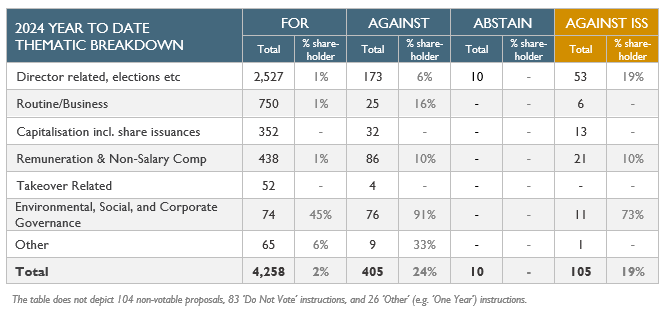
ACTIVITY The Firm entered into a proxy voting service agreement with ISS on 17 June 2014. ISS is a provider of corporate governance solutions for asset owners, investment managers, and asset service providers. ISS’ solutions include objective governance research and recommendations and end-to-end proxy voting and distribution solutions. The Firm has subscribed to the ‘Implied Consent’ service feature under the ISS Agreement to determine when and how ISS executes ballots on behalf of the funds and segregated clients. This service allows ISS to execute ballots on the funds’ and segregated clients’ behalf in accordance with the ISS vote recommendations. However, the Firm retains the right to override the vote if it disagrees with the ISS vote recommendation by using the ISS Proxy Exchange platform to communicate override instructions to ISS. In practice, ISS notifies the Firm of upcoming proxy voting and makes available the research material produced by ISS in relation to the proxies. The Firm then decides whether or not to override any of ISS’ recommendations. Hosking Partners’ investment strategy is founded on a multi-counsellor approach with each portfolio manager operating on an autonomous basis. The decision as to whether to follow or to override an ISS recommendation or what action to take in respect of other shareholder rights is ultimately taken by the individual portfolio manager(s) who hold the position. In circumstances where more than one portfolio manager holds the stock in question, it is feasible, under this multi-counsellor approach, that the portfolio managers may have divergent views on the proxy vote in question and may vote their portion of the total holding differently. Any decision to override the ISS recommendation is reviewed by Compliance to check that it does not give rise to any conflicts of interest and records are maintained. OUTCOME Data describing the voting practices of Hosking Partners for calendar year 2024 is provided below. The ‘% shareholder’ column describes the proportion of the relevant category and instruction which were shareholder proposals (e.g., 2% of the total 4,258 proposals voted ‘FOR’ were shareholder proposals).

Report chart

Notable examples of voting decisions taken over the past 12 months (and related rationale) are provided over the following pages.

Trailing 12-Month Examples (to 30th April 2025) Example Topic Example Narrative

Vote AGAINST (against Management, with ISS)

One of Hosking Partners’ holdings, Tosei Corporation, recently requested shareholders approve a poison pill. A Japanese company, Tosei Corp develops and sells residential properties, leases office spaces, and manages real estate investments, predominantly in Tokyo. A poison pill is a type of takeover defence strategy companies can leverage to deter a would-be acquirer from taking control of the company without the board’s consent. This is typically achieved by making the stock more expensive and thus unattractive to the acquirer. There are several types of poison pill which companies may adopt. In this case it would involve issuing warrants to all shareholders except for the offending shareholder, thereby diluting their holding and making it more costly to accumulate a controlling share. Preventing a takeover can be beneficial to minority shareholders, particularly where a company is temporarily undervalued, as an acquirer could accumulate a controlling share, taking advantage of a temporary price decline, and force out minority shareholders at a value below what might be deemed fair. Although this can be an effective deterrent against hostile acquirers, these strategies can be costly to execute. This cost is ultimately borne by shareholders and can impede potentially positive change by entrenching the current management, who may become less responsive to disempowered shareholders. Thus, management should ensure that any takeover defence strategy put forward for approval represents “a proportional response to a credible threat”. ISS have suggested several benchmarked criteria against which a strategy’s “proportionality” can be measured, which should be considered before an assessment need be made of whether a credible threat exists. Measuring the company’s plan against ISS’ criteria, Hosking Partners had several concerns with the plan, including the excessive 5-year duration and the presence of additional takeover defence initiatives already available to the board. The plan also lacked sufficient independent oversight, characterised by the majority insider board. Combined with a potentially high and unnecessary cost to shareholders, these deficiencies presented a material agency threat, and we believed the balance of cost to benefit was not in shareholders’ favour. As such, putting aside the absence of a present credible threat, Hosking Partners believed the proposed plan did not reflect a proportional response, leading us to vote with ISS and against Management accordingly.

Vote AGAINST (with Management, against ISS)

At the latest annual general meeting of Morgan Stanley, a shareholder proposal was raised requesting the company to report on it’s Clean Energy Supply Financing Ratio, a proposal which we voted against. Morgan Stanley has committed to achieving net-zero financed emissions by 2050 and has announced 2030 interim financed emissions targets. Holding companies to account and understanding how they plan to meet those targets is important, not only from an environmental point of view but also so we can better assess how effectively management is allocating capital. The proponent argued that since the ratio of global investment in non-fossil fuel energy to fossil fuel investment must grow over time for the IEA’s net zero pathway to be met, banks should therefore disclose their investments on the same terms. Theoretically this idea has merit, but at the time of the

Report chart

Vote FOR (with Management, against ISS)

In an example of the limitations of ISS’ rules-based approach to proxy voting recommendations, at the latest annual general meeting of Ferroglobe, ISS recommended voting against management on a proposal seeking authorisation for a share buyback, stating the buyback plan did not meet several of ISS’ standards for UK-listed companies regarding quantity, duration, and price. However, having discussed the issue with the company, we were strongly supportive of the buyback. The discrepancy arose because, although Ferroglobe is UK-listed, most of its shareholders are US-based, and the proposal was designed to align with US standards. Our opinion was that the buyback provision was reasonable and would enhance management’s capital allocation optionality. As such, we voted with the company on the proposal.

Vote FOR (with Management, against ISS)

Report chart

Vote AGAINST (against Management, against ISS)

In Q4, Altius Renewable Royalties Corp. (ARR) called a special meeting to seek shareholder approval for its acquisition by an affiliate of Northampton Capital Partners, LLC. ARR was originally structured to provide long-term, royalty-based capital to renewable power developers and operators. Notably, it was 58% owned by Altius Minerals Corp. (a separate long-term holding in our portfolio), which focuses on acquiring, exploring, and developing mineral properties in Eastern Canada. The proposal before shareholders was to allow Royal Aggregator LP (an affiliate of Northampton Capital Partners) to acquire the remaining 41.74% of ARR’s outstanding shares for CAD $12.00 per share in cash, leading to a delisting from the Toronto Stock Exchange. Management’s rationale for recommending this deal centred on persistent declines in renewable energy valuations and a high implied cost of raising public equity capital. Against this backdrop, they argued the company would struggle to secure the funding it needed to pursue its growth pipeline in a way that would benefit shareholders. Proxy adviser ISS supported the transaction, noting that the offer represented a 9.1% premium above ARR’s share price at the time of announcement. Their endorsement also referenced an independent valuation that set a range of CAD $10.50 to CAD $12.50 per share – close to the highest trading levels ARR had reached since early 2022. We began investing in ARR relatively recently (January 2024), seeing strong fundamentals and a promising pipeline of new royalty deals. With existing cash flow poised to fund further growth, we believed the company had the potential to benefit from a rerating once multiple development projects reached operational status. We were aware that Altius Minerals Corp. and other investors holding 81% of ARR’s common shares had already signed voting support agreements. This made it highly unlikely that minority shareholders could block the acquisition. Nonetheless, we believe firmly that a minority shareholder’s vote can still convey a meaningful message to management and other stakeholders – even when it goes against the majority decision. In our view, the CAD $12.00 offer did not fully reflect ARR’s intrinsic value or its imminent revenue uptick. Accordingly, we voted against management and against ISS’s recommendation. Although we recognised this would not alter the

final outcome, we wanted to register our dissatisfaction with the proposed valuation and the deal process. We also felt it was important to communicate to the Alberta court (where ARR is incorporated) that minority interests deserve fair consideration in any corporate transaction. The resolution passed with 94.26% of votes cast in favour of the merger. Despite this, we stand by our decision. We believe we sent a clear signal about the importance of minority shareholder rights, the need for fair valuation in corporate deals, and the value of dissenting voices – even in instances where the ownership structure makes a foregone conclusion likely. We have also communicated our position to Altius Minerals Corp., whose shares we continue to hold in our portfolio.

Statement of Compliance Hosking Partners LLP is authorised and regulated by the Financial Conduct Authority in the United Kingdom and registered with the Securities and Exchange Commission in the United States. The investment objective is to achieve rates of return in excess of the benchmark over the long term via investment in a portfolio of global securities. The UK Stewardship Code is overseen and published by the Financial Reporting Council, the independent regulator overseeing financial reporting, accounting and auditing and corporate governance. The Code, first published in 2010, sets the benchmark in the UK for institutional investors to meet ownership obligations in respect of their holdings of UK equities. Hosking Partners’ multi-counsellor approach is deliberately structured to give each autonomous portfolio manager the widest possible opportunity set and minimal constraints to make investment decisions. Hosking Partners supports the aims of the Stewardship Code for its UK investments and supports the Principles as best practice for its other investments. Hosking Partners considers that it complies with the recommendations of the UK Stewardship Code. Set out in the preceding document is the approach taken in respect of the key recommendations. Contact Please direct any questions regarding Hosking Partners’ approach to stewardship to one of the following:

Useful Links

Document Link

Active Ownership Report Q1 24 Available here

Active Ownership Report Q2 24 Available here

Active Ownership Report Q3 24 Available here

Active Ownership Report Q4 24 Available here

Voting Policy Available here

Conflicts of Interest Policy Available here

Shareholder Engagement Statement Available here

ESG Statement Available here

Modern Slavery Statement Available here

TCFD Report 2024 (Entity) Available here

TCFD Report 2024 (Product) Available here