2026 Active-Passive Investor Summit – Starboard Value LP
Starboard Value is a New York activist hedge fund that Jeff Smith and partners spun out as an independent firm in 2011 (the strategy dates to 2002 at Ramius). It targets undervalued U.S. small- and mid-caps, pushing board overhauls and operational fixes — famously its ~300-page Darden/Olive Garden deck.
In plain words
This piece says the aggregates sector has been oversold due to diesel inflation fears, but history shows it can pass on costs, making now a buying opportunity. The author (Starboard Value) is optimistic overall. Three key holdings: Knife River (KNF) has a big margin gap vs peers, with a $125 million pricing opportunity; Skyworks after buying Qorvo trades at just 7x forward earnings; Solstice has a duopoly in next-gen refrigerants.
At a Glance
One-sentence summary: The author believes the aggregates sector has been oversold due to diesel inflation concerns, Knife River’s margin gap is significant but has clear room for improvement, and Skyworks/Qorvo’s post-merger valuation is severely undervalued, with an overall stance of [Bullish].
- The median stock price in the aggregates sector has fallen 23% amid a 76% surge in diesel prices, but history shows the industry can overcome inflation through pricing power; the author sees this as an opportunity to buy quality companies.
- Knife River (KNF) currently has an adjusted EBITDA margin of only 15.1%, while the peer median stands at 29.0%; the author believes a reasonable target is 22%, corresponding to a roughly $125 million pricing opportunity.
- Skyworks’ pro forma operating margin after acquiring Qorvo could reach 29%, with a long-term target of 30–35%, yet its current forward P/E is only about 7x, far below the peer median, and the market has yet to price this in.
- Solstice holds a duopoly advantage in the next-generation HFO refrigerant market, benefiting from mandatory global refrigerant transitions, with high business quality and clear growth drivers.
At a Glance
The report argues that the aggregates industry has historically demonstrated strong pricing power, stemming from local market barriers, transportation economics, and regulatory constraints, which grant local market leaders exceptional pricing ability. The author cites data from 1902 to 2024 showing a long-term upward trend in both aggregates sales volume and prices. However, despite this pricing power, the industry's stock performance year-to-date (as of October 12) has lagged due to concerns over diesel cost inflation—the median industry stock price has fallen 23%, while diesel prices have surged 76% over the same period. The author believes this scenario mirrors 2022: when diesel prices soared 63%, industry stocks initially dropped 34%, but the sector subsequently used its pricing power to offset inflation, driving the median adjusted EBITDA margin from 22.2% in 2021 to a sustained expansion to 29.3% in 2025. Stock prices eventually rebounded 53% from their lows. The author emphasizes: "We Believe This Creates a Compelling Opportunity to Acquire Great Businesses at Attractive Valuations Amid Inflation Concerns They Have Proven They Can Overcome."
Knife River Underperformed Peers More, as Its Margin Gap Widened Amid Industry Expansion

As the broader industry corrected on inflation concerns, Knife River (KNF) delivered a year-to-date total shareholder return of -29.7%, significantly worse than the peer median of -21.8%, making it the worst-performing company in the sector. The author traces KNF's history: it was spun off from utility parent MDU Resources in 2023. At the time of the spin-off, management explicitly acknowledged a large margin gap versus peers and committed to closing it through the "EDGE strategy." CEO Brian Gray stated in May 2023: "we started looking at ourselves in the mirror as a stand-alone materials supplier that's vertically integrated and realized that we want to focus our attention on our margin improvements."

At the time of the spin-off, KNF's 2022 adjusted EBITDA margin was only 11.7%, compared to a peer median of 22.2%, a gap of over 1,000 basis points (approximately 1,053 bps). Management set formal targets: 15% for fiscal 2025 (still 700 bps below peers) and a long-term target of 20% (200 bps below peers). However, since the 2023 spin-off, peer margins have expanded from 22.2% to 29.0% (LTM), while KNF's margin improvement has lagged significantly—the report implies its actual performance has fallen well short of its targets, causing its stock price decline to far exceed that of peers. The author believes this creates a rare opportunity to "acquire great businesses at attractive valuations," as KNF operates in the highly attractive aggregates industry with a vertically integrated business model covering crushed stone, sand, gravel, ready-mix concrete, and asphalt across the full value chain, in operating regions benefiting from favorable population growth in the U.S. Midwest and West.

1. Knife River's Margins Are Far Below Peers; 22% Is the Reasonable Target
Starboard believes Knife River's margin target should be significantly raised from 15% to 22%, as its peers have materially improved margins while Knife River has failed to keep pace.


- In 2022, Knife River set a near-term margin target of 15%, when its adjusted EBITDA margin was 11.7%, a gap of approximately 700 basis points versus the peer median (22.2%).
- As of the latest twelve months (LTM), the peer median has risen to 29.0%, while Knife River has only improved to 15.1%. Maintaining the original 700 bps gap to peers implies a 22% adjusted EBITDA margin target today, not the unchanged 15%.
- The author states: "Maintaining the original 700 bps gap to peers implies a 22% adjusted EBITDA margin target today."
| Metric | 2022 | Current LTM |
|---|---|---|
| Peer Median Adjusted EBITDA Margin | 22.2% | 29.0% |
| Knife River Adjusted EBITDA Margin | 11.7% | 15.1% |
| Gap (bps) | ~700 | ~700 |
| Starboard's Implied Target Margin | — | 22% |
2. Peer Margin Distribution Clearly Shows Knife River's Significant Upside

By comparing the LTM adjusted EBITDA margins of eight peer companies, Starboard points out that Knife River's 15.1% sits at the bottom of the industry, while the most comparable peers all have margins exceeding 20%, indicating substantial improvement opportunity.
- Peer margins from low to high: KNF (Knife River) 15.1%, ROAD 20.5%, CRH 22.1%, SUM (Summit Materials, 2023 data) 24.9%, AMRZ (Amrize) 29.0%, VMC 32.3%, EXP 32.3%, MLM 32.7%.
- Starboard categorizes margins into three tiers:
- Floor ~15%: Corresponds to Knife River's current level, which the author believes should be its margin floor.
- Target ~22%: Corresponds to the level of the most comparable peers like CRH, Amrize, Summit Materials.
- Margin Ceiling ~30.8%: Corresponds to companies with nearly pure aggregates businesses like MLM, EXP, VMC.
- The author emphasizes: "Knife River’s closest peers operate at margins much higher than Knife River, signaling a sizeable opportunity."
3. Weighted by Business Comparability, the Low-20s Margin Target Still Holds
Starboard weights peer margins based on the similarity of each company's business model to Knife River's, and the resulting weighted average margin further supports the 22% target.
- Weighting allocation:
- EXP (significant wallboard business, different margin structure): 5.0%
- MLM (primarily aggregates, minimal downstream contracting): 5.0%
- VMC (primarily aggregates, limited downstream contracting): 5.0%
- ROAD (has downstream materials but also unrelated roofing business): 12.5%
- AMRZ (primarily road paving and construction services, comparable to Knife River's contracting services): 32.5%
- CRH (diversified, vertically integrated materials and contracting, highly comparable operating model): 40.0%
- The weighted average adjusted EBITDA margins for FY2022 and LTM based on these weights are 21.2% and 20.9%, respectively, both well above Knife River's original 15% target. The author concludes: "Weighing Peer Margins for Business Mix Further Supports a Low-20s Margin Target for Knife River."

1. Both of Knife River's Business Segments Significantly Lag Peers
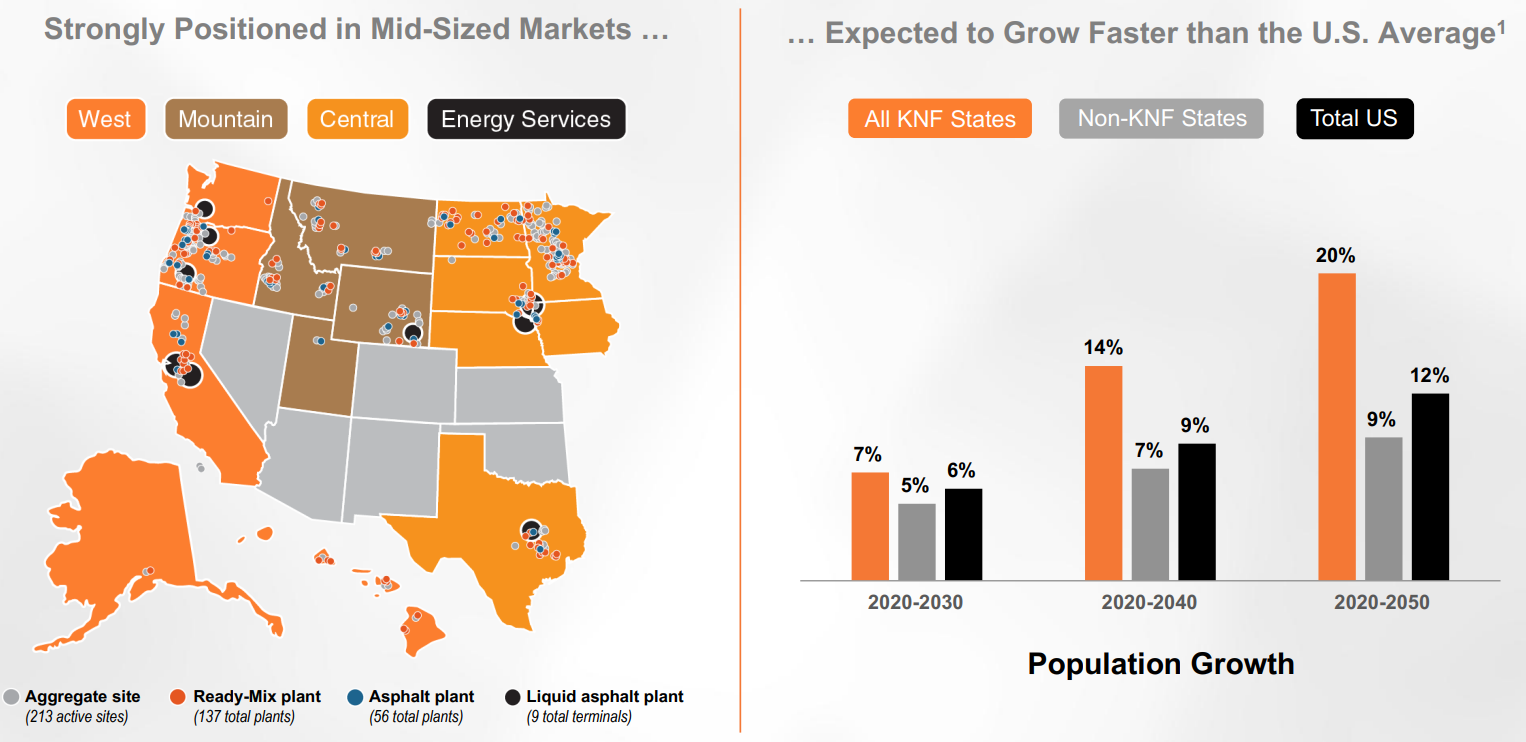
Knife River operates two distinct business segments with very different margin profiles: Construction Materials and Contracting Services. Construction Materials accounts for 44% of revenue and 24% of gross profit, while Contracting Services accounts for 56% of revenue and 76% of gross profit. Construction Materials has higher margins, while Contracting Services has lower margins.

The Construction Materials segment's LTM adjusted EBITDA margin is only 20.5%, compared to a peer median of 30.6%. Specific comparison:
| Company | LTM Adjusted EBITDA Margin |
|---|---|
| MLM | 32.7% |
| EXP | 32.3% |
| VMC | 29.0% |
| AMRZ | 27.2% |
| KNF Materials | 20.5% |
The author notes: "Knife River’s materials margins are +1,000bps lower than its construction materials peers!"
The Contracting Services segment's LTM adjusted EBITDA margin is only 8.2%, compared to a peer median of 13.5%. Specific comparison:
| Company | LTM Adjusted EBITDA Margin |
|---|---|
| CRH | 20.5% |
| ROAD | 15.0% |
| GVA | 11.9% |
| KNF Contracting | 8.2% |
The author judges: "Similarly, Knife River’s Contracting Services margins lag peers by ~500bps."
2. If Each Segment Reaches Peer Levels, the Combined Margin Could Reach 22%
If each of Knife River's segments could achieve the peer median margin, its combined adjusted EBITDA margin would rise from the current ~15% to at least 22%. The specific calculation is as follows:
| Metric | Knife River Current Level | Level After Reaching Peer Median |
|---|---|---|
| Construction Materials Adjusted EBITDA Margin | 20.5% | 30.6% |
| Contracting Services Adjusted EBITDA Margin | 8.2% | 13.5% |
| Combined Adjusted EBITDA Margin | ~15% | At least 22% |
The author emphasizes: "Margins should be at least 22%!!"
3. Two Key Levers for Margin Improvement: Pricing and Costs
The author believes Knife River can achieve a 22% adjusted EBITDA margin through two key levers: raising aggregates prices to close the structural gap with peers, and saving SG&A costs through operational efficiency.
On aggregates pricing, the gap between Knife River and peers has been widening. In fiscal 2025, Knife River's average aggregates price per ton (excluding freight) was $15.03, compared to a peer median of $22.64, a gap of $7.61/ton. From FY2016 to FY2025, Knife River's pricing rose slowly from $9.61 to $15.03, while the peer median rose sharply from $12.28 to $22.64, widening the gap from $2.67 to $7.61.
Each $1/ton price increase generates approximately $30 million in incremental EBITDA. The author's calculation logic: annual production of ~35 million tons × ~85% flow-through rate = ~$30 million EBITDA.
The total pricing opportunity is as high as $225 million, and the author believes ~$125 million can be captured over the next three years. Total price gap of $7.61/ton × $30 million EBITDA per $1/ton = approximately $226 million EBITDA opportunity. The author judges: "We believe the Company can capture ~$125mm of this over the next three years."
On costs, Knife River's SG&A as a percentage of sales is approximately 250 basis points higher than the peer median. Knife River's LTM adjusted SG&A as a percentage of sales is 9.5%, compared to a peer median of 7.0%. Specific comparison:
| Company | LTM Adjusted SG&A as % of Sales |
|---|---|
| KNF | 9.5% |
| AMRZ | 8.2% |
| EXP | 7.2% |
| ROAD | 7.1% |
| CRH | 6.9% |
| VMC | 6.9% |
| MLM | 6.9% |
The author notes: "KNF spends nearly ~250bps more than the peer median on SG&A."
4. Margin Improvement Will Drive Significant Valuation Re-rating, and the Company Itself Is a Scarce Strategic Asset
Knife River's current trading valuation is already significantly below peers, and if it achieves a 22% margin, its valuation would appear extremely cheap. Knife River's current 2027E adjusted EBITDA multiple is 7.8x, compared to a peer median of 9.6x. Adjusted for a 22% margin, its multiple would further decline to 5.5x. The author emphasizes: "KNF Trades EVEN CHEAPER!"
Furthermore, the author believes Knife River is a scarce and highly strategic asset in a highly fragmented and continuously consolidating industry. Peer markets are saturated, requiring M&A to expand geographic footprints, and Knife River possesses scarce physical assets (difficult to build new large-scale quarries). The author judges: "We believe Knife River presents an attractive acquisition opportunity for many of their peers." Historical transaction cases also demonstrate its potential strategic value.
Investment Implications
The author (Starboard Value), through a detailed margin gap analysis, constructs a clear dual value realization logic of "operational improvement + potential M&A." The core argument is that Knife River's current low margins are not a structural defect but an operational gap that can be bridged through price increases and cost reductions. Once improved, not only will its own valuation be significantly re-rated, but it could also become an acquisition target in industry consolidation. Readers should note that this is the perspective of activist investor Starboard's portfolio, and its analysis inherently carries a motivation to drive change and boost stock prices. Furthermore, the assumption of "capturing $125 million in pricing opportunities over the next three years" involves uncertainty.
1. If Knife River Fails to Meet Margin Targets, Its Aggregates Platform Will Have Significant Synergy Value
Starboard believes that if Knife River's management fails to achieve margin targets, its aggregates platform will become a highly attractive acquisition target. The article highlights the valuation discount by comparing Knife River's current trading multiples with historical industry M&A multiples.
| Metric | Multiple |
|---|---|
| Knife River Current 2027E Trading Multiple | 7.8x |
| Knife River Pro Forma 2027E Trading Multiple | 5.6x |
| Industry Historical M&A Median Multiple | 12.4x |
| Industry Historical M&A Average Multiple | 13.7x |
The author states: "Knife River would be a highly sought after asset." The article cites recent aggregates industry M&A cases (e.g., Lhoist/MLM at 17.2x, Arcosa/CRH at 15.0x), implying significant re-rating potential from Knife River's current 7.8x valuation.
2. Starboard Has Deep Experience in Semiconductors; Qorvo Is a Success Story
Starboard reviews its investment history in the semiconductor sector, highlighting Qorvo as a typical value creation case. It invested in TriQuint in 2013, pushing for its merger with RFMD (resulting in Qorvo). Both companies' stocks rose nearly 200% from the announcement to the completion of the transaction.
However, by 2025, Qorvo's margins had fallen to historical lows: gross margin dropped from 52.1% in FY21 to 44.6% in FY25E (down 780 bps), and operating margin fell from 32.2% to 16.2% (down 1,720 bps). After Starboard rebuilt its position, it pushed for the addition of three new independent directors to the board (including Marvell President Chris Koopmans and former NXP CEO Rick Clemmer) and optimized the manufacturing footprint. Result: gross margin recovered to 50.8% (+620 bps), and operating margin recovered to 23.8% (+760 bps).
3. Significant Synergy and Margin Improvement Potential Exist After Skyworks Acquires Qorvo, But the Market Has Not Priced It In
Starboard believes the strategic and financial logic of Skyworks' acquisition of Qorvo is clear, but the market underestimates its earnings growth potential due to low attention. Post-merger, Skyworks' pro forma FY26E operating margin is 23% (including Qorvo's contribution), which could reach 29% with the announced $500 million in cost synergies. Management's long-term target is a 30-35% operating margin, corresponding to $2.5-3.0 billion in operating profit.

The author quotes: "So 2-3 years from now, you'd expect us to see kind of certainly getting to our business model target, 50% to 55% gross margin, 30% to 35% operating margin, 35% to 40% EBITDA margins, very attractive capital structure, large and growing markets..."
From the merger announcement to completion (October 2025 to October 2026), Skyworks' stock price rose only 14%, while the semiconductor index rose 47%, underperforming by over 30%. Starboard notes that only 5 out of 22 analysts updated their models, leading to overly low consensus expectations. Updated analyst expectations for FY28E EPS are approximately $11, about 30% higher than consensus ($7.88). Based on the midpoint of long-term targets, Skyworks' pro forma forward P/E is only about 7x, compared to the current FY28E consensus P/E of 12.7x.
4. Skyworks Derives ~62% of Revenue from Mobile End Markets; Post-Merger Product Portfolio Is More Complete
Post-merger, Skyworks' annual revenue is approximately $7.5 billion, with 62% from mobile (including Qorvo ACG) and 38% from broad markets (including Qorvo HPA and CSG). The article argues that the merger gives Skyworks a more comprehensive product portfolio in the RF market, laying the foundation for long-term growth.
As an independent third-party analyst, I will now analyze the continuation of the Starboard Value research report "Introduction" chapter you provided.
1. Post-Merger, Skyworks Becomes a More Important Supplier in Mobile with Enhanced R&D and Customer Stability
The article points out that Skyworks' and Qorvo's mobile product lines are highly complementary, and the combined company will cover all major RF front-end categories, making it a more important supplier to customers. The author states: "Skyworks’ and Qorvo’s mobile product sets are largely complementary, and together they cover every major RF front-end category. We believe this makes the combined company a more important supplier to its customers."
The article uses a table to demonstrate the advantages of the combined product portfolio, covering categories such as Low Band, Mid/High Band, Transmit, Diversity Receive, Ultra-High Band, Wi-Fi/GPS, Antenna Tuning, and Power Management, summarizing four key benefits:
- Broader Product Portfolio: Complementary and best-in-class RF product portfolio.
- Customer Diversification: Diversified mobile technology portfolio strengthens customer relationships.
- Enhanced Stability: Reduced cyclicality and improved revenue stability.
- R&D Scale: Larger R&D scale to invest in next-generation technologies.
2. AI-Driven Upgrade Cycles and Emerging Products Offer Growth Options for Skyworks, and RF Content Is at an Inflection Point
The author argues that market concerns over smartphone unit sales growth ignore the AI-driven upgrade cycle. Meanwhile, new AI consumer products require RF content, expanding Skyworks' total addressable market. The author judges that investors are getting a free AI growth call option with Skyworks. The article cites IDC data, forecasting smartphone sales between 1.01 billion and 1.25 billion units from 2024 to 2027, and lists AI products like smart glasses, AI pins/pendants, and humanoid robots.
The article further points out that smartphones are becoming the primary AI devices, AI workloads demand higher uplink requirements, and management feedback indicates that RF complexity is rising for the first time in years. The author expects 6G to continue this trend. The article cites data showing that from 3G to 6G, the RF front-end content per smartphone will grow from approximately $15 to over $25, an increase of more than 50%. Drivers include:
- Smartphones becoming the primary AI device, with 29% of US AI assistant users being mobile-only.
- A shift towards flagship and premium phones (in H1 2026, phones over $600 accounted for 25% of global sales).
- AI-driven uplink traffic expected to increase significantly by 2031 compared to 2025.
3. The Broad Markets Business (Including Defense and Data Centers) Is Skyworks' Underappreciated Growth Engine
The article notes that nearly 40% of Skyworks' revenue comes from broad markets, serving attractive end markets such as Defense & Aerospace, AI Data Centers, Edge IoT, and Automotive & Industrial. The author is particularly bullish on the Defense & Aerospace and Data Center businesses, believing their growth is not fully reflected.
- Defense & Aerospace: Qorvo's Defense & Aerospace business has a long-term double-digit growth runway, with revenue expected to grow from approximately $400 million in FY2025 to approximately $500 million in FY2027E, with a long-term target of approximately $1 billion.
- Data Centers: Skyworks' Data Center business is growing at over 50% annually, has secured design wins with several leading customers, and management indicates demand exceeds supply.
The author concludes that the merger positions Skyworks favorably in two of the fastest-growing end markets in the semiconductor industry.
4. Skyworks' Valuation Is Significantly Below Peers, Representing a Notable Discount
The article quotes Skyworks CEO Philip G. Brace's statement on September 10, 2026, describing the company's future financial profile as "mid-single-digit growth, 50-55% gross margin, 30-35% operating margin, 35-40% EBITDA margin," which the author believes will drive good EPS growth.
Based on this, the article compares Skyworks' valuation multiples with peers:
| Company | NTM P/E |
|---|---|
| MPWR | 34.5x |
| MTSI | 31.2x |
| TXN | 27.3x |
| ADI | 23.6x |
| MCHP | 17.7x |
| ON | 16.8x |
| QCOM | 16.7x |
| SWKS (FY27E Consensus) | 12.5x |
| SWKS (FY27E Based on Updated Analysts) | 12.7x |
| SWKS (FY28E Based on Updated Analysts) | 10.1x |
| SWKS (Long-Term Financial Target Midpoint) | ~7x |
| CRUS | 15.5x |
The article points out that Skyworks' pro forma P/E, considering margin improvement, is approximately 7x, significantly below the peer median (Broad Markets peer median 25.5x, Mobile peer median 14.6x), representing a notable discount.
5. Solstice Is a High-Quality Specialty Materials Company with a Unique Fluorine Chemistry Business Portfolio
The article introduces Starboard's third thesis—Solstice Advanced Materials Inc. The company operates through two segments: Refrigerants & Application Solutions (RAS) and Electronics & Specialty Materials (ESM). It has an enterprise value of $11 billion, FY2027E revenue of $4.4 billion, and an EV/FY2027E EBITDA of 9.3x. RAS contributes 72% of revenue, and ESM contributes 28%.
Solstice focuses on fluorine chemistry, with applications spanning refrigerants, nuclear fuel conversion, building insulation foam, pharmaceutical packaging, body armor, semiconductor manufacturing, and research chemicals. The article believes Solstice owns seven unique and exciting businesses that are high-quality, market leaders, and benefit from end markets with long-term growth drivers.
6. Solstice Holds a Leadership Position in the Refrigerant Market, Especially a Duopoly in Next-Gen HFO Refrigerants
Solstice is one of the largest refrigerant businesses globally, serving fixed, mobile, and data center end markets. The article argues that Solstice is a leader in HFC refrigerants but holds an even stronger position in next-generation HFO refrigerants, as it is one of only two players with key patent IP.
The article notes that the HFO refrigerant industry has an attractive duopoly market structure. This implies Solstice has strong pricing power and competitive barriers in this area.
The Refrigerant Industry is Transitioning from Legacy HFCs to Next-Gen HFOs; Solstice's Refrigerant Business Will Benefit
The article points out that governments worldwide are mandating companies to stop using legacy HFC refrigerants, supporting a transition towards next-generation, more environmentally friendly HFO refrigerants. The author states: "Governments around the world are mandating companies to stop using legacy HFC refrigerants, supporting a transition towards next-generation, more environmentally friendly HFO refrigerants."
Starboard lists the following companies as comparable peers for Solstice in the refrigerant space: Air Liquide, A-Gas, Arkema, Chemours, Daikin, Dongyue, iGas, Linde, National Refrigerants, Orbia, Weitron. Starboard acknowledges this peer group is subjective, and including other companies could yield significantly different results.


Volume comparison of HFO vs. HFC refrigerants (US and European markets, in kilotons):
| Year | HFOs | HFCs |
|---|---|---|
| 2025 | 168 | 370 |
| 2035 | 306 | 198 |
Solstice's Nuclear Business Is Highly Valuable; UF6 Conversion Is a Key Bottleneck in the Nuclear Fuel Cycle


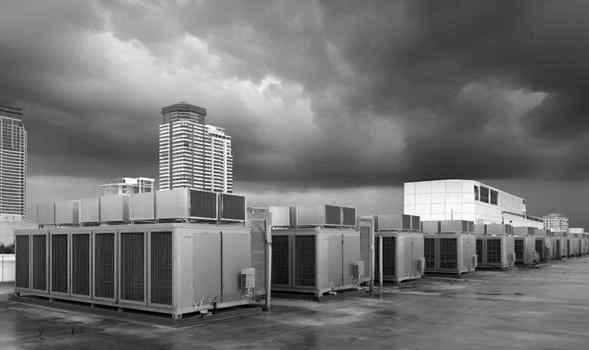
The article argues that nuclear energy is a great industry. Surging electricity demand from data centers (global data center electricity consumption forecast: ~200 TWh in 2020, up to 2,200 TWh in a high scenario by 2035) is driving a nuclear renaissance. Global nuclear power capacity is expected to grow from ~400 GWe in 2025 to ~1,200 GWe by 2050.
Solstice provides critical UF6 conversion services in the nuclear sector—a chemical reaction combining uranium with fluoride to produce UF6. UF6 conversion accounts for only about 5% of nuclear fuel costs but is one of the most capacity-constrained steps in the nuclear fuel cycle. The author emphasizes: "Solstice provides UF6 conversion services, a small but critical step in making nuclear fuel… And conversion is becoming one of the biggest bottlenecks in the nuclear fuel cycle."
Solstice owns the only UF6 conversion facility in the United States and is one of only three such facilities in the Western world. Due to the highly regulated nature of the nuclear industry, obtaining a permit to build a conversion facility is extremely difficult.

Due to Supply-Demand Imbalance, UF6 Conversion Contract Prices Have Soared; Solstice's Existing Contracts Are Well Below Market Rates
UF6 conversion contract prices have surged from approximately $15/kgU in 2011 to $56/kgU in 2026. Starboard estimates that Solstice's existing contracts have an average price of approximately $30/kgU, roughly 45% (about $25/kgU) below current market rates. The author states: "We believe Solstice’s UF6 conversion contracts are priced ~$25/kgU (~45%) below current market rates."
As these low-priced contracts expire and are repriced, Starboard expects Solstice's nuclear business revenue to grow at a 15% CAGR (from ~$356M in 2025 to ~$725M in 2030) and EBITDA to grow at a 24% CAGR (from ~$125M in 2025 to ~$370M in 2030), at least through 2030.
The Western UF6 Supply Gap Will Continue to Widen; Solstice Is Best Positioned to Fill It

Currently, UF6 demand far exceeds Western supplier capacity, with the gap filled by Russian imports and secondary supplies (recycled fuel, depleted uranium, inventory drawdowns). There is a 35% gap between current supply (~48.9 kT in 2026) and demand. As secondary supplies dwindle and the US ban on Russian imports takes full effect in 2028, the supply-demand gap will widen further.
Among the three Western UF6 conversion facilities, Solstice has the most room for capacity expansion. Its 2026 production is 9.5 kT, while its permitted total capacity is 15.0 kT, leaving 5.5 kT of expansion potential. In contrast, Orano (France) and Cameco (Canada) are operating near their permitted limits. Starboard believes Solstice is the best-positioned supplier to fill this structural shortfall.

Solstice CEO David Sewell stated in February 2026: "With robust demand from our customers, Solstice is now actively evaluating further ways to expand our UF6 production to meet this demand." Starboard believes further expansion of UF6 conversion capacity would be a high-ROIC investment and could further accelerate growth.
Solstice Also Owns High-Quality Assets in Other Business Areas
Beyond nuclear and refrigerants, Solstice owns a range of high-quality businesses, including Electronic Materials, Safety & Defense Solutions, Healthcare Packaging, Construction Solutions & Research Intermediates, and High-Performance Chemicals. The article argues these businesses are valuable due to their technological differentiation, long-term growth trends, and strong revenue growth.
1. The Acquisition of Element Solutions Was the Trigger for the Stock Price Plunge
Starboard believes Solstice's proposal to acquire Element Solutions caught investors off guard, causing the stock price to fall nearly 25% in three days. The article points out that Element Solutions' business mix is very different from Solstice's core competency in fluorine chemistry. The author states: "Element Solutions has a very different business mix than Solstice and would have moved the Company away from its core competencies in fluorine-based chemistries and would have diluted the Company’s market-leading franchises in Nuclear and Refrigerants."
| Business Segment | Solstice EBITDA % (1) | Element Solutions EBITDA % (2) |
|---|---|---|
| Electronic Materials | 17% | 76% |
| Other | 24% | 24% |
| Nuclear | 12% | — |
| Construction Solutions & Intermediates | 18% | — |
| Refrigerants | 45% | — |
| NTM EBITDA Multiple (3) | 13.1x | 17.5x |
Note: (1) Starboard estimate of 2026 EBITDA mix; (2) Based on consensus 2026 EBITDA mix; (3) Multiples as of July 2, 2026.
Following the acquisition announcement, Solstice's stock price fell from around $80 to the $60 range. Although the transaction was terminated by both parties in August, the stock price has not yet recovered to pre-announcement levels. Starboard judges: "we believe the proposed Element Solutions acquisition remains a large overhang."
2. Current Valuation Is Severely Misaligned with Growth Potential
Starboard believes Solstice's current 9.3x 2027E EBITDA valuation is significantly undervalued relative to its portfolio of market-leading businesses. The article compares Solstice to a group of slower-growing, more commoditized chemical peers, noting that its valuation is at the median level, but its business quality is far superior.
| Company | TEV / 2027E EBITDA | 2026E-28E Revenue CAGR |
|---|---|---|
| RPM | 10.8x | 4% |
| ATR | 10.3x | 5% |
| DD | 10.2x | 4% |
| KWR | 9.7x | 4% |
| SOLS | 9.3x | 3% |
| ASH | 8.5x | 6% |
| NGVT | 8.5x | 1% |
| AVNT | 8.0x | 2% |
| AMCR | 7.9x | 4% |
| AXTA | 7.2x | 3% |
| CC | 7.1x | 4% |
| EMN | 5.5x | 2% |
Note: Peer median is 8.5x. Starboard considers RPM, ATR, DD, KWR, ASH, AMCR, NGVT, AVNT, AXTA, CC, EMN as appropriate comparable companies.
3. Nuclear Business Valued at Nearly $4 Billion
Starboard believes Solstice's nuclear business is worth at least $3.9 billion, corresponding to a 20.0x 2029E EBITDA multiple. This business benefits from premium valuations in the nuclear industry and its unique competitive position. The article cites valuation comparisons with nuclear peers (Cameco, BWXT, Centrus), arguing that Solstice's nuclear business growth prospects support a 20.0x multiple.

| Item | Value |
|---|---|
| 2029 EBITDA | $320 million |
| Solstice Share (1) | 61% |
| Solstice Nuclear EBITDA | $196 million |
| Applicable Multiple | 20.0x |
| Nuclear Value | $3.9 billion |
Note: (1) After deducting the share payable to General Atomics in the ConverDyn joint venture.
4. Electronic Materials and Defense/Packaging Businesses Are Also Undervalued
Starboard believes the Electronic Materials business should be valued at 19.0x 2027E EBITDA, Safety & Defense at 12.5x, and Healthcare Packaging at 8.5x. Electronic Materials directly benefits from AI infrastructure buildout and semiconductor demand growth. The article compares peers like Entegris, Materion, Qnity, and Element Solutions, arguing that Solstice's Electronic Materials growth prospects support a 19.0x multiple. The Safety & Defense business (e.g., Dyneema brand) and Healthcare Packaging business (with peers like Aptar, Amcor) are also market leaders in their respective industries, and their implied valuation multiples are below comparable companies.
Electronic Materials, Safety & Defense, and Healthcare Packaging Are Worth $3.7 Billion Combined and Could Be Separated
Starboard believes Solstice's three businesses—Electronic Materials, Safety & Defense Solutions, and Healthcare Packaging—are worth at least $3.7 billion combined. The specific valuation breakdown is as follows:
| Business Segment | 2027E EBITDA | Valuation Multiple | Corresponding Value |
|---|---|---|---|
| Electronic Materials | $130 million | 19.0x | $2.5 billion |
| Safety & Defense Solutions | $130 million | 12.5x | $600 million |
| Healthcare Packaging | $75 million | 8.5x | $600 million |
| Total | $3.7 billion |
Starboard notes that its selected comparable companies for the defense sub-sector include EXENS, AVON, CHG, THEON, NPK; Dyneema transaction valuation and growth data are calculated on an NTM basis. The author believes these companies are comparable to SOLS in the defense and healthcare industries but also acknowledges that "this presentation is a determination that is subject to a certain degree of subjectivity," and including other companies could lead to significantly different conclusions.
After Excluding Nuclear and the Above Businesses, Solstice's Core Refrigerant Business Trades at Only 4.3x EBITDA

After stripping out the value of the Nuclear, Electronic, Defense, and Healthcare businesses, Solstice's remaining business (primarily Refrigerants) trades at only 4.3x EBITDA, well below the chemical peer median of 8.5x. Specific comparison:
| Company | TEV / 2027E EBITDA |
|---|---|
| RPM | 10.8x |
| ATR | 10.3x |
| DD | 10.2x |
| KWR | 9.7x |
| ASH | 9.6x |
| SOLS (Overall) | 9.3x |
| AMCR | 8.5x |
| NGVT | 8.5x |
| AVNT | 8.0x |
| AXTA | 7.9x |
| CC (1) | 7.2x |
| EMN | 7.1x |
| PF SOLS (Refrigerants & Other) (2) | 5.5x |
| SOLS (Refrigerants & Other) | 4.3x |
Note: (1) Chemours' TEV includes $1.6 billion in PFAS liabilities. (2) This multiple excludes the value of Nuclear ($3.9B), Electronic Materials ($2.5B), Safety & Defense ($600M), and Healthcare Packaging ($600M). Starboard values the Nuclear business at $3.9 billion, Electronic Materials at $2.5 billion, Safety & Defense at $600 million, and Healthcare Packaging at $600 million.
Solstice Has at Least $100 Million in Cost Reduction Opportunities
Solstice's corporate overhead expense ratio is significantly higher than peers; reducing it to the peer median could save at least $100 million. Comparison of estimated 2026 unallocated corporate overhead as a percentage of revenue:
| Company | Unallocated Corporate Expense as % of Revenue (2026E) |
|---|---|
| SOLS | 5.3% |
| ASH | 3.5% |
| AVNT | 3.5% |
| NGVT | 3.2% |
| CC | 2.9% |
| ATR | 2.3% |
| DD | 1.7% |
| EMN | 1.7% |
| RPM | 1.5% |
| Peer Median | 2.3% |
Starboard judges: "We believe Solstice has the potential to reduce its corporate overhead expenses by at least $100 million." This $100 million cost saving represents approximately 20% of its SG&A.
After Accounting for Cost Cuts, Solstice's Core Business Valuation Is Only 3.8x EBITDA
After stripping out the value of Nuclear, Electronic, Defense, and Healthcare businesses, and factoring in $100 million in cost cuts, Solstice's remaining business trades at only 3.8x EBITDA. This multiple is well below the chemical peer median of 8.5x and also below the 4.3x before accounting for cost cuts. The author summarizes: "When also factoring in $100 million of cost cuts, the remaining business trades at just 3.8x EBITDA."
Investment Implications

Starboard completes its core valuation argument in this section: by valuing Solstice's individual businesses using a Sum-of-the-Parts (SOTP) method, it concludes that its core refrigerant business is severely undervalued, and the discount is further amplified by the potential for cost cuts. The author explicitly assigns responsibility to management: "It Is Management’s Responsibility to Unlock Shareholder Value" and notes that "There is still an overhang from the poorly received, but now terminated, Element Solutions deal." Institutional Perspective Bias Note: As an activist investor, Starboard's valuation model is inherently designed to support its thesis of driving a spin-off or restructuring. Readers should be aware that its selection of comparable companies and multiple assumptions may be optimistic, and the spin-off itself carries execution risks and costs.
Position Moves
| Ticker | Direction | Author's One-Sentence View | Key Data |
|---|---|---|---|
| Knife River (KNF) | Hold & Watch | The margin gap is massive but the improvement path is clear, presenting a rare opportunity to "acquire a quality business at an attractive valuation" | Current margin 15.1% vs peer 29.0%; target 22%; each $1/ton price increase corresponds to ~$30mm EBITDA |
| Skyworks (SWKS) | Hold & Watch | Post-merger margin improvement potential is not priced in by the market, valuation is at a significant discount, and there is a "free AI growth call option" | Pro forma FY28E PE ~7x vs consensus 12.7x; long-term target 30-35% operating margin |
| Qorvo (QRVO) | Hold & Watch | Synergies from the Skyworks acquisition are clear, and margins have already recovered from the trough | Gross margin recovered from 44.6% to 50.8%; operating margin recovered from 16.2% to 23.8% |
| Solstice Advanced Materials | Hold & Watch | Holds a unique fluorochemical business portfolio with a duopoly advantage in the HFO refrigerant market | EV $11bn; 2027E EBITDA multiple 9.3x; RAS accounts for 72% of revenue |