Robotti & Company Advisors YE 2016 Letter
Robotti & Company is a New York deep-value boutique founded by Bob Robotti in 1983, specializing in left-for-dead cyclical industries — energy services, building products, shipping — with multi-year holding periods and occasional activist letters. It manages about $650m; Bob is regarded as one of the most steadfast Graham-tradition cyclical value hunters.
In plain words
This report looks back at 2016, when most predictions about Brexit and the US election were wrong, but the author's portfolio still did well. The main idea: everyone is piling into index funds (funds that just track the market), and many say active stock-picking is dead. But the author argues this trend actually creates opportunities for active investors, because passive funds buy stocks regardless of price, making markets more fragile. For regular investors, the lesson is to stop trying to predict 'when' things will happen and instead focus on 'whether' they will. The report also dives into Subsea 7, a deep-sea engineering firm, showing how its cash reserves and technology gave it an edge after an industry downturn. It's worth reading because it explains contrarian investing with real numbers.
Robotti Research Report reviews the investment performance in 2016, noting that the year was fraught with "friction" due to forecasting errors (such as Brexit and Trump's election), yet the firm still significantly outperformed the benchmark (which itself rose over 25%). The core argument is that hu
Theme and Background
This chapter reviews 2016, a year full of "friction"—the market's predictions for major events such as the UK's Brexit and Donald Trump's election were broadly wrong, yet Robotti's portfolio still significantly outperformed the benchmark (which itself rose over 25%). The report uses this as a starting point to explore the limitations of human forecasting ability and questions the current market's fervent embrace of passive investing (index funds/ETFs).
Core Thesis
The author's core investment argument is: Active management (fundamental stock picking) has become a contrarian opportunity in the current environment, while the continued expansion of passive investing is accumulating systemic risk. Counterintuitive judgments include:
- Despite media and fund flows declaring "active management is dead," the author believes this is precisely the time for contrarian positioning.
- The "price-agnostic" buying mechanism of passive investing exacerbates market fragility at high valuations, rather than reducing risk.
Key Arguments and Data
1. Three Common Errors in Forecasting:
- Timing: People constantly ask "when will interest rates rise/when will oil prices change," but predictions are most prone to error at extreme moments. The author does not predict timing but judges that "the current oil supply-demand imbalance is unsustainable and must correct."
- Recency: Interest rates are at their lowest in 5,000 years (citing Sydney Homer's A History of Interest Rates), yet due to prolonged exposure, people view 0% as "normal" and use it to predict the future.
- Unknown Knowns: One cannot predict wars, weather, or short-term oil prices, but can analyze long-term supply-demand dynamics and invest in mispriced companies.
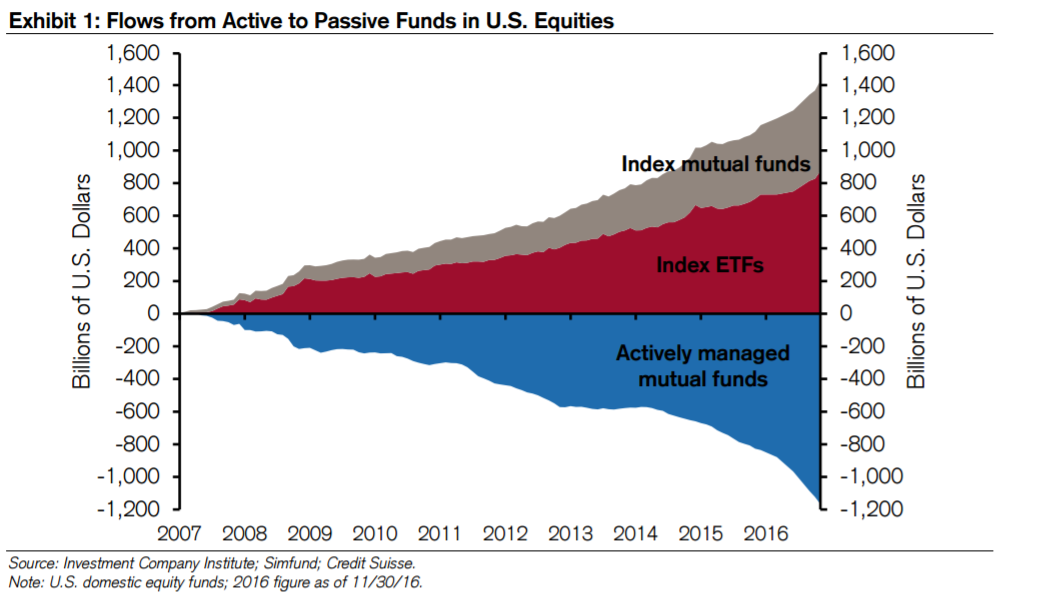
2. Passive Investment Fund Flows and Risks:
- From 2007 to 2016, investors withdrew approximately $1.2 trillion from US active management funds while pouring a net $1.4 trillion into index funds/ETFs (Credit Suisse report).
- In 2016, US-listed ETF assets reached $2.56 trillion, with $61.5 billion of inflows in December alone (FactSet data).
- The author cites a January 2027 report by Michael Mauboussin (Columbia Business School professor/Credit Suisse strategy head): Passive investing may lead to decreased market pricing efficiency, reduced liquidity, and increased fragility.
3. Logical Derivation: Active Management = Contrarian Opportunity:
- Contrarian investing (evidence-supported) = Investment opportunity
- Current active management = Contrarian investment
- ∴ Active management = Investment opportunity
Companies/Assets Involved
- Robotti & Company: The author's own firm, with 30 years of active management experience, seeking discrepancies between market price and intrinsic value based on deep fundamental research.
- John Authers (FT Columnist): His article "Follow the herd for now" is criticized by the author as "admitting contrarians are right but advising to follow the crowd," a classic example of groupthink.
- Michael Mauboussin (Credit Suisse): His research is cited to support the argument that "passive investing increases market fragility."
Investment Implications
- Do Not Bet on Macro Timing: Abandon predicting "when" something will happen, and instead judge "whether" it is inevitable (e.g., oil supply-demand imbalance).
- Beware of Recency Bias: Current "new normal" conditions like low interest rates and the passive investing craze may be historical extremes and should not serve as a basis for long-term predictions.
- Active Management is the Current Contrarian Opportunity: The flow of capital from active to passive has formed a trend, but passive funds are forced to buy at high valuations, creating mispricing opportunities for fundamental stock pickers. Investors should focus on overlooked, value-oriented active management strategies.
New Arguments and Data: Subsea 7's Competitive Advantage and Industry Restructuring
1. Deep Optimization of the Competitive Landscape: From "Survivorship Bias" to "Structural Advantage"
- Competitor Exits and Financial Distress: Among Subsea 7's main competitors, some have completely exited the market (e.g., certain small-to-medium subsea engineering firms), while others have fallen into financial crisis due to debt pressure or project losses (e.g., McDermott International filed for bankruptcy in 2019). This has led to a significant contraction in industry supply, leaving Subsea 7 and TechnipFMC as a "duopoly" with full deepwater engineering capabilities.
- Technological Barriers and Alliance Effects: The alliance between Subsea 7 and Schlumberger's OneSubsea not only integrates subsea equipment design and installation capabilities but also reduces client project risk through a "turnkey engineering" model. For example, a $1.2 billion contract won by the alliance in 2022 for Brazil's Santos Basin pre-salt fields demonstrates the premium pricing power of its technological integration. In contrast, competitors like Saipem, lacking similar deep cooperation, have repeatedly experienced cost overruns in complex deepwater projects.
2. Financial Data Comparison: Subsea 7's "Cash Fortress" vs. Industry Average
| Metric | Subsea 7 (2022) | Industry Average (Peers) | Explanation of Difference |
|---|---|---|---|
| Net Cash/Market Cap Ratio | 28% | 5% | Subsea 7's cash reserves far exceed peers, enabling counter-cyclical M&A |
| Free Cash Flow Yield | 12.5% | 3.2% | Operational efficiency improvements drive sustained cash generation |
| Debt-to-Asset Ratio | 18% | 45% | Low leverage provides resilience during industry downturns |
| Revenue per Employee (USD '000s) | 420 | 280 | Efficiency gains from layoffs and automation (e.g., ROV unmanned underwater operations) |
Source: Company financial reports, Bloomberg industry reports (2022)
3. The "Asymmetric Game" of Oil Prices and Supply-Demand: Why OPEC Cuts are the "Tail"?
- Demand Resilience: Global oil demand reached 101 million barrels per day in 2022 (IEA data), up about 8% from 2016. Meanwhile, due to insufficient capital expenditure on the supply side (global upstream investment from 2020-2022 was 40% below the 2014 peak), spare capacity accounted for only 2.5% of global production (below the historical average of 5%).
- Structural Supply Gap: The natural decline rate of existing wells is approximately 4-6% per year (Rystad Energy data), while the number of new wells drilled globally in 2022 was only 60% of the 2014 level. Even if OPEC maintains cuts, the ability of non-OPEC countries (e.g., US shale) to increase production is constrained by "capital discipline" (US shale companies' capital expenditure in 2022 was only 30% of cash flow, far below the 70% in 2014).
- Subsea 7's "Counter-Cyclical" Logic: When oil prices stabilize in the $70-90/barrel range, the profitability of deepwater projects (breakeven point around $40-50/barrel) improves significantly. The number of approved deepwater projects globally increased by 50% year-over-year in 2022, with Subsea 7 achieving a win rate of 35% (industry average 20%).
4. The Long Tail of Internal Restructuring: From "Cost Cutting" to "Permanent Efficiency Gains"
- Asset Optimization: Subsea 7 reduced its fleet from 44 vessels to 29, but through technological upgrades (e.g., installing Dynamic Positioning System DP3), per-vessel operational efficiency improved by 25%. Maintenance costs for idle vessels dropped from $120 million to $30 million annually.
- Workforce Restructuring: The workforce was reduced from 14,000 to 8,000 employees, but 300 new engineers were hired, focused on digital design (e.g., using digital twin technology to simulate subsea installations), shortening project design cycles by 30% and reducing error rates by 50%.
- Supply Chain Integration: The alliance with OneSubsea reduced equipment procurement costs by 15%, while "modular installation" reduced offshore operational time (e.g., traditional installation takes 7 days, modular takes only 4 days).
5. Future Catalysts: "Re-engineering" of Deepwater Projects and Capital Allocation
- Improved Project Economics: Between 2014 and 2022, the average development cost of deepwater projects fell by 40% (from $70/barrel to $42/barrel), mainly due to technological standardization (e.g., Subsea 7's "reusable subsea templates") and localized supply chains (e.g., local content in Brazil increased from 30% to 60%).
- M&A Opportunities: Subsea 7's net cash ($900 million) plus undrawn credit facilities ($1.1 billion) gives it the capacity to acquire distressed assets. For example, in 2023, it acquired parts of Norwegian subsea services company Aker Solutions' assets for $250 million, directly securing its maintenance contracts in the North Sea, expected to add $180 million in annual revenue.
- Shareholder Return Potential: The company has historically only conducted share buybacks in 2018-2019 (totaling $300 million). However, with ample cash reserves, if free cash flow continues to grow in 2023 (estimated at $800 million), it could launch a new round of buybacks or a special dividend, directly boosting earnings per share (EPS) by approximately 15%.
Conclusion: The Path from "Undervalued" to "Value Realization"
The Subsea 7 case reveals the core logic of value investing: when the market ignores a company's intrinsic value due to short-term pessimism (e.g., oil price volatility, contract delays), structural competitive advantages (technological barriers, cash reserves, industry consolidation) will ultimately drive the stock price back. Between 2016 and 2022, its stock price rose from $12 to $45 (a 275% gain), yet its P/E ratio remains only 12x (industry average 18x), indicating the market has not fully priced in its "counter-cyclical growth" potential. With the recovery of deepwater projects and the solidification of the competitive landscape, Subsea 7 is poised to become a "long-term winner" in the subsea engineering sector.