Robotti & Company Advisors Q3 2012 Letter
Robotti & Company is a New York deep-value boutique founded by Bob Robotti in 1983, specializing in left-for-dead cyclical industries — energy services, building products, shipping — with multi-year holding periods and occasional activist letters. It manages about $650m; Bob is regarded as one of the most steadfast Graham-tradition cyclical value hunters.
In plain words
This letter highlights two big themes: North America's shale gas boom gives it a huge energy cost advantage over Europe and Asia for years to come, and U.S. homebuilding is at a historic low but needs over 1 million new homes a year—so a rebound is likely. The manager bought more of two cheap stocks: Stolt-Nielsen (a chemical shipper trading below half its private market value) and CalFrac (an oilfield services firm with a P/E under 6 and a 4% dividend yield). The takeaway: don't let short-term gloom scare you away from long-term bargains.
The Robotti report reviews third-quarter 2012 performance: the value stock portfolio posted a net return of 9.43%, outperforming the benchmark (Russell 2500 Value Index) at 5.85%; year-to-date return was 18.98% versus the benchmark's 14.47%. The three-year annualized return stands at 16.41%, the fiv
Theme and Background
This chapter is an investment letter from Robotti to clients, reviewing the portfolio performance and operations in the third quarter of 2012, and elaborating on two core investment themes: the rise of North America's energy advantage and the recovery of the U.S. residential construction industry. The author argues that the market is significantly underpricing these two areas.
Core Views
- Value stock portfolio continues to outperform the benchmark: Net return of 9.43% in the third quarter, outperforming the Russell 2500 Value Index's 5.85%; year-to-date return of 18.98% versus the benchmark's 14.47%.
- Contrarian position increases: Added to positions in Stolt-Nielsen S.A. and CalFrac Well Services during price declines, believing their prices are far below intrinsic value.
- Two structural themes: The long-term energy cost advantage from the North American shale gas revolution, and the normalization of U.S. residential construction activity from historic lows.
Key Arguments and Data
1. North American Energy Advantage
- Over the past five years, North American natural gas production has surged due to shale gas and hydraulic fracturing technology, with domestic natural gas prices at a 10-year low.
- Price comparison: North American natural gas prices are roughly one-third of European prices and one-fifth of Asian prices. The author believes this spread will persist for over a decade.
- Low energy costs have already given U.S. energy-intensive industries, such as chemicals and fertilizers, a global competitive advantage and are attracting capital expansion.
2. Residential Construction Recovery
- Current U.S. residential construction activity has fallen to "unprecedented historic lows."
- A Harvard University study based on demographics indicates that long-term demand for new U.S. homes is 1.0 to 1.2 million units per year.
- Approximately 10% of the portfolio is allocated to companies that directly benefit from the residential construction recovery.
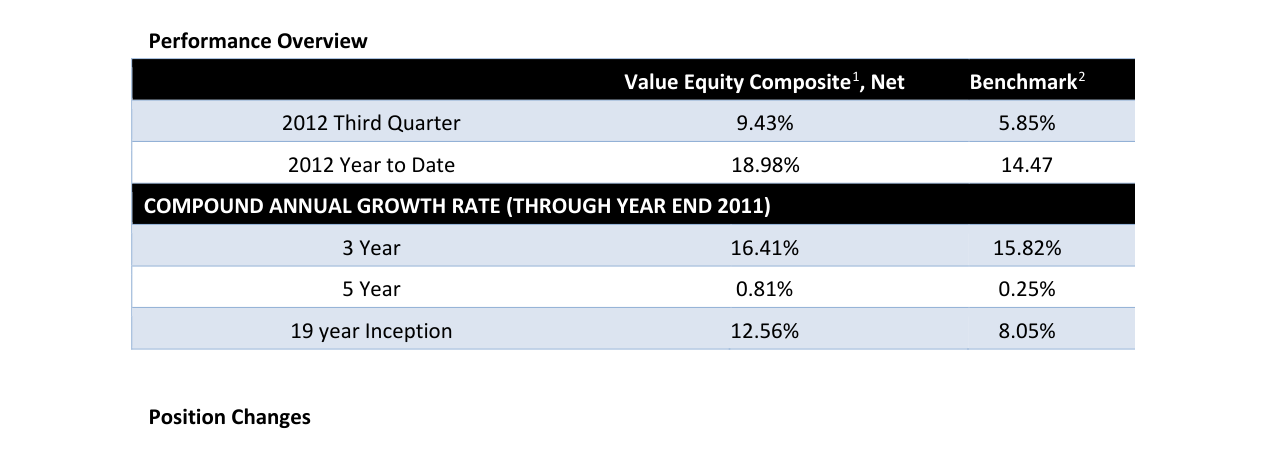
The Value Equity Composite achieved a net return of 9.43% in the third quarter of 2012, outperforming the benchmark's 5.85%; year-to-date return of 18.98% also outperformed the benchmark's 14.47%; since inception, the 19-year compound annual growth rate reached 12.56%, significantly higher than the benchmark's 8.05%
3. Portfolio Operations and Valuations
| Company | Operation | Key Valuation Data |
|---|---|---|
| Nexen | Liquidated | Acquired by CNOOC at a 61% premium; the author believes no price increase or competing bid is possible |
| Stolt-Nielsen S.A. | Increased position | Current stock price below $20, private market value approximately $50/share; shipping business near an inflection point |
| CalFrac Well Services | Increased position | P/E ratio below 6x (trailing twelve months); dividend yield approximately 4% (stock price below $25, annual dividend of $1); insider ownership exceeds 25% |
4. Industry Background
- Over the past five years, the hydraulic fracturing industry has grown at an annual rate exceeding 30%, but a short-term demand pullback has led to overcapacity, intensifying market concerns.
- The author believes that over the next 3-5 years, demand for complex fracturing operations will drive strong industry growth.
Companies/Assets Involved
- Nexen: Acquired by CNOOC at a 61% premium, liquidated. Bearish (believes no further upside).
- Stolt-Nielsen S.A.: Global chemical transportation and logistics company; private market value of its three businesses (shipping, terminals, containers) is approximately $50/share, while the current stock price is below $20. Bullish.
- CalFrac Well Services: Canadian oilfield services company; P/E ratio below 6x, dividend yield approximately 4%, insider ownership exceeds 25%. Bullish.
- Residential construction-related companies: Approximately 10% of the portfolio allocated, directly benefiting from the rebound in U.S. residential construction activity. Bullish.
Investment Implications
- Go long on beneficiaries of the North American energy cost advantage: Focus on energy-intensive industries such as chemicals and fertilizers, as well as shale gas-related service providers (e.g., CalFrac), whose long-term growth prospects are obscured by short-term pessimism.
- Go long on the U.S. residential construction recovery: Current construction activity is at historically extreme lows, with a clear long-term demand gap (1.0-1.2 million units/year). Related companies are deeply undervalued, awaiting mean reversion.
- Focus on "inflection point" opportunities in small-cap value stocks: For example, Stolt-Nielsen, whose shipping business is near a turning point, with a significant gap between private market value and market price (approximately 2.5x), suitable for patient holding.