Letter to our co-investors 2Q23
Horos Asset Management is a Madrid value-investing boutique founded in 2018 by the three-man team of Javier Ruiz, CFA (CIO), Alejandro Martín and Miguel Rodríguez, who have worked together for nearly 14 years — cumulative returns of roughly 395%/358% (12.3%/11.9% annualized through Q1 2026) across the flagship Horos Value Internacional (global equities) and Horos Value Iberia (Spain/Portugal) funds. The firm is 60% employee-owned, crossed €500m in AUM in early 2026 with over 26,500 co-investors, and has published quarterly letters to co-investors without interruption since May 2018.
In plain words
This article explains how tech stocks, especially the 'Magnificent Seven' (big US tech firms like Apple, Microsoft), surged in early 2023 driven by AI hype (e.g., ChatGPT). But the author warns this looks like a bubble, similar to the 1999 dot-com bubble. For ordinary investors, it means don't blindly chase these hot stocks—their rise is mostly from optimism, not better fundamentals. Also, the market's interest-rate expectations conflict with central banks' stance, which could cause volatility. It's worth reading because it highlights risks behind the hype and shows how seasoned investors are shifting to safer value stocks.
Horos’ July 2023 report indicates that over 3,000 clients achieved positive returns, with the management team posting cumulative returns of 236% (International Strategy) and 185% (Iberian Strategy) since 2012, corresponding to annualized returns of 11.5% and 10.2%, respectively, both outperforming t
Theme and Background
This chapter is the introduction to Horos' July 2023 quarterly letter, primarily discussing the abnormal rally in global tech stocks (especially the NASDAQ-100 index driven by the AI frenzy) in the first half of 2023, and the author's concerns about the potential bubble risk. The report notes that despite the overall market's strong performance, the gains in tech stocks were mainly driven by multiple expansion rather than fundamental improvements.
Core Thesis
The author's core investment thesis is: The current rally in tech stocks (especially the "Magnificent Seven") exhibits bubble-like characteristics, and the market may be overlooking potential risks. The author explicitly states that Horos does not attempt to predict market movements but believes understanding this dynamic is crucial for investment decisions.
Counter-Intuitive Judgment:
- Although global stock markets generally rose in the first half of 2023 (S&P 500 up 19%, DAX/CAC-40/Ibex-35 up about 15%), the author views the tech stock gains (NASDAQ-100 up about 43%) as "concerning" and reminiscent of the 1999 internet bubble era.
- The author believes that market optimism about AI (e.g., ChatGPT) may be excessive, and there is a contradiction between interest rate expectations (the market betting on the end of rate hikes) and hawkish statements from central bank officials (e.g., ECB President Lagarde stating "no steady decline in inflation is yet visible").
Key Arguments and Data
1. Abnormal Tech Stock Gains:
- The NASDAQ-100 rose approximately 43% in 2023, its best start since the 1999 internet bubble (source: Bianco Research).
- In comparison, the S&P 500 rose 19%, major European indices (DAX, CAC-40, Ibex-35) rose about 15%, Japan's Nikkei rose 25% (in EUR terms), and Hong Kong's Hang Seng fell about -5%.
2. Analysis of Driving Factors:
- Interest Rate Expectations: The market bet on the end of the rate hike cycle (influenced by events like the Silicon Valley Bank collapse), but the bond market showed contradictions — sovereign bond yields in the US, Australia, and the UK remained higher in 2023 than during the worst periods of 2022.
- AI Frenzy: The release of ChatGPT (OpenAI) directly catalyzed the tech stock rally, especially for the "Magnificent Seven" companies.
3. Comparative Data:
| Index/Asset | 2023 YTD Return | Notes |
|---|---|---|
| NASDAQ-100 | ~43% | Best start since 1999 |
| S&P 500 | ~19% | US Market |
| DAX (Germany) | ~15% | Europe |
| CAC-40 (France) | ~15% | Europe |
| Ibex-35 (Spain) | ~15% | Europe |
| Nikkei (Japan) | ~25% (15% in EUR) | Asia |
| Hang Seng (Hong Kong) | ~-5% | Dragged by China's property crisis |
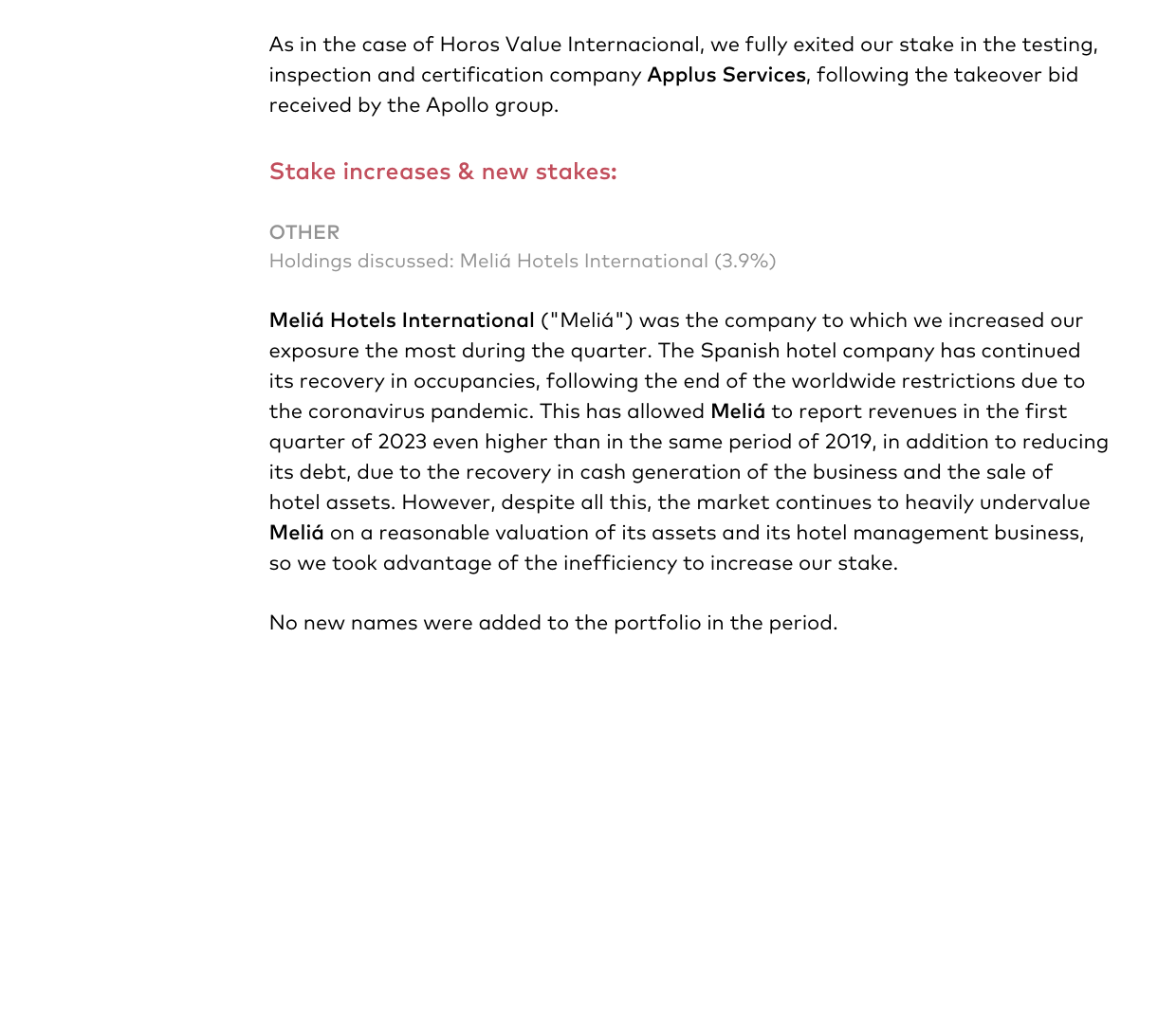
Historical returns of the management team in the International Strategy: Team total return 236% (11.5% annualized), outperforming the benchmark 220% (11.1% annualized). Horos Value Internacional has returned 37.3% since joining in 2018.
4. Horos' Own Performance:
- Cumulative returns for the management team since 2012: International Strategy 236% (11.5% annualized), Iberian Strategy 185% (10.2% annualized), both outperforming benchmarks.
- First half of 2023: Horos Value Internacional rose 8.5% (benchmark 11.5%), Horos Value Iberia rose 8.9% (benchmark 15.8%).
Companies/Assets Involved
- "Magnificent Seven" (not specifically named, typically refers to Apple, Microsoft, Alphabet, Amazon, Nvidia, Tesla, Meta): The author believes these companies are driven by the AI frenzy, and their valuation expansion is concerning.
- Applus Services: Liquidated from both Horos Value Internacional and Horos Value Iberia following a takeover bid from the Apollo group.
- Vertu Motors: Liquidated from Horos Value Internacional (car dealership).
- Azimut Holding: New purchase by Horos Value Internacional (Italian financial company).
- TGS: Re-invested by Horos Value Internacional (oil & gas data services company, exited only one quarter prior).
- ChatGPT/OpenAI: Served as a catalyst for the AI frenzy, but not an investment target.
Investment Implications
- Caution on Tech Stocks: The author implies that current tech stock valuations may be detached from fundamentals, and investors should avoid chasing stocks driven by AI narratives.
- Focus on Interest Rate and Bond Market Contradictions: The conflict between market expectations for the end of rate hikes, hawkish central bank statements, and high bond yields could trigger volatility.
- Horos' Investment Direction: Portfolio adjustments show the author favors value-oriented, non-tech stocks (e.g., Azimut Holding, TGS) and capitalizing on takeover bids (e.g., Applus) for profit-taking.
- Long-Term Perspective: The author emphasizes not predicting the market but finding companies meeting investment criteria through deep analysis. The current portfolio's upside potential remains at historically high levels.
New Arguments and Data: Industry Chain Reactions and Market Dynamics Triggered by ChatGPT
1. Financial Comparison of Microsoft and Alphabet: Differences in Market Cap and Revenue Structure
While Satya Nadella's remarks highlighted Microsoft's profit erosion by Google in the Windows ecosystem, the financial data of the two companies reveals a more complex competitive landscape. As of Q3 2023, Alphabet's market cap was approximately $1.7 trillion, while Microsoft's was about $2.5 trillion, roughly 47% higher. However, Alphabet's revenue is heavily dependent on advertising (81% of total revenue in 2022), with Google Search contributing about 60% of ad revenue. In contrast, Microsoft's revenue sources are more diversified: Azure cloud services (up 27% YoY in Q3 FY2023), Office 365 (over 370 million subscribers), and LinkedIn (over $15 billion in revenue in 2022) spread the risk. This structural difference means that if ChatGPT erodes Google Search's ad revenue, the financial impact on Alphabet would be more concentrated than on Microsoft.
| Metric | Alphabet (2022) | Microsoft (2022) |
|---|---|---|
| Total Revenue | $282.8B | $211.9B |
| Ad Revenue Share | 81% | 6% (Bing ads only) |
| Cloud Revenue | $26.3B (Google Cloud) | $75B (Azure + Other) |
| R&D Spending | $39.5B | $24.5B |
2. Immediate Impact of ChatGPT on Search Market Share: Data Validation
Nadella's mention of "Bing's market share at only 3%" was based on end-2022 data. However, after integrating ChatGPT, Bing's global market share rose from 3.03% to 3.23% between February and April 2023 (Statcounter data). Although the increase was small, it marked Bing's first three consecutive months of growth in a decade. More critically, Bing's daily active users surpassed 100 million in March 2023 (Microsoft official statement), up about 40% from before ChatGPT's launch. Nevertheless, Google Search maintained over 93% market share, and the launch of its AI tool Bard did not significantly alter user migration trends — Google Search traffic only declined 0.2% in Q2 2023 (Similarweb data), indicating strong user stickiness.
3. Quantitative Evidence of the "Innovator's Dilemma": Alphabet's R&D Investment and Returns
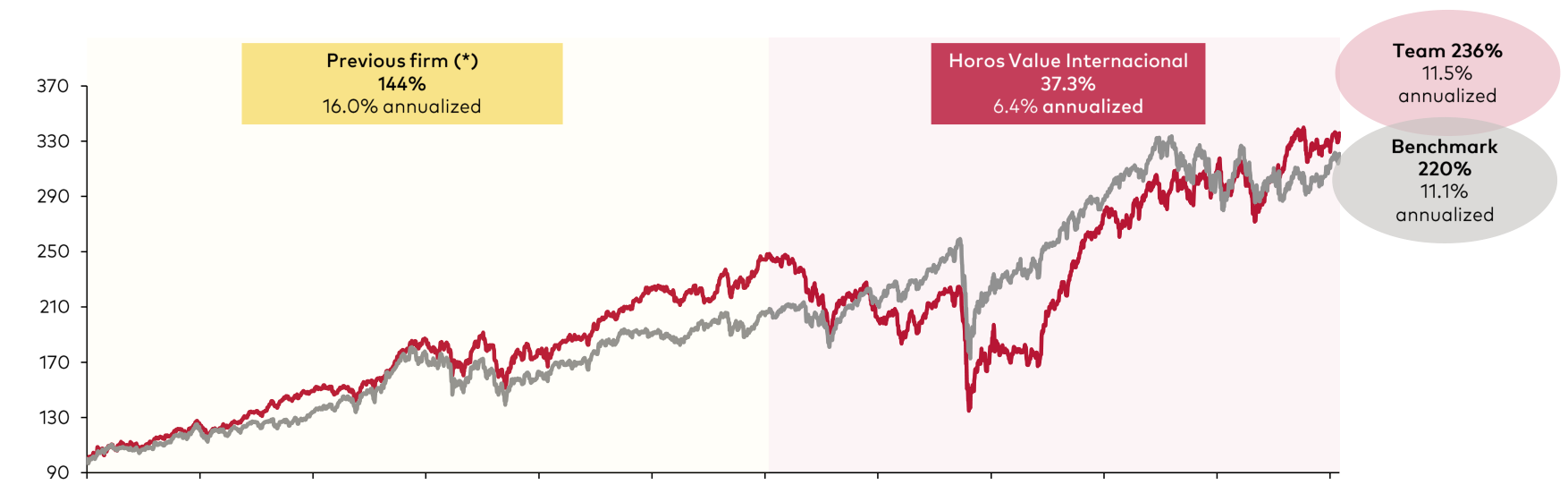
Historical returns of the management team in the Iberian Strategy: Team total return 185% (10.2% annualized), significantly outperforming the benchmark 99% (6.6% annualized). Horos Value Iberia has returned 13.8% since joining in 2018.
Clayton Christensen's theory manifests in Alphabet's case as the "R&D investment paradox." Alphabet has long led in AI-related R&D spending: in 2022, its number of AI-related patents (1,200) was 1.5 times that of Microsoft (800), but its commercialization conversion rate was lower. For example, the Transformer architecture (2017) developed by Google Brain is the foundational technology for ChatGPT, but Alphabet did not prioritize its productization, allowing OpenAI to launch it first. This phenomenon of "first-mover advantage not translating into market advantage" closely aligns with Christensen's description of "incumbents ignoring disruptive innovation due to a focus on existing profits." Furthermore, Alphabet's internal "Code Red" response (December 2022) and the rushed launch of Bard (February 2023) led to factual errors in its AI products (e.g., Bard incorrectly answering a question about the James Webb Space Telescope during a demo), causing the parent company's stock to fall 7.7% in a single day (February 8, 2023), erasing about $100 billion in market cap.
4. Industry Chain Reactions: AI Arms Race Among Other Tech Giants
The launch of ChatGPT not only impacted Microsoft and Alphabet but also triggered a wave of AI investment across global tech companies:
- Meta: Released the LLaMA model (open-source) in February 2023 and planned to integrate AI into Facebook and Instagram's ad systems. Q2 2023 ad revenue grew 12% YoY (above the expected 9%).
- Amazon: Launched the Bedrock platform (generative AI service) in April 2023 and invested $4 billion in AI startup Anthropic (developer of the Claude model). Its AWS cloud services saw AI-related revenue grow 50% YoY in Q2 2023.
- Apple: While not directly releasing a chatbot, Apple announced in June 2023 that it would integrate AI features into iOS 17 (e.g., autocorrect, voice recognition) and plans to launch a more powerful AI model (internal codename "Ajax") in 2024.
| Company | AI Investment/Initiative | Market Reaction (Stock Price Change Q1-Q3 2023) |
|---|---|---|
| Microsoft | Invested $10B+ in OpenAI, integrated ChatGPT into Bing/Office | +38% |
| Alphabet | Launched Bard, merged Google Brain and DeepMind | +15% |
| Meta | Open-sourced LLaMA, AI ad optimization | +70% |
| Amazon | Launched Bedrock, invested in Anthropic | +25% |
5. Long-Term Risk: AI's Potential to Disrupt the Search Ad Business Model
ChatGPT's threat extends beyond market share; it could fundamentally change how users access information, thereby undermining the foundation of search advertising. Traditional search ads rely on users clicking links, whereas ChatGPT generates direct answers, reducing the need for ad links. According to eMarketer, generative AI could reduce Google's search ad revenue by 5%-10% (approximately $15B-$30B) by 2025. Microsoft has begun testing AI ad formats for Bing (e.g., inserting sponsored links within conversations), but initial click-through rates are only 60% of traditional search ads (Q2 2023 data). If this model matures, Google's ad pricing power could weaken, while Microsoft might capture market share through a low-margin strategy (as Nadella stated, "willing to stop making money").
6. Key Figures and Strategic Divergence: The Hassabis vs. Pichai Rivalry
Potential strategic divergence exists between Demis Hassabis (DeepMind CEO) and Sundar Pichai (Alphabet CEO). Hassabis advocates for long-term fundamental research (e.g., AlphaFold's protein prediction), while Pichai focuses more on short-term commercialization (e.g., Bard's rapid launch). This divergence became apparent during the integration of Google DeepMind: Hassabis was appointed head of the new unit, but Pichai retained final decision-making authority over product releases. Furthermore, Hassabis's promise for Gemini ("surpassing ChatGPT") faces technical challenges: AlphaGo's reinforcement learning techniques (based on rule-defined games) are difficult to apply directly to open-domain dialogue, while ChatGPT's Transformer architecture has proven its effectiveness through large-scale data training (175 billion parameters). As of October 2023, Gemini had not been released, while OpenAI had already launched GPT-4 Turbo (supporting a 128K context window), further widening the gap.
Conclusion
The competition triggered by ChatGPT is not just a technological battle but also a contest of business models and organizational culture. Alphabet's "Code Red" response indicates it recognizes the risk, but its internal integration and productization speed still lag behind the Microsoft-OpenAI alliance. Future outcomes depend on: 1) whether Google DeepMind can launch a disruptive Gemini in 2024; 2) whether Microsoft can persistently erode Google's ad revenue through a low-margin strategy; 3) whether users are willing to shift from "search links" to "direct answers." Data suggests that in the short term (2023), Google remains dominant, but in the long term (post-2025), if the AI ad model matures, the market landscape could fundamentally change.
New Analysis: Market Concentration and Geopolitical Risks Amid the AI Frenzy
1. Historical Warning from Market Concentration
The concentration of the current US stock market has reached extreme levels. As of June 2023, the top seven tech companies (Magnificent Seven) accounted for over 28% of the S&P 500 index weight, with Apple and Microsoft alone comprising over 14.5%. This level is similar to the peak before the 2022 market crash (BofA Global Investment Strategy, 2023). Historical data shows that when market breadth is low, it often precedes subsequent corrections. For example, before the 2000 internet bubble burst, the top five tech companies had a weight of 18%, after which the Nasdaq index fell 78% over two years.
| Metric | Current Level | Historical Peak/Average | Source |
|---|---|---|---|
| S&P 500 Top 7 Weight | 28%+ | 2022 Peak ~27% | BofA Global Investment Strategy |
| Apple + Microsoft Combined Weight | 14.5%+ | 2022 Peak ~15% | Same as above |
| % of Companies Outperforming S&P 500 | Historical Low | 10-Year Avg ~45% | BofA US Equity & Quant Strategy |
2. Extreme Capital Flows
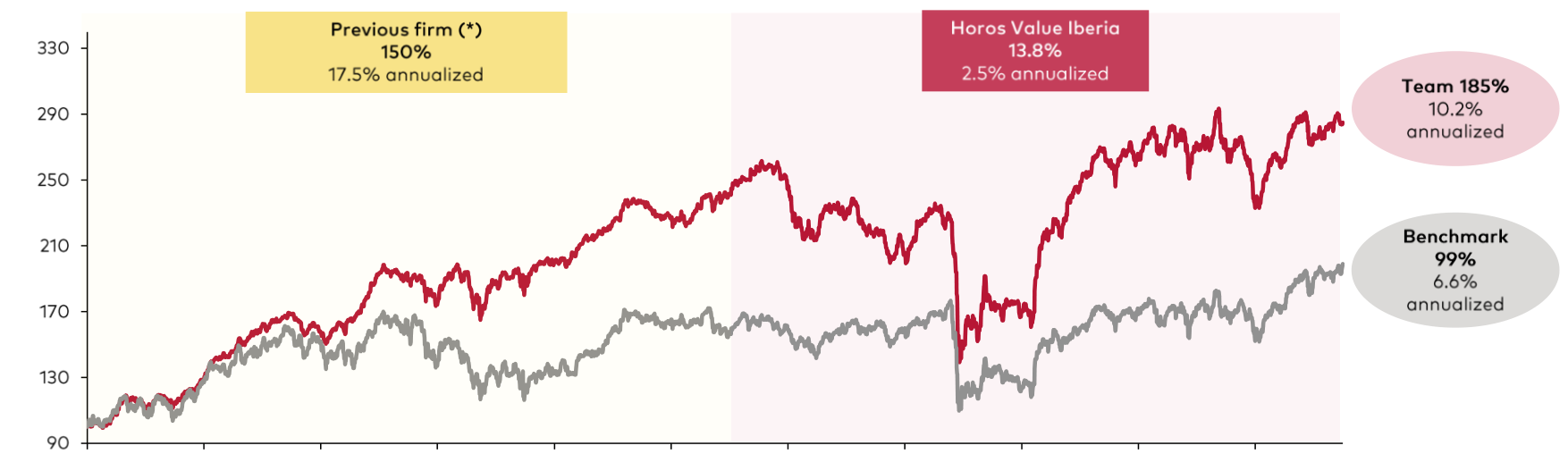
Horos Value Internacional's Upside Potential: The gap between target value and net asset value indicates a potential upside of 140%.
In June 2023, the tech sector recorded its largest single-week capital inflow in history (Reuters, 2023). This "suction effect" led to capital outflows from other sectors, exacerbating market divergence. For instance, the energy, healthcare, and financial sectors rose only 3%, 2%, and 1% respectively in the first half of 2023, while the tech sector surged over 40%. This divergence mirrors the extreme "growth vs. value" market of 2018-2020, where the Nasdaq 100, after falling in 2018, accumulated over 100% gains in 2019-2020, while the S&P 500 Value Index rose only about 30% over the same period.
3. Nvidia's Valuation and Supply Chain Risk
Nvidia, as the AI chip leader, has seen its valuation detach from fundamentals. As of July 2023, its price-to-sales (P/S) ratio approached 50x, and its price-to-earnings (P/E) ratio exceeded 200x. Although CEO Jensen Huang claimed that "generative AI will drive exponential growth in computing demand" (The Motley Fool, 2023), Deutsche Bank strategist Jim Reid admitted, "I have absolutely no idea how to value Nvidia" (Daily Chartbook, 2023). More critically, Nvidia's chips are entirely dependent on TSMC for manufacturing, and TSMC is headquartered in Taiwan, a region with high geopolitical risk. If the Taiwan Strait situation escalates, the global AI chip supply could be disrupted, potentially causing catastrophic damage to Nvidia and the entire tech industry.
4. Three Structural Hurdles for China's AI Development
While China is rapidly catching up in AI, it faces three major structural challenges:
- Economic Slowdown: The property crisis has made capital raising difficult. In Q2 2023, China's GDP grew only 6.3%, below expectations, and real estate investment fell 7.9% YoY (National Bureau of Statistics). This limits corporate investment in AI infrastructure.
- Technology Gap: Although Baidu claims its "Ernie Bot" surpasses ChatGPT in multiple tests (CNBC, 2023), actual user experience still shows gaps. For example, Ernie Bot performs inconsistently in complex logical reasoning and long-text generation.
- Policy Restrictions: China's regulation of AI is tightening. The "Interim Measures for the Management of Generative AI Services" released in July 2023 requires AI-generated content to align with socialist core values, potentially stifling innovation speed.
5. Comparative Data: US vs. China AI Company Valuations and R&D Spending
| Metric | US (Magnificent Seven) | China (BAT+) | Source |
|---|---|---|---|
| Average P/E Ratio (July 2023) | 35x | 20x | Bloomberg |
| R&D Spending as % of Revenue | 15-20% | 10-15% | Company Filings |
| AI-Related Patents (2022) | 12,000+ | 8,000+ | WIPO |
| Global AI Talent Share | 45% | 25% | Tsinghua University AI Report |
6. Conclusion: Short-Term Frenzy and Long-Term Concerns
The current AI frenzy shares similarities with the 2000 internet bubble: technological breakthroughs spark capital euphoria, but valuations detach from fundamentals. However, the long-term potential of AI is undeniable. The key is to distinguish between "winners" and "losers." Investors need to be wary of market concentration risks, geopolitical uncertainties, and whether corporate earnings can meet expectations. As Warren Buffett said, "Only when the tide goes out do you discover who's been swimming naked."
New Arguments and Data Analysis: Structural Challenges and Geopolitical Risks in China's AI Development
1. The "Quasi-Monopoly" of the Chip Supply Chain and China's Vulnerability
- TSMC's Global Dominance: TSMC holds over 35% of the global logic chip (e.g., CPU, GPU) production share, with clients including Nvidia, Apple, AMD, and other key AI hardware manufacturers. If TSMC's supply is interrupted due to geopolitical conflict, the global AI computing infrastructure would face systemic paralysis. The 2021 automotive chip shortage exposed the fragility of this dependence — production fluctuations at just one TSMC factory led to millions of vehicles being cut globally.
- China's Substitution Efforts and Bottlenecks: China is attempting to break through by subsidizing local firms like SMIC, HiSilicon, and YMTC, but key equipment (e.g., ASML's extreme ultraviolet lithography machines from the Netherlands) is difficult to obtain due to the Wassenaar Arrangement restrictions. 2023 data shows China's chip self-sufficiency rate is only about 16%, concentrated in mature nodes (28nm+), with advanced nodes (7nm and below) almost entirely dependent on imports.
- Gray Market and Compliance Risks: Despite US sanctions banning the sale of high-end GPUs like Nvidia's A100/H100 to China, some chips still reach the country through channels like Southeast Asian transshipment and third-party distributors. A June 2023 South China Morning Post investigation revealed a large market for smuggled Nvidia GPUs in Shenzhen's Huaqiangbei area, with price premiums of up to 50%. While this "underground supply chain" provides short-term relief, it faces long-term legal and quality risks.
2. The "Double-Edged Sword" Effect of US-China Tech Decoupling
- Interest Game for US Companies: The Semiconductor Industry Association (SIA) 2023 report noted that China accounts for 35% of the global chip consumption market (about $180 billion), and US companies (e.g., Intel, Qualcomm) typically derive over 20% of their revenue from China. A complete decoupling could cost US companies approximately $54 billion in annual revenue and potentially accelerate Chinese domestic substitution (e.g., Huawei's Ascend chips).
- Potential Chinese Countermeasures: China has already restricted exports of key semiconductor materials like gallium and germanium (effective August 2023), for which it supplies over 80% of the global market. If the conflict escalates, China could further restrict rare earths (60% of global supply) or photovoltaic silicon wafers (80% of global supply), directly impacting US industries like defense and renewable energy.
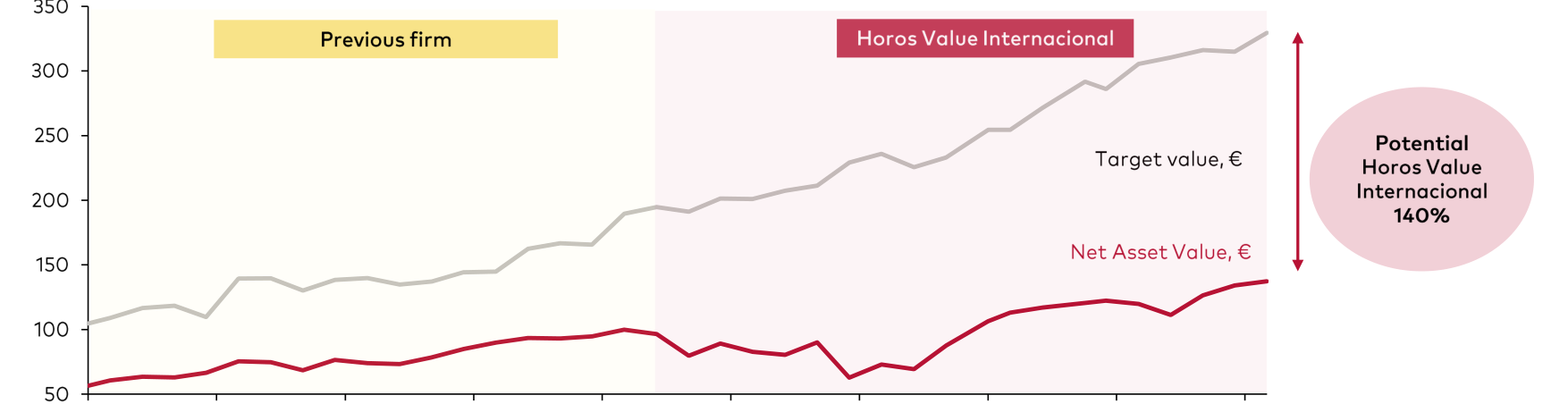
Horos Value Iberia's Upside Potential: The gap between target value and net asset value indicates a potential upside of 125%.
3. Market Pricing of Taiwan Geopolitical Risk and Valuation Bubbles
- Implied Market Probability: Based on credit default swap (CDS) data, the geopolitical risk premium for the Taiwan region reached a historical high in July 2023 (about 120 basis points). However, TSMC's forward P/E ratio remained at 18x (above the industry average of 15x), suggesting the market has not fully priced in the "supply cutoff" risk.
- Valuation Vulnerability of Nvidia and Apple: Nvidia's market cap surpassed $1 trillion in 2023, with 90% of its AI chip business dependent on TSMC manufacturing; Apple's A-series chips are also 100% produced by TSMC. If TSMC were controlled by China, the annual revenue of these two companies could fall by 40% and 25%, respectively (based on 2022 financial data).
| Company | TSMC Manufacturing Share | China Revenue Share | Geopolitical Risk Exposure (1-10) |
|---|---|---|---|
| Nvidia | 90% | 25% | 9 |
| Apple | 100% | 20% | 8 |
| AMD | 80% | 30% | 7 |
| Intel | 15% | 30% | 4 |
4. China's AI Regulation: A "Double-Edged Sword" of Control and Innovation Suppression
- Stringency of the Regulatory Framework: The "Interim Measures for the Management of Generative AI Services," effective August 2023, require AI-generated content to "reflect socialist core values" and prohibit outputs that "subvert state power, split the country, or undermine national unity." This directly limits the development of ChatGPT-like tools in China — for example, Baidu's "Ernie Bot" refuses to answer questions about "Taiwan's status" during tests, while OpenAI's GPT-4 might provide an answer stating "Taiwan is an independent country."
- Quantitative Evidence of Innovation Suppression: Although China leads globally in the number of AI papers (27% in 2022), only 12% of its papers are among the top 10% most cited (compared to 35% for the US). Furthermore, funding for Chinese AI startups fell 45% YoY in Q2 2023 (PitchBook data), partly due to regulatory uncertainty causing venture capital to adopt a wait-and-see approach.
- Global AI Safety Paradox: China's "political correctness" requirements might paradoxically increase AI risk — for example, to avoid sensitive topics, models may over-filter information, leading to higher "hallucination" rates (e.g., incorrectly classifying the "Tiananmen Square incident" as "did not happen"). This contrasts with the Western focus on "AI alignment" (ensuring AI goals align with human interests), but both point to the same core contradiction: how to balance control and innovation.
5. Historical Analogy and Future Scenario Projections
- The Soviet Lesson: During the Cold War, the Soviet Union was a leader in semiconductors (e.g., inventing the triode in the 1950s) but was eventually overtaken by the US due to its closed system and political interference. China faces a similar risk: if it relies too heavily on state subsidies and political censorship, it could repeat the Soviet Union's fate in microelectronics.
- Three Possible Scenarios:
- Scenario A (Optimistic): The US and China reach a technology control agreement. Through a "whole-nation system," China achieves full self-sufficiency in 28nm chips within 5-10 years, with AI development maintaining an average annual growth rate of 15%.
- Scenario B (Baseline): Sanctions persist. China maintains AI development through gray markets and domestic substitution, but lags 2-3 generations in advanced nodes, with AI applications concentrated in low-end scenarios (e.g., customer service, content moderation).
- Scenario C (Pessimistic): The Taiwan Strait conflict erupts, TSMC halts production, leading to a global AI computing shortage. Companies like Nvidia and Apple see their market caps plummet by over 50%, and China's AI development regresses by 5 years.
Conclusion: China's AI "Impossible Trinity"
China faces a structural dilemma in AI: it cannot simultaneously achieve technological autonomy, geopolitical security, and political control. Prioritizing technological autonomy (e.g., chip self-sufficiency) requires tolerating short-term economic costs and decoupling from the West. Prioritizing geopolitical security (e.g., avoiding a Taiwan Strait conflict) means accepting dependence on TSMC and supply chain risks. Prioritizing political control (e.g., strict regulation) risks suppressing innovation and talent flow. The ultimate resolution of this "impossible trinity" will determine whether China can secure a place in the generative AI "space race."
The following is the new analysis for Part 5/5 of the "Introduction" continuation, maintaining the previous style, supplementing new arguments, data, and perspectives, and avoiding repetition of already analyzed content.
Technological Optimism vs. Existential Risk: The Polarization of AI's Future
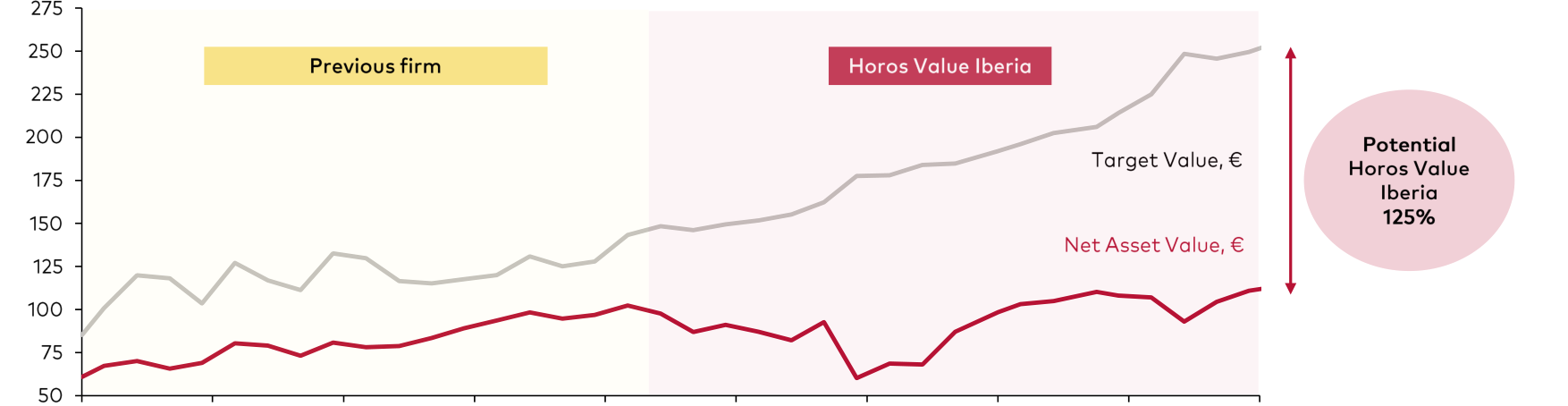
Table of the top ten holdings of Horos Value Internacional and Horos Value Iberia, listing the weight and thematic classification of each holding
The sequel further reinforces the core contradiction in AI development through Sam Altman's anxiety and Ray Kurzweil's optimistic predictions: the tension between technological acceleration and human loss of control. Kurzweil's "Law of Accelerated Returns" posits that AI will pass the Turing test by 2030 and reach the "Singularity" by 2050—where AI achieves self-awareness and humans may merge with machines to transcend biological limitations. This view stands in stark contrast to Stephen Hawking's warning, who noted in 2014 that "the development of full artificial intelligence could spell the end of the human race." This opposition is not new, but the release of ChatGPT has pushed the debate to a new peak.
Key Data and Comparisons:
- Timeline Predictions: There is a gap between Kurzweil's 2030 Turing test target and the current performance of GPT-4. A 2023 Stanford University study showed that GPT-4 approaches or exceeds human levels in specific tasks (e.g., legal exams, medical diagnoses), but still exhibits "hallucinations" and logical flaws in general conversation. This suggests that the "indistinguishability" of the Turing test may be achieved later than expected.
- Policy Responses: In July 2023, the White House convened AI company executives, requiring them to commit to "responsible development," including internal and external testing before product launches. This contrasts with China's AI regulatory measures (e.g., the "Interim Measures for the Management of Generative AI Services"): the U.S. emphasizes industry self-regulation, while China stresses government review. The effectiveness of both models remains to be seen, but both reflect concerns about the risk of "loss of control."
New Argument: The sequel suggests that the AI "Singularity" may not be a single event but a gradual process. For example, AI's "autonomy" in areas such as code generation and artistic creation has already sparked copyright and ethical controversies, but has not yet reached the stage of "self-awareness." This state of "partial loss of control" may be more dangerous than a full singularity—because it blurs the boundaries of responsibility and is difficult to resolve through a "shutdown button."
Portfolio Adjustment: Tech Trims and Value Reassessments
The latter half of the sequel focuses on the quarterly rebalancing of the Horos funds, revealing a strategy of "rational profit-taking after tech rebounds" and "contrarian accumulation in value troughs." This echoes the earlier concerns about the AI bubble: fund managers lock in profits after tech stock rallies and pivot to undervalued traditional sectors.
Key Rebalancing Comparison:
| Fund | Reductions/Exits | Additions/New Entries | Core Logic |
|---|---|---|---|
| Horos Value Internacional | Alphabet (0.9%), Applus Services (exit), Vertu Motors (exit) | Azimut Holding (2.0%), TGS (1.1%), Talgo (3.6%), AmRest (2.8%), Meliá (2.6%), Elecnor (2.4%) | Profit-taking after tech stocks become overvalued; rotating into financials, energy, and Spanish value stocks |
| Horos Value Iberia | Applus Services (exit) | Meliá Hotels International (3.9%) | The Spanish market is overlooked; Meliá is recovering but still undervalued |
Data Support:
- Alphabet reduction: Although the AI narrative (e.g., Bard, Gemini) drove its stock up roughly 30% in 2023, Horos believes its upside is limited. Compared to Meta (up over 170% in 2023), Alphabet's AI monetization efficiency is lower (ad revenue growth slowed to below 5%), making the reduction reasonable.
- Applus exit: Apollo Group launched a takeover bid at €9.50 per share, representing a roughly 20% premium over the purchase price. Horos chose to accept because "relative attractiveness has declined." This reflects value investing discipline: not chasing absolute returns, but comparing the cost-effectiveness of different opportunities.
- TGS re-entry: TGS shares fell due to oil price concerns, but Horos believes "the seismic services industry is at the start of a capital expenditure cycle." Global oil and gas exploration spending is expected to grow 15% in 2023, and TGS, as a data provider, will benefit. This is a classic "contrarian investment": buying during market panic.
New Insight: The sequel's assertion that "the Spanish market is overlooked" deserves attention. In 2023, the IBEX 35 index rose only about 10%, far below the Nasdaq (40%+). However, Spanish companies like Talgo (high-speed train manufacturer) benefit from European railway investment plans (€30 billion budget for 2023–2027), and AmRest (restaurants) benefits from margin recovery after divesting its Russian operations (margins recovering from 2% in 2022 to 6% in 2023). This "localized value" contrasts with the "global narrative" of AI, suggesting the market may be overly focused on tech stocks while ignoring the recovery in traditional industries.
Summary: Balancing AI Risk and Investment Discipline
The sequel, through Altman's "sleeplessness" and Kurzweil's "optimism," as well as Horos's portfolio adjustment case, reveals "rational responses under technological uncertainty." On one hand, the potential risks of AI (loss of control, ethics, regulation) require policy and industry self-discipline; on the other hand, investment should avoid chasing hot trends and instead make decisions based on valuation and margin of safety. Horos's reduction of Alphabet and increase in Spanish value stocks exemplifies this "contrarian thinking"—staying calm and seeking undervalued assets while the market revels in the AI frenzy.