Total Factor Productivity Growth
GMO is a Boston asset manager co-founded in 1977 by Jeremy Grantham with Richard Mayo and Eyk Van Otterloo, known for valuation-driven dynamic asset allocation built on long-horizon mean reversion. Grantham is famous for calling historic bubbles, warning publicly ahead of both the 2000 dot-com crash and the 2008 financial crisis. Flagship publications include the GMO Quarterly Letter (now written by Asset Allocation co-heads Ben Inker and John Pease), Grantham's Viewpoints essays and the 7-Year Asset Class Forecast.
In plain words
This report argues that Total Factor Productivity (TFP), often called a measure of innovation, is actually just a weighted average of wage growth and profit growth. So the debate about whether innovation is slowing down might be based on a wrong idea. For everyday investors, don't take investment stories built on TFP too seriously—like claims that a tech revolution will boost growth or that innovation is stalling. Instead, focus on real wages and how profits are shared. The report also warns that many economic models used for predictions rest on shaky assumptions.
GMO Research Report: "Total Factor Productivity Growth: Completely Fictional, Inflated Garbage" The report points out that economists often attribute growth stagnation to a decline in Total Factor Productivity (TFP), viewing it as a measure of innovation. However, authors James Montier and Philip Pi
As a third-party investment research analyst, the following are my research notes on the "Introduction" chapter of the GMO report Total Factor Productivity Growth: Complete Bullshit Made Up Entirely of Hot Air, prepared for Chinese-speaking investors.
Theme and Background
This chapter aims to thoroughly deconstruct the concept of "Total Factor Productivity (TFP)," which is widely used by mainstream economists and markets. The report points out that the current market generally attributes economic slowdowns to a decline in TFP growth and views it as a measure of "innovation." The author argues that this perception is fundamentally flawed, and the real issue is not innovation stagnation, but the prolonged weakness in real wage growth.
Core Thesis
The author's core investment thesis is: Total Factor Productivity (TFP) is not a measure of innovation; it is merely a weighted average of real wage growth and profit growth. Therefore, debates about "innovation exhaustion" or "temporary technological stagnation" centered on the decline of TFP are pseudo-problems based on a false premise.
Counter-Intuitive / Contrarian Judgments:
1. TFP is Not an Innovation Metric: This directly contradicts mainstream financial media like the Financial Times and Bloomberg, which describe it as a "measure of innovation" and an "engine of long-term growth."
2. Growth Accounting (Cobb-Douglas Production Function) is Fictional: The author cites several economists, arguing that the macroeconomic production function has serious theoretical and empirical flaws, and its "good fit" is merely a statistical illusion.
3. The Real Focus Should Be on Real Wages, Not TFP: The report argues that the "puzzle" of slowing TFP growth actually reflects the more fundamental problem of persistently weak real wage growth.
Key Arguments and Data

The author supports their thesis through logical deduction and citations of authoritative opinions, rather than relying on traditional data models.
1. The Mathematical Nature of TFP: The report deduces that, under the national income accounting identity, the TFP growth rate (Solow residual) can be transformed into the labor share multiplied by the real wage growth rate plus the capital share multiplied by the profit growth rate. Therefore, TFP is not an independent indicator of technological progress, but a mirror of changes in income distribution.
2. Critique of the Cobb-Douglas Production Function:
- Solow's Own Doubt: Cites Solow (1957), who acknowledged that discussing an "aggregate production function" requires an "extraordinary 'willing suspension of disbelief'."
- Franklin Fisher's Critique: Professor Fisher explicitly states that the aggregate production function is "entirely imaginary," requiring extremely stringent and unrealistic assumptions (e.g., all firms using the same proportions of labor and capital, producing the same proportions of output).
- Joan Robinson's Critique: She points out that the production function is a "powerful tool of miseducation," with the core problem being the inability to aggregate different capital goods like shovels and semiconductors in non-monetary terms.
3. The "Good Fit" Trap: The author argues that the defense of the production function by economists (the model fits the data well) is invalid because such regressions essentially estimate an identity, not a causal relationship.
Companies/Assets Involved
This chapter does not involve specific companies or assets; it primarily critiques macroeconomic concepts and academic viewpoints.

| Institution/Person Mentioned | Role/Viewpoint | Author's Attitude |
|---|---|---|
| The Financial Times | Describes TFP as a "measure of innovation" and "almost everything." | Critical, views this as a misattribution. |
| Bloomberg | Describes TFP as the "engine of long-term economic growth" and a "measure of efficiency gains." | Critical, views this as a blind fetishization of the concept. |
| Robert Solow | Proposed the growth accounting framework and the Solow residual, but also questioned the existence of the aggregate production function. | Cites his doubts as supporting evidence. |
| Franklin Fisher | MIT professor who argues the aggregate production function is "imaginary." | Cites his views to support the critique. |
| Joan Robinson | Economist who criticized the production function for its inability to measure capital. | Cites her views to support the critique. |
Investment Implications
For investors, the core implication of this report is: Be wary of market narratives built around "total factor productivity" and "innovation."
1. Re-evaluate Growth Logic: If TFP is not an innovation metric, then the logic of being bearish on the economy or specific markets based on "innovation slowdown leading to prolonged low growth" needs to be re-examined. Similarly, optimistic expectations based on a "technological revolution driving a TFP surge" may lack a solid foundation.
2. Focus on Income Distribution: The report shifts the focus from "innovation" to "real wage growth." This means investors should pay more attention to labor market conditions, wage bargaining power, and the distribution relationship between corporate profits and wages. Persistently weak real wages may be the true root cause of sluggish economic growth.
3. Question Macro Models: Many investment models rely on macroeconomic growth accounting. This report reminds investors that the foundational assumptions of these models may be very fragile, and their conclusions (e.g., potential growth rate, output gap) should be treated with caution, not as precise scientific predictions.
Additional Arguments and Data: The Redundancy of TFP and the Centrality of Wage Growth
1. Literature Support: The Academic Lineage of TFP Critique

The author cites research from several scholars to further strengthen the argument that "TFP has no substantive content." These studies reveal the mathematical identity nature of TFP from different angles:
- Anwar Shaikh (1974): Demonstrated through the "humbug production function" that even with random data, a seemingly plausible production function can be fitted, exposing it as a statistical illusion.
- Codrina Rada and Lance Taylor (2006): Pointed out the "empty source" problem in growth accounting and suggested replacing it with empirical methods from Kaldor and Goodwin.
- Jesus Felipe (2008) and Felipe and McCombie (2013): Systematically argued that the aggregate production function is logically "not even wrong," meaning its underlying assumptions (e.g., competitive equilibrium, constant returns to scale) cannot be met in reality.
These studies collectively show that TFP measurement relies on the national income identity, not on any technological relationship. Therefore, any change in the TFP growth rate is essentially a mirror of changes in income distribution.
2. Equivalence of Three TFP Calculation Methods
The author provides an empirical comparison for the US from 1948-2016, verifying that the results from three methods (Solow residual, weighted productivity growth, factor payment weighting) are nearly identical:
| Period | Solow Residual Method | Weighted Productivity Method | Factor Payment Weighting Method |
|---|---|---|---|
| 1948-1972 | 1.49 | 1.47 | 1.48 |
| 1972-1995 | 1.03 | 1.01 | 1.03 |
| 1995-2008 | 1.28 | 1.26 | 1.28 |
| 2008-2016 | 0.65 | 0.65 | 0.65 |
| 1948-2016 | 1.20 | 1.18 | 1.20 |
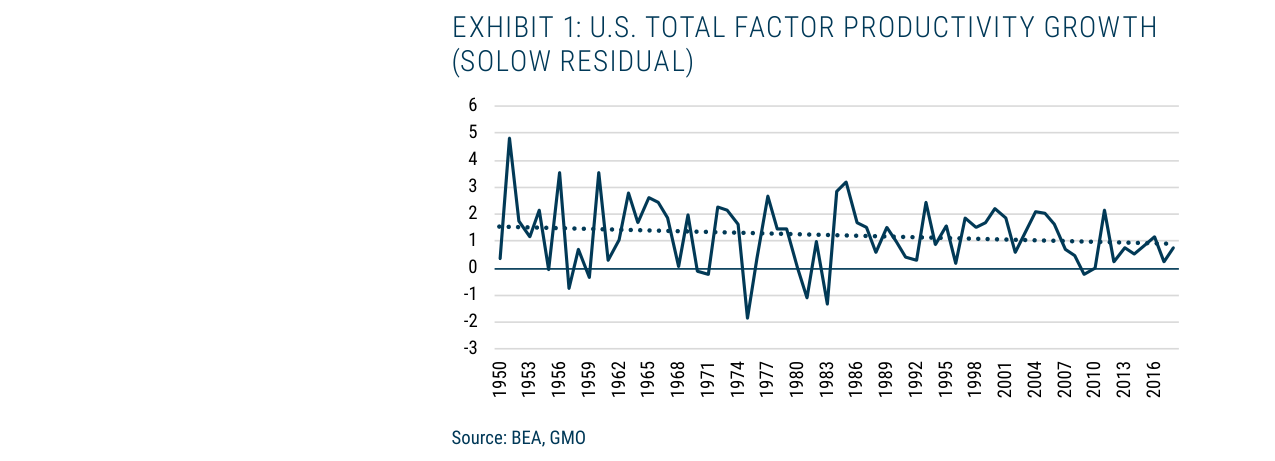
U.S. Total Factor Productivity Growth (Solow Residual) fluctuated downward from a peak of around 5% in the early 1950s to about 1% in 2016, showing a clear long-term slowdown
Key Finding: The latter two methods rely entirely on the national income identity, without any production function assumptions. This means that TFP "measurement" is essentially circular reasoning—it is merely a weighted average of wage and profit growth rates, not an independent indicator of technological progress.
3. The Real Reason for Slowing TFP Growth: Stagnant Wage Growth
The author further decomposes the components of TFP growth, finding a high correlation with real wage growth:
| Period | Real Wage Growth | Real Profit Growth | TFP Growth |
|---|---|---|---|
| 1948-1972 | 2.72 | -0.07 | 1.48 |
| 1972-1995 | 1.27 | 0.69 | 1.03 |
| 1995-2008 | 1.88 | 0.50 | 1.28 |
| 2008-2016 | 0.71 | 0.57 | 0.65 |
| 1948-2016 | 1.82 | 0.40 | 1.20 |
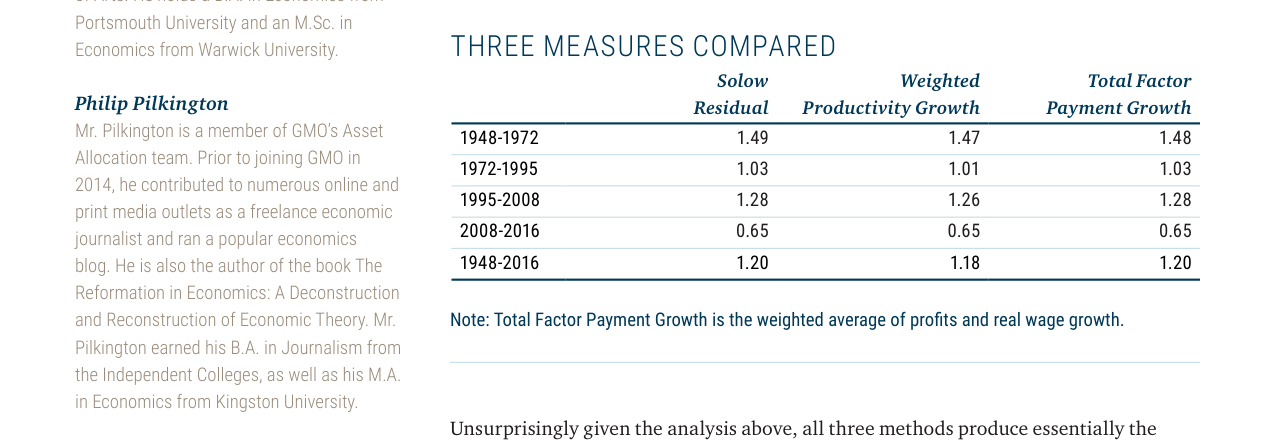
The three TFP calculation methods (Solow residual, weighted productivity growth, total factor payment growth) yield nearly identical results for 1948-2016 (1.20, 1.18, 1.20 respectively), proving TFP is merely a weighted average of wage and profit growth
Data Interpretation:
- 1948-1972: Strong wage growth (2.72%), negative profit growth (-0.07%), relatively high TFP growth (1.48%).
- 2008-2016: Wage growth plummeted to 0.71%, profit growth rose to 0.57%, TFP growth was only 0.65%.
- Entire Period (1948-2016): Wage growth (1.82%) far exceeded profit growth (0.40%), and TFP growth (1.20%) was closer to wage growth.
Conclusion: The slowdown in TFP growth is not a "mysterious" deceleration of technological progress, but a direct reflection of the prolonged weakness in real wage growth. If economists want to understand economic dynamics, they should shift their focus from TFP to wage determination mechanisms—such as labor market bargaining power, globalization shocks, and technological substitution effects.
4. Policy Implications: The Ineffectiveness of TFP as an Analytical Tool
- Redundancy: TFP provides no information beyond the national income identity. If wage and profit growth rates are known, TFP can be directly derived without additional assumptions.
- Misleading: Treating TFP as an indicator of "technological progress" could lead policymakers to misjudge economic potential. For example, the post-2008 TFP slowdown was attributed to "innovation exhaustion," but the real root cause was stagnant wage growth.
- Alternative Direction: The author suggests abandoning TFP analysis and instead studying income distribution dynamics (e.g., declining labor share), investment structure (e.g., capital deepening vs. capital shallowing), and institutional factors (e.g., union power, minimum wage policies).
5. Methodological Critique: From "Black Box" to "Identity"
- Fundamental Flaw of the Solow Model: Its estimation relies on an "aggregate production function" that does not exist in reality, because aggregating labor and capital requires stringent mathematical conditions (e.g., homogeneity, additivity) that cannot be met in a heterogeneous economy.
- Inevitability of the National Income Identity: Any TFP measurement based on GDP accounting is essentially a differential transformation of the identity \( Y = wL + rK \). Therefore, fluctuations in the TFP growth rate are necessarily synchronized with changes in factor income shares.
Summary
Through theoretical deduction, literature review, and empirical comparison, this chapter thoroughly deconstructs the validity of TFP as an "indicator of technological progress." The core argument is that TFP growth is merely a weighted average of wage and profit growth rates, and its measurement does not rely on any production function assumptions. Consequently, the "puzzle" of slowing TFP growth is actually an artifact of slowing wage growth. Policymakers and researchers should abandon their excessive focus on TFP and instead delve into analyzing real economic issues such as income distribution, labor market structure, and institutional change.