Catalysts are overrated
Bireme Capital is a long-short value fund founded in 2016 by Ryan Ballentine (CEO) and Evan Tindell (CIO), based in Tampa, Florida. Its flagship Fundamental Value strategy runs bottom-up, contrarian deep-value investing that exploits behavioral biases and structural mispricings.
In plain words
Bireme argues against paying a premium for catalysts and discusses Airtel Africa and Airtel Money. It disclosed making Airtel Money a material position. The 184-pence price and roughly 16x free-cash-flow multiple refer to the subsidiary. FY2031 EPS of 26 pence and a 420–520-pence share price are the author's projections.
Bireme argues against paying a premium for catalysts and discusses Airtel Africa and Airtel Money. It disclosed making Airtel Money a material position. The 184-pence price and roughly 16x free-cash-flow multiple refer to the subsidiary. FY2031 EPS of 26 pence and a 420–520-pence share price are the
Catalysts and value creation
The author argues against paying a premium for catalysts. A listing does not itself add customers, margins or operating assets. Selling a subsidiary at an unusually favorable price and redeploying the proceeds could change per-share value, but a listing alone need not do so.
The original investment and business growth
Bireme invested in Airtel Africa in April 2023. Over the three years ending FY2023, Airtel Money increased active users from 18.3 million to 31.5 million, annual revenue from $311 million to $692 million, and annual transaction value from $31.6 billion to $88.6 billion. The business generated roughly $350 million of EBITDA with about $50 million of annual capital expenditure. The original slide describes a software product cross-sold to a 150 million telecom user base. The author's 2023 valuation was $5–10 billion for the mobile-money business, compared with $5–6 billion for the parent's market capitalization.
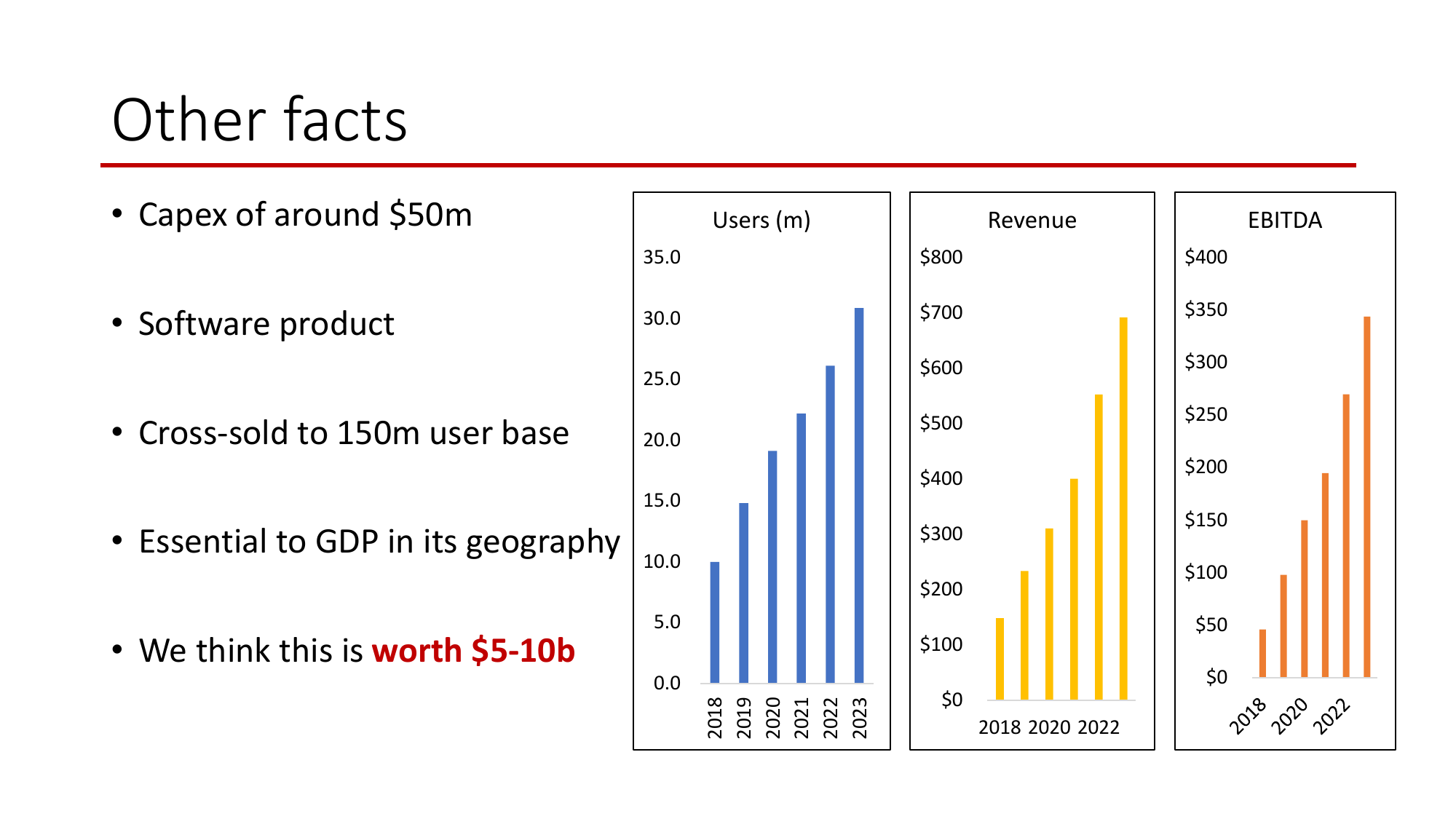
The original 2023 slide is retained. Its bars do not carry individual precise labels; the figures above come from the article's explicit disclosures.
IPO timing and the parent's decision
In a discussion with Andrew Walker of Rangeley Capital, the original IPO target was identified as March 2025. The author says it was delayed by approximately a year and a half. In the context of this article dated October 21, 2026, the stated IPO occurred on October 9, 2026, with normal trading starting October 14.
The author attributes the parent's improvement from early 2025 to rising earnings, which made its sub-150-pence prices in 2023–2024 look increasingly low. Shares were flat or down around the IPO announcement and in the preceding six months.
The subsidiary's IPO valuation was reduced to about $7 billion, and Airtel Africa sold no shares. It raised no money for the parent, while fulfilling commitments to TPG and Mastercard. The author usually avoids IPOs because buyers face insiders motivated to sell; the parent's refusal to sell was an important distinction here.

The agreement screenshot concerns exploring a listing within four years of first close. In limited no-IPO or unapproved-change-of-control circumstances, TPG could sell AMC BV shares to Airtel Africa or affiliates at fair market value. The minimum relates to original investment consideration less distributions and sale proceeds, without a time-value adjustment or minimum return; the share limit caps consideration at $400 million. This cap is not a valuation of the entire business.
A separate investment in Airtel Money
The quoted 184 pence and approximately 16x free cash flow refer to Airtel Money, not the parent. The author estimates Airtel Africa as a whole at around 20x free cash flow, while regarding the subsidiary's growth opportunity as stronger.
The model assumes customers roughly double over five years; higher revenue per customer helps produce approximately 23% annual revenue growth. Forecast FY2031 EPS is about 26 pence; 16–20x earnings implies roughly 420–520 pence, plus interim dividends. These are the author's assumptions and projections.
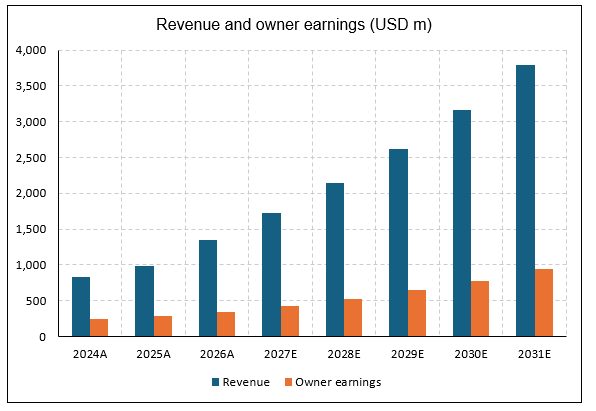
The chart shows revenue and owner earnings in USD millions: 2024A–2026A are historical periods and 2027E–2031E are estimates. No precise values are inferred from unlabeled bars.
Network differences and disclosed positioning
The author contrasts Airtel Money's network with DLocal, StoneCo, Payoneer and PagSeguro. Those firms sell primarily to businesses and compete on price and service; the author allows that they can succeed, but distinguishes their model from a largely closed transfer network.
Many Airtel Money transfers stay within its accounts, which serve as bank accounts in many locations. Network transfer value exceeds 100% of GDP in countries such as Zambia. As of June 30, 2026, it had 2.3 million agents for cash deposits and withdrawals, a distribution network the author regards as difficult to replicate.
The author disclosed making Airtel Money a material position over the prior week; no recent addition to the parent is disclosed. The article mentions a FatAlpha Online presentation scheduled for October 22, 2026. Readers should recognize the author's position-holder perspective and the assumptions behind the valuation.