Half-year letter 2H2024
azvalor Asset Management is a Madrid deep-value boutique founded in 2015 by Álvaro Guzmán de Lázaro and Fernando Bernad, formerly the core of Bestinver's investment team in the Graham tradition. It is known for contrarian concentration in unloved cyclical assets — gold and silver miners, oil services, uranium — buying into panic and exiting once value is realized. Its flagship international fund is about 70% of firm AUM and has more than tripled since inception a decade ago; letters were quarterly from 2016-2022 and semiannual since 2023.
In plain words
This is Azvalor's 2024 letter to investors. It warns that US stocks are overpriced and government bonds are risky. Instead, Azvalor buys unloved companies (like Spanish steel tube maker Tubacex) with huge upside potential (some over 100%). They also note that most stock market gains come from just a few days, so trying to time the market is pointless. Better to hold good companies long-term. Worth reading for a contrarian view backed by real examples.
Azvalor describes 2024 as a "sowing year": after the bumper harvests of 2021-2023, when its funds gained +122% (Azvalor International), +71% (Managers), and +64% (Iberia) respectively, the firm shifted its focus to positioning for the future. Assets under management at year-end reached €2.92 billion
Theme and Background
This chapter is the first part of Azvalor's 2024 letter to investors, primarily reviewing the fund's performance and investment deployment in 2024, which it describes as a "seeding year." The fund manager elaborates on its contrarian investment philosophy and, based on the high valuation of the U.S. stock market and sovereign debt risks in the West, issues warnings about traditional assets (such as bonds) and mainstream indices.
Core Views
- No macro predictions, but a clear bearish stance on Western government bonds: The author argues that the U.S. is running its largest fiscal deficit in history against a backdrop of low unemployment. If unemployment rises, the deficit could spiral further out of control. Therefore, holding bonds for the long term is not a prudent strategy.
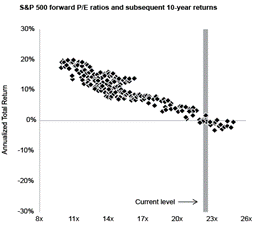
- Pessimistic outlook for mainstream indices: Current price-to-earnings ratios of major U.S. stock indices are at elevated levels, and earnings are also at highs. If earnings decline or valuations contract, the stock market could fall by 20-30%, and even after such a decline, it may not be significantly undervalued. Historical data suggests that higher starting valuations typically correspond to lower future returns.
- Contrarian investing: Azvalor's portfolio looks nothing like the index and tends to perform better during market downturns (e.g., 2022). Since the start of 2025, its portfolio has continued to outperform on days when the index has fallen.
Key Arguments and Data
- Market Outlook: The author notes that if U.S. stock earnings and price-to-earnings ratios contract modestly, the market could fall by 20-30%. Even after such a decline, the market would still not be deeply undervalued.
- Historical Patterns: The original text references a chart (specific values not provided) showing that higher starting valuations directly lead to lower long-term returns.
- Portfolio Revaluation:
- The potential upside for the current portfolio is more significant than ever. The international portfolio has an upside potential of +105%, well above net asset value.
- Azvalor Iberia's portfolio has an estimated upside potential of +80%.
Companies/Assets Involved
- Tubacex (Spanish steel tube manufacturer): The largest holding in the Azvalor Iberia fund. Azvalor significantly increased its position during the pandemic-induced panic in 2020 at around €1 per share (compared to €3.5 in early 2018). The stock has risen +40% in the last six months, but the author believes that, benefiting from favorable industry tailwinds and a substantial improvement in the company's fundamentals, the target price remains far above the current stock price, and this does not account for potential value creation by management through M&A.
- Prosegur Cash (Spanish cash management company): Its profits come mainly from Brazil and Argentina. After several years of headwinds, it is expected to encounter tailwinds.
- Bonds (Sovereign Debt): Explicitly bearish. The author argues that given the U.S. fiscal situation, holding bonds for the long term is not a wise strategy.
Investment Implications
- Beware of exposure to high-valuation indices: For investors holding long positions in U.S. tech stocks or broad market indices, Azvalor's analysis suggests that current valuation levels present high downside risk. A dual contraction in earnings and valuations could lead to significant drawdowns.
- Focus on contrarian value opportunities: The report emphasizes that market pessimism toward certain cyclical or "out-of-favor" sectors can create excellent margins of safety. Azvalor's holdings (e.g., Tubacex, Prosegur Cash) indicate that when well-managed companies with improving competitive dynamics encounter temporary headwinds, it may be an opportune time to build positions.
- Consider the deteriorating risk-reward of bonds: Given concerns about U.S. sovereign debt, Azvalor advises that investors should not view bonds as a long-term safe asset, and its own portfolio construction does not rely on bonds.
- Risk appetite for concentrated portfolios: Azvalor Iberia's top ten holdings make up approximately two-thirds of the portfolio, reflecting a very high level of concentration. This strategy relies on a very deep understanding of individual companies and is suitable for investors who align with its analytical logic, but it entails lower diversification.
Theme & Background
This chapter summarizes the performance divergence among Azvalor's various funds in 2024 and discloses the latest developments in the company's operations and social responsibility. The report emphasizes that despite short-term net value fluctuations, long-term returns have been significant, and the current portfolio still offers substantial upside potential.
Core Thesis
The author's central investment argument is: A smaller fund pool is superior to a larger one in terms of concentration and flexibility, making it more conducive to generating excess returns. Although Azvalor Blue Chips has the smallest scale, it currently offers the highest estimated upside potential (nearly +115%) due to its concentration and agility.
Counterintuitive insight: Most investment returns are concentrated in extremely short time windows (only 5% of the time), making market timing futile; long-term holding and ignoring market volatility are key.
Key Arguments & Data
- Azvalor Blue Chips: Net value declined -2.2% in 2024, but cumulative return since inception stands at +89% (rising to +92% as of the letter's deadline). Managed assets total approximately €70 million, with at least 75% of positions allocated to large-cap stocks with market capitalizations exceeding €3 billion, while the remaining ~25% can be flexibly allocated to small- and mid-cap stocks. Current estimated upside potential is as high as nearly +115%.
- Azvalor Managers: Returned +12.9% in 2024, with a cumulative return of +78% over six years since inception. The portfolio's P/E ratio is just 9.6x, representing a discount of more than 50% versus the global stock market and a 70% discount versus the Nasdaq index (Morningstar data). 76% of positions are in small- and mid-cap stocks, and six portfolio companies received takeover bids in 2024.
- Azvalor Global Value: Returned -2.34% in 2024, with a cumulative return of +93% since inception. Managed assets total €197 million, with an average annual return of +18.5%. As of January 2025, among 960 Spanish pension funds, this fund ranks first in 5-year performance.
- Historical pattern: Excess returns that beat the index are concentrated in only 5% of the time (i.e., 6 months out of 120 months over ten years). Over a decade, an initial investment held continuously would have grown 2.5 times.
Companies/Assets Involved
| Fund Name | Role/Characteristics | Key Data | Core Judgment |
|---|---|---|---|
| Azvalor Blue Chips | Primarily large-caps, with flexible allocation to small/mid-caps | Managed assets ~€70M; cumulative return +89% → +92% | Most favored: Current estimated upside +115% |
| Azvalor Managers | Small/mid-cap value, low overlap with market indices | 2024 return +12.9%; P/E 9.6x, discount 50%-70% | Bullish: Significant discount, persistent takeover bids |
| Azvalor Global Value | Pension fund, long-term performance champion | Avg. annual return +18.5%; #1 in Spain over 5 years | Bullish: Cumulative return +93%, still has +115% upside |
Investment Takeaways
1. Clear direction: Focus on value funds with large valuation discounts and relatively small management scale. Azvalor Blue Chips' +115% upside potential is most noteworthy, as it combines large-cap stability with small/mid-cap flexibility.
2. Hold long term, abandon market timing: Historical data proves that excess returns concentrate in very short time windows (5%), so "invest spare money you won't need short-term, then forget about it" is the optimal strategy.
3. Pay attention to takeover signals: Azvalor Managers saw six portfolio companies receive takeover bids in 2024, indicating that the market is gradually recognizing the true value of its holdings, and the discount may continue to narrow.